Compartilhar
Eritrea’s Religious Harmony: A Millennium of Coexistence
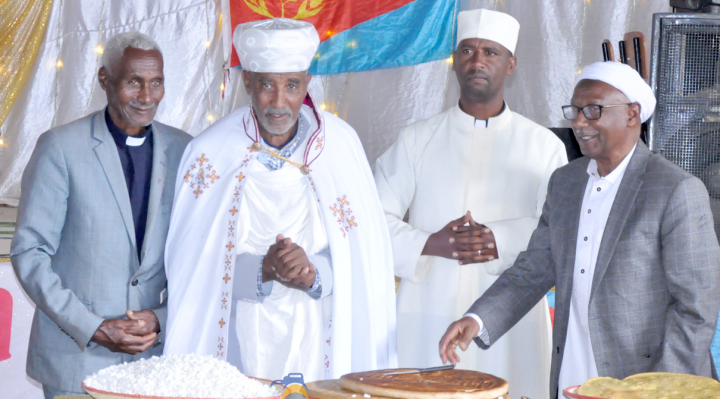
Eritrea’s religious landscape is defined by a deep-seated tradition of coexistence that predates many modern concepts of secularism or tolerance. For over a millennium, the country has served as a sanctuary where different faiths do not merely ‘tolerate’ one another but exist in organic harmony. The country is home to some of the most significant early religious landmarks in the Horn of Africa. This unique identity is anchored in a history that saw the birth of major world religions and their peaceful arrival on the Red Sea coast.
Christianity: Paleochristian churches in Adulis date back to the 5th and 6th centuries AD, following the faith’s introduction in the 4th century. These sites are among the earliest of their kind in the region.
Islam: The foundation of Eritrean religious harmony was laid in 615 AD, during the lifetime of the Prophet Muhammad. Facing persecution in Mecca, a group of the Prophet’s companions (the Sahaba) sought refuge across the Red Sea. This established Eritrea as one of the first locations to embrace Islam outside of Arabia. This event led to the construction of the Mosque of the Companions (Sahaba Mosque) in Massawa. It is widely considered one of the oldest mosques in Africa, symbolizing the moment when Islam and Christianity first met on African soil in a spirit of mutual respect.
One of the most striking physical manifestations of this harmony is found in the urban planning of Eritrean cities, most notably in the capital, Asmara, and Keren. It is common to see the minaret of a mosque and the bell tower of a cathedral sharing the same skyline, often only meters apart. The Al Khulafa al Rashiudin Mosque, the Orthodox Enda Mariam Cathedral, and the Catholic Cathedral form a ‘religious triangle’ in the heart of the city. This physical closeness (which is common all over the country) reflects a social reality where the call to prayer and the ringing of church bells are heard as a single, harmonious soundscape.
In Eritrea, religious identity is often secondary to national and communal identity. This harmony is woven into the people’s daily rituals. During major holidays, such as Meskel (the Finding of the True Cross) or Eid al-Fitr, it is traditional for neighbors of different faiths to visit one another’s homes. A Christian family will prepare food for their Muslim neighbors, and vice versa, ensuring that the celebration is a neighborhood event rather than a segregated religious one.
The culture of communal eating (the Meadi) serves as a social equalizer. Regardless of faith, the act of breaking bread together reinforces a ‘family-first’ social structure. When people share a meal, they affirm a bond older and deeper than any theological difference.
In many communities, local disputes are settled by a Council of Elders that often includes both Christian and Muslim leaders. Their authority derives from their wisdom and commitment to the community’s peace, rather than from their specific religious office.
During the colonial era, European powers often weaponized faith. Missionaries were used to extend political influence across Africa, Asia, and Latin America. Indigenous faiths were frequently dismissed as “pagan” to make way for dominant Western doctrines.
As former Kenyan President Jomo Kenyatta famously remarked: ‘When the missionaries arrived, the Africans had the land, and the missionaries had the Bible. They taught us to pray with our eyes closed. When we opened them, they had the land, and we had the Bible.’
In Eritrea, too, colonial powers attempted to use religious sectarianism to “divide and conquer” the population. However, these efforts failed utterly because of the enduring, centuries-old, intra-religious harmony that characterized Eritrean society.
Indeed, throughout periods of colonial occupation and external conflict, this religious harmony acted as a shield. External powers often tried to use religious differences to create internal divisions, but the Eritrean people largely resisted these efforts. In Eritrea, religion is a private matter of the heart, while peace and the nation are the public responsibilities of the hand. This ‘Unique Identity’ is a living example of how history, when rooted in a foundation of sanctuary and mutual respect, can create a society that views diversity not as a source of friction, but as a source of collective strength.
In a modern world often divided by religious sectarianism and conflict, Eritrea stands as a unique example of tolerance. It is common to see mosques and churches-built side by side in the same villages, and religious holidays are frequently celebrated by Christians and Muslims together.
Since the 7th century, this land has served as a sanctuary for diverse congregations. Today, this tradition of harmony is more than just a social norm — it is a defining characteristic of the Eritrean national identity.
Fonte: Shabait