Compartilhar
Keynote Address by President Isaias Afwerki on the Occasion of the 35th Independence Anniversary Asmara, 24 May 2026
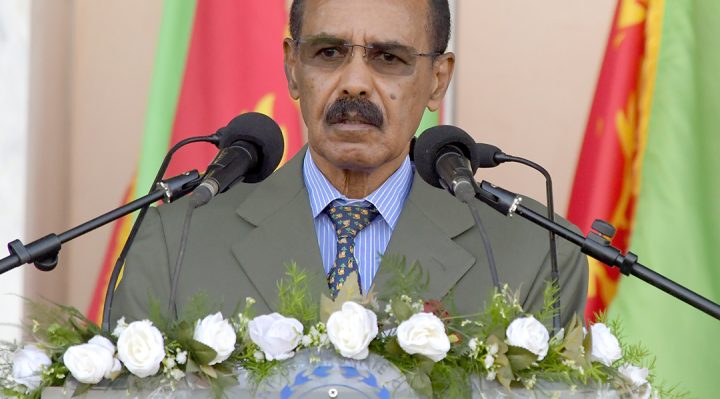
Dear Participants,
Ladies and Gentlemen,
First and foremost, allow me to extend my warmest congratulations to the patriotic Eritrean people at home and abroad and to all its friends in struggle all over the world.
I would also like to express my profound gratitude to all those who, year after year, organize and present magnificent events and celebrations in various places to commemorate and honor this glorious Day, as well as to all friends of Eritrea who have sent messages of congratulations.
The annual celebration of our Independence Day is, indeed, both a manifestation and measure of the trajectory and progress of our generational mission of nation-building. This must be assessed not only against the backdrop of our heroic liberation struggle and the immense sacrifices it exacted, but also in light of the additional sacrifices made in the last 35 years to confront persistent hostilities and subterfuges, while simultaneously advancing the integrated task of national development. Independence, sovereignty and territorial integrity constitute an ongoing process that must be continuously consolidated and sustainably strengthened. In this regard, we must reflect on where we stood yesterday, where we stand today, and what the future will hold.
These are profound considerations for introspection at this historic juncture of our Independence Day. Such considerations compel us to objectively evaluate the progress achieved, draw appropriate lessons from our experience; and further refine and intensify our efforts in pursuit of optimal results. Glory and honor to the Eritrean people and to our Martyrs!
Our national situation and developmental progress cannot be viewed in isolation from a just international order and from the regional architecture of stability, cooperation, prosperity, and integration that we, together with the peoples of the world, cherish and aspire to realize. As such, it is imperative that we comprehend and analyze, through objective metrics, the prevailing global and regional frameworks and evolving trends.
Ladies and Gentlemen,
In view of the palpable global stature of the United States, I had highlighted in my address on the occasion of the 34th Independence Anniversary last year, the prudence of undertaking serious and careful assessment of the policies and potential ramifications of the Trump Administration upon its return to the White House for a second presidential term. Nevertheless, the phenomenon remains highly complex and heavy, requiring patience and caution against premature conclusions even as rigorous analysis grounded in the compilation of relevant facts and evidences as well as standard and comprehensive inferences are routinely made.
In this respect, to further examine and explore the substance and contours of President Trump’s “MAGA” doctrine through relevant metrics – including wealth, industrial output, technological dominance, military power, and sphere of influence – within the historical trajectory of the United States, particularly during the Cold War and the subsequent, reckless phase of the “unipolar world order,” is both timely and of paramount importance.
When viewed through the economic indicators of natural endowments and industrialization, including value addition through processing, the national debt accumulated through prolonged fiscal wastefulness under successive Administrations in Washington has reached alarming proportions. This quagmire has been exacerbated by strategic economic imbalance stemming from the misguided policy of “offshoring”. The latter was essentially designed to consolidate US “economic and financial hegemony and domination” by capitalizing on low wages, abundant manpower, and reduced energy costs in other countries. This policy orientation, which gained currency especially after the end of the Cold War, was predicated on the assumptions of its “unassailable superiority in innovation and industrialization…” as well as the perception that “others cannot compete but merely imitate US products”. The galloping aggregate US debt, which I referenced last year as exceeding 30 trillion dollars, now appears to have reached 40 trillion. This is by no means an insignificant factor.
President Trump’s acute recognition of the impending danger associated with this trajectory and prospects of decline may, in itself, be considered positive. However, questions persist as to whether the measures pursued by the new Administration – including expenditure reduction, the repatriation of industries and investments, increased tariffs, domestic tax cuts, monopolization of rare minerals, recourse to threats and intimidation, and intensive diplomatic and information campaigns – can truly constitute a functional remedy. Where, and with whom can these policies possibly succeed?
In regard to technological dominance, including Artificial Intelligence, there are no indicators that establish Washington’s competitive advantage although the topic warrants more elaborate comparative analysis.
In terms of military power – setting aside the weakening status of NATO, which cannot serve as the only benchmark – assessments cannot be gauged merely on dramatic episodes, intimidation, targeted killings, the elimination of “small” forces, the possession of nuclear arsenals, drones and missiles alone. Twentieth century and contemporary military history provide ample evidence in this regard.
Concerning sphere of influence, various trial balloons released in the past year include Greenland, Canada, Mexico, Cuba, etc. Were these motivated by natural resources, geography, strategic influence, or prestige? And what might their ultimate ramifications be? Accurate appraisal requires tremendous patience and restraint from speculative conclusions.
Ladies and Gentlemen,
Beyond these trial balloons, it may be appropriate to focus on Venezuela and Iran among the major events of the past year.
The issue of drug trafficking in the Americas is longstanding and complex. Where is Venezuela ranked in this pecking order? What was the role of President Maduro? If he could have been indicted in accordance with international law, why and on what legal basis did the White House take unilateral action of “arresting’’ Maduro? Does Venezuela truly pose a threat to the national security of the United States, and if so, in what way? Was Maduro, as an individual, a direct threat to U.S. national security? Was the operation launched as a pretext for other agendas? The episode requires patience without speculative conclusions pending full clarification of the facts.
Iran:
Iran’s nuclear program was initiated in the early 1970s during the reign of the Shah. Who supported and encouraged it is well-known. How it developed after 1979 is a long story. Nevertheless, there are still fundamental questions regarding the war waged against Iran. Which countries possess nuclear programs? Which countries possess and have developed various nuclear weapons? Who granted them the right or authority to possess and develop such weapons? If there are entities empowered to grant such rights, where does that prerogatives and privilege come from? Why is Iran alone prohibited? Does Iran genuinely constitute a threat to the U.S.? What legal privilege has the United States to take unilateral military action?
Rather than focusing on the closure of the Strait of Hormuz as a consequence, it is more prudent to engage on the broader issues pertinent to regional and global stability. It is evident that this was driven by grave miscalculation and must be halted in order to avert potentially far-reaching risks.
Ladies and Gentlemen,
The developments that I have attempted to address are the events that have unfolded especially over the past year and a half, and the policies and actions that President Trump has taken since his return to the White House. Still, two and half years remain. How will Trump’s policies toward Europe, China, Russia, India, the Middle East, Asia, Latin America, and Africa evolve? How will countries engage, individually and collectively, on various issues and at different junctures? What cumulative outcomes may emerge over the coming thirty months? While it is imperative to monitor unfolding developments on the radar-screen on an hour-by-our basis, what alternative pathways can be considered?
It is equally important to note that criticism should not be directed at President Trump alone. Those who are complicit in these aberrations must be given due consideration. Furthermore, those who claim to be “influential” and strive to mislead and corner Trump must not be forgotten
More importantly, how do the various agendas pursued by great powers and others affect us? Our responses should not be limited to reactive contingencies. Indeed, there is no alternative to the formulation, through active initiative, of proactive ideas and strategies that are grounded on fundamental principles and values
Transitioning from the old and exhausted global order, which the peoples of the world have grown weary of, is no longer optional. The prevailing global system, characterized by the absence of genuinely free trade and fair distribution of resources and wealth; by exploitative financial mechanisms rooted in usury, plunder, and deception; and by zero-sum paradigms that perpetuate modern forms of slavery/colonial domination and dependency, must come to an end. The establishment of a new global order founded upon fairness and justice must be regarded as one of humanity’s foremost missions and should not be relegated to the side-lines.
The present era represents a transitional phase from the old global order to a new one. Although these principles are not new, they reflect the enduring values of the Eritrean people’s armed struggle for liberation. In this spirit, the concepts listed below, and which may be elaborated and further refined, were what we presented during the 80th General Assembly of the United Nations to contribute for a new road-map:
- Human beings must fairly own their economic resources and the produce of their work, and march on a sustainable path of generational progress and prosperity by accumulating wealth.
- To secure peace and stability in order to guarantee prosperity and economic growth.
- To ensure prevalence of fairness and justice as vital prerequisites for peace and stability.
- To promote mutual respect, complementarity, and cohesion/integration so as to bolster far-reaching regional and global peace and stability as well as mutual growth.
- To establish appropriate legal executive structure and associated mechanisms for the implementation of these fundamental human aspirations.
While the dismantling of the old global system and the establishment of a new one concerns humanity as a whole, these issues carry particular significance for the marginalized peoples and victims of the prevailing zero-sum order, especially across Africa, where many societies continue to endure conditions of subsistence livelihood. It is therefore imperative that Africa and its sub-regions formulate complementary strategies and clearly defined plans within the larger global framework. This was, indeed, the very reason that prompted the transition from the Organization of African Unity (OAU) to the African Union (AU). Should the African Union fail to fulfil its lofty mission, it risks losing its relevance. Consequently, our engagement and efforts to strengthen friendship and cooperation within Africa must become increasingly active and vigorous.
To focus in our Region:
Last year, I addressed issues in what we call our neighbourhood; specifically, the Nile Basin, the Horn of Africa, the Red Sea, and the Gulf, with particular reference to Ethiopia and the Sudan. Because the global vulnerability of the region has worsened, following the crisis surrounding the Strait of Hormuz, the importance of collective security mechanism based on an agreement and cooperation among the States in the neighbourhood – rather than the normalized interventionist policies of self-proclaimed regional powers and external actors – that we have been advocating for long has, once again, become abundantly clear. It is high-time that serious efforts are exerted towards this end.
Ladies and Gentlemen,
The Horn of Africa is the sub-region of the neighbourhood to which we devote close and sustained attention for its evident practical significance. The efforts we exerted in the past years since our independence to transform IGAD from its original, limited, mandate of “combating drought and desertification – IGADD” into a vehicle of development – IGAD) that leverages stability for regional framework of development and cooperation did not come to fruition. The situations in Somalia, Ethiopia, the Sudan, South Sudan continue to be deeply precarious and increasingly demand more attention and efforts. What are the fundamental problems?
Although the matter can be discussed in far greater detail, the broadly “similar” characteristics revolve around the challenges of nation-building. First, instead of building citizen-centred nationhood, societies are polarized along vertical ethnic, clan, and religious lines, thereby stoking hatred and civil strife that often degenerate into internecine killings. Second, the cultivation of warlords to replace and undermine sovereign institutions. Third, the preponderance of chronic and corrosive culture of corruption and embezzlement. Fourth, and most detrimental of all, foreign interventions and subservience to external interests. While there may be minor disparities in the details, in terms of general categorization, these are the principal crises that require resolution. In this context and as a pragmatic pre-condition, the immediate termination of external interventions and funding remains mandatory indeed.

Ladies and Gentlemen,
On domestic issues:
As it will be recalled, I had elaborated, during last year’s Independence Day celebrations, on our development programmes and priorities across various sectors. While the concept itself is not new, the short-term objective remains improving our people’s livelihood, with priority to marginalized and underserved regions. The broader and long-term development programme consists of extricating the country from subsistence economy. It encompasses strengthening productivity, ensuring sustainable growth in production, laying the foundations for advanced processing and value-added industrial manufacturing, and service sectors. Beyond the economic dimension, these priorities also extend to encompass the diplomatic and informational domains. Moreover, the significance of capital and technology, in the context of emerging opportunities and broad and sustainable partnerships, cannot be overstated. As emphasized repeatedly, the decisive factor is to ensure synergy and sustainability by effective coordination between nation-wide popular participation, the quality and number of young professionals, and all the patriots in the diaspora. In order to advance in accordance with our aspirations, we must continue revising and streamlining our programs while at the same time strengthening our resource mobilization. All these preparatory and coordination tasks could perhaps affect the pace of our ongoing development progrmmes this year.
Road and transportation projects will be expanded according to plan. Extensive housing programmes will also proceed in parallel. Implementation of projects aimed at expanding electricity and water services will start within this year in spite of potential delays in supply chains. In the sphere of social services, particular emphasis will be placed on education, beginning from the pre-school level with broad popular participation. Likewise, the expansion of quality healthcare services will be pursued vigorously.
Kudos to the dedicated, hardworking, courageous, patient, and steadfast people of Eritrea, along with the ever-present Defense Forces; the kernel, strong shield, and cornerstone of our development programs. Even if obstacles are encountered, there is no cause for apprehension. Rest assured!
Our Resilience, Our Guarantee!
Eternal Glory to our Martyrs, exemplars of steadfastness!
Victory to the Masses!
24 May 2026
Fonte: Shabait