Compartilhar
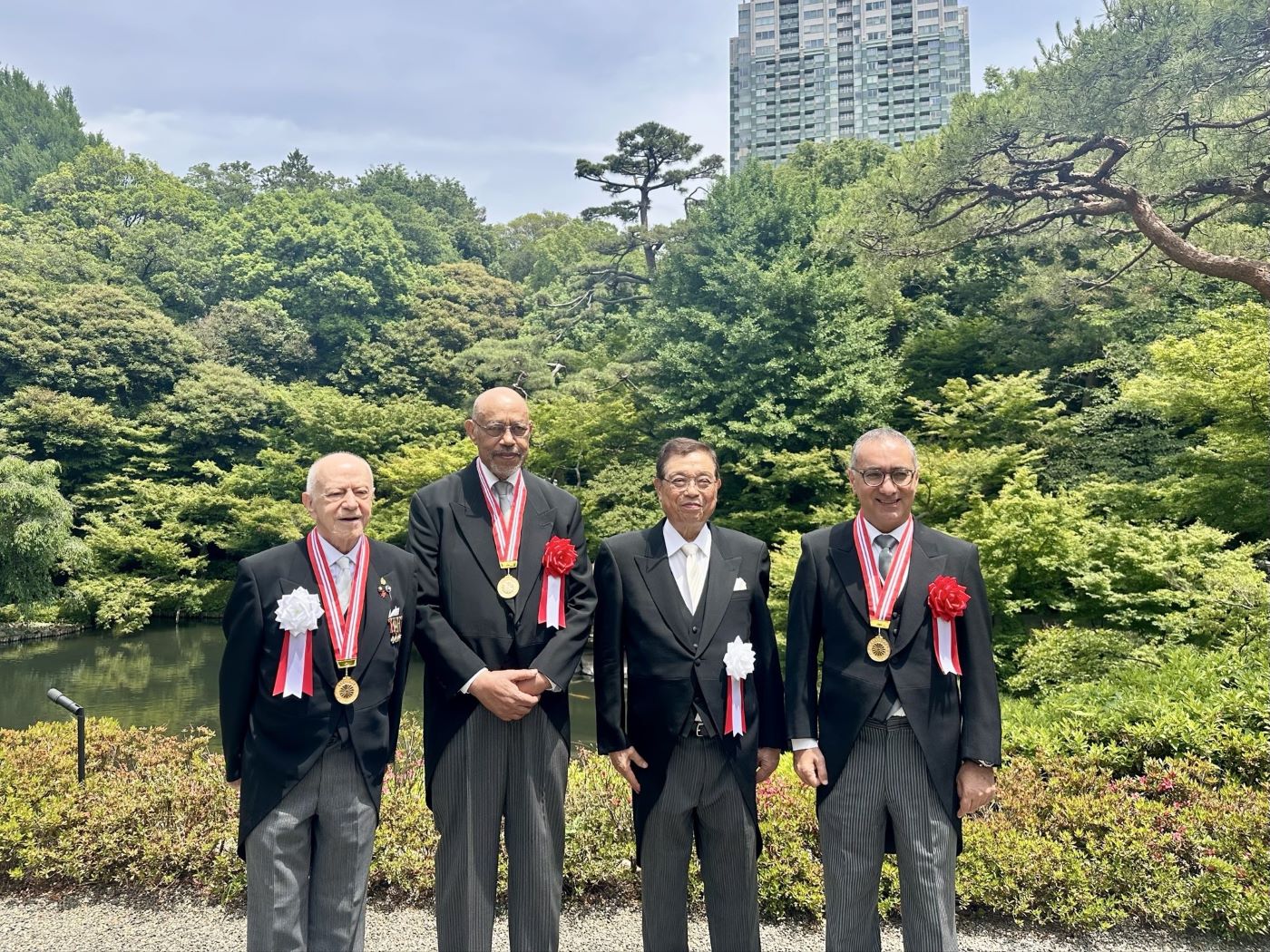
Statements made by Ambassador Estifanos Afeworki at the 60th Higashikuninomiya International Cultural Award ceremony, Tokyo May 26, 2026
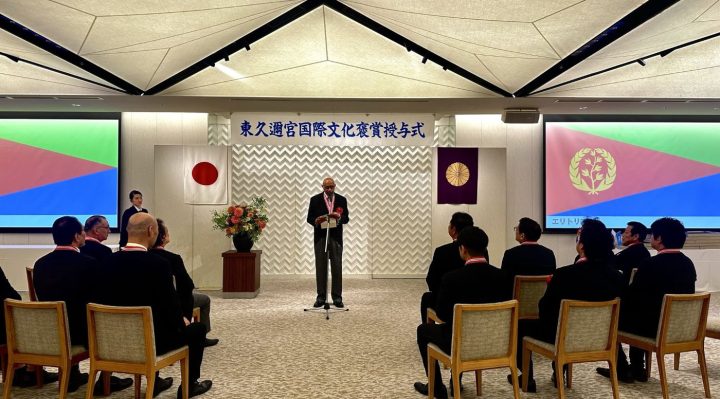
Mr. Fumiyasu Akegawa, Chairperson of Higashi-kuninomiya International Cultural
Award Commemorative Foundation
Honorable participants,
Ladies and Gentlemen,
First and foremost, let me extend my deep-felt gratitude and thanks for the 60th Higashi-kuninomiya
International Cultural Award bestowed to me, in the presence of many
esteemed personalities, in this prestigious cultural ceremony being held here in Tokyo
today.
It is a great honor for me to be part of this important cultural award of Japan founded
following the wishes of the late Prince Morihiro Higashi-Kuni to honor individuals who
made significant contributions to Japan and the world.
As a diplomat of my country, the State of Eritrea, stationed here in Tokyo since 2003, my
main task has been to foster and facilitate regional peace, trade, investments, creating
people-to-people communication bridge for building and enhancing the cultural
understanding trajectory, which existed for centuries between our peoples, by utilizing
all available communications tools in local and international forums here in Japan.
On this important occasion, allow me to take the opportunity to give honorable
participants a brief snapshot of the last 90 years history of the bilateral relations between
Eritrea and Japan.
Modern history of the Japan-Eritrea nation states dates back to the Italian Colonial
Administration period of Eritrea. Diplomatic relation between Japan and the “Italian
Colonial Administration of Eritrea” was established in September 1936. Japan and Eritrea
had an active cultural, trade and investment exchanges since that period. Eritrea was one
of the major exporters of industrial salt and fertilizer products to Japan going back to that
period.
Local and Japanese experts from Nippon Mining also revealed rich major base and
precious mineral deposits occurring in the areas of Embaderho, Adi Rassi, Debarwa, Adi
Nefas, Weki and other areas in Eritrea in the early seventies. Japanese companies have
also made several investments in leather, cotton, house-wares, aluminum and other small
and medium manufacturing enterprises in Eritrea in the late sixties and early seventies.
Japan started Overseas Economic Cooperation Fund (OECF) for Africa in the early 1970.
The Hirst Yen-loan agreement was signed with Ethiopia in May 1973. This period
coincides with the beginning of “Ethio-Nippon Mining” and other investment activities in
Eritrea, that I just mentioned briefly.
After the independence of Eritrea (1991): in view of its long and short term interest and
in line with the natural give-and-take-relations that existed between both countries for
many years in areas of trade, investment, tourism and other mutual partnership
programs in the past, Foreign Direct Investment (FDI) of Japan was targeted from the onset
to participate in the rebirth of the economy of our country i.e. mining, Fisheries,
agroindustry, SMEs, coastal development – infrastructure development as well as in the
new eight colleges that were established to offer science, engineering technology,
agriculture, business, economics, marine sciences, health and technical education with an
expected desirable outcome to the improvement of educational system in Eritrea through
Japanese experiences and to the mutual development of future trade and investment of
both countries.
Therefore, without losing sight of the past and the developed and emerging economies in
Asia and their reflection and influences to the economies of African countries in general
and Eritrea’s economy in particular, I have tried my level best, as the Hirst resident
Ambassador of my country to Japan, to the enhancement and development of this historic
relationship. The push and pull of the global economic powers and its subterfuges in the
Middle East, the Nile basin and the Horn of Africa countries was also a big challenge
during this important period of our common history.
I believe, as in the past, Eritrea Japan future trajectory of a successful bilateral relations
shall be dictated by an enhanced and developed technical cooperation tie-ups in
geological research, exploration and, related energy and resources diplomacy for
revitalizing futuristic and sustainable businesses.
Hence, building a robust bridge between Eritrea and Japan or for that matter between
Africa and Japan was not a choice but a must during the last two decades of my service
here in Tokyo.
Thank you again for giving me this chance,
ESTIFANOS Afeworki, Ambassador
State of Eritrea
Tokyo
May 26, 2026
Fonte: Shabait