Compartilhar
The Mesob: A Testament to the Artistry, Unity, and Grace of Eritrean Women
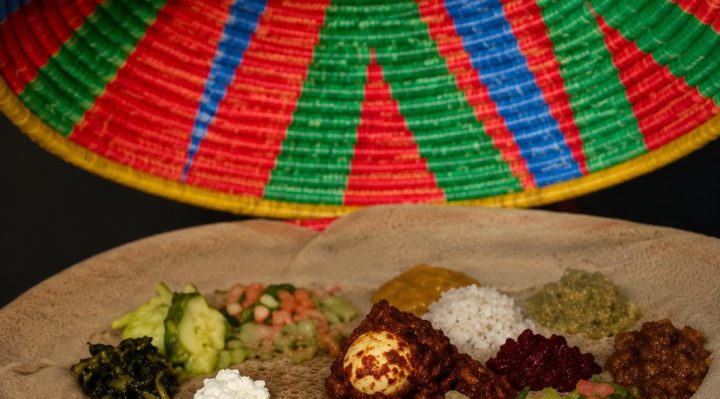
Eritrean women are universally celebrated for their creativity, resilience, and mastery of traditional handicrafts. Among these cultural treasures, the Mesob stands supreme. It is an intricately woven, straw-and-raffia dining basket that serves a dual purpose: it is both the literal centerpiece of communal dining and a treasured work of art prominently displayed to bring color, warmth, and prestige to the Eritrean living room.
Conical in its classic architecture, the Mesob features a wide, stable base that tapers elegantly in the middle before flaring out to its widest point at the top, where food is presented. Crowned with a beautifully matching conical lid, it is adorned with an array of vibrant geometric patterns woven seamlessly into its structure.
Far more than a utilitarian object, the Mesob is a cultural canvas. It demonstrates the boundless patience, artistic vision, and deep love that Eritrean women pour into preserving their national heritage.
The creation of a Mesob is a meticulous, labor-intensive process that can take a skilled artisan several months or even years to complete. Women harvest raw materials from locally grown palm leaves, known for their exceptional strength and structural durability.
To transform the rigid palm fronds into a pliable medium, the fibers are shredded into thin, flexible strands and soaked in water to maintain their elasticity during construction. Starting from the exact center of the circular base, the weaver uses a specialized needle to tightly bind and loop the soft strands, gradually working her way upward to the crown. The same rhythmic, coiled method is used to fashion the independent lid.
Once the structural foundation is secure, the artisan introduces dyed raffia or thread, weaving intricate geometric patterns into the body. The color palette is deeply symbolic, often mirroring the vibrant hues of the Eritrean national flag: red for sacrifice, green for fertility and agriculture, blue for the sea, and yellow for the country’s mineral wealth. The sheer dexterity required to maintain perfect geometric symmetry throughout this demanding process showcases the immense skill of Eritrea’s women.
The palm leaves used to craft these masterpieces grow primarily in the fertile Gash-Barka region. This geographic connection is profoundly symbolic. Just as the Mesob represents abundance, hospitality, and nourishment, Gash-Barka—endowed with expansive agricultural plains and life-giving river networks— serves as the undisputed breadbasket of Eritrea.
The Mesob beautifully mirrors the core Eritrean philosophy of “Unity in Diversity.” It acts as a sacred communal table where family members and guests gather in harmony. Food is placed on a large platter nestled at the top of the basket, typically layered with soft, fermented injera (flatbread) and ladled with a wide variety of spiced national dishes.
Eritrean women inherently embrace circular design principles across almost all foundational household domains. This curved aesthetic is echoed in the mogogo (the traditional clay oven), the injera itself, the kitcha (unleavened traditional bread), and the tsahli (the clay cooking pot).
This focus on the circle is not accidental; it implies absolute equality. When sitting around the Mesob, every family member and guest occupies an equal space, sharing the meal from a single platter regardless of age, status, or gender.
Most significantly, the Mesob anchors the time-honored cultural practice of communal dining—a tradition through which generations of Eritreans have fostered mutual respect, deep affection, and unbreakable social bonds. This practice of eating together from a single, shared platter is vibrant and alive across all nine of Eritrea’s ethnic groups, each possessing its own beautiful term for this focal point of hospitality: Tigrinya: Meadi (መኣዲ), Tigre: Metaagal, Saho: Maddi, Bilen: Meddira or Gbar, Kunama: Gonta or Nada Gonta, Nara: Gaan, Bidawyet (Hadendowa): Tooda, Afar: Galadda, Rashaida (Arabic): Maida.
The visual splendor of the Mesob bears a striking resemblance to the natural grace and poise of Eritrean women. Its sweeping posture— the round base narrowing in the middle, expanding at the crown, and draped with a beautifully fitting lid—evokes the image of a dignified Eritrean matriarch walking proudly in her traditional, elegantly embroidered dress.
This connection is celebrated dynamically during national festivals and cultural dances, where women perform synchronized, circular movements while gracefully balancing miniature Mesob lids on their heads.
The Mesob is far more than a woven basket; it is a monument to the spirit of Eritrea. Through its captivating geometry, its rich national colors, and the nourishing meals served from its crown, it reflects the generosity, intellect, and love of the women who craft it. It is a magnificent testament to a national heritage engraved with beauty. Let us all honor, celebrate, and preserve the brilliant artistic legacy of Eritrea’s women.
Fonte: Shabait