Compartilhar
EU-funded resilience programme launched to strengthen peace and security in Marsabit
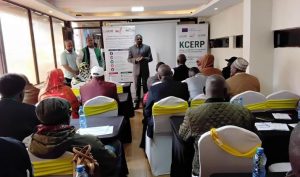
Security and peacebuilding efforts in Marsabit County have received a significant boost following the launch of the Kenya Community Engagement and Resilience Programme (KCERP), a multi-stakeholder initiative aimed at preventing violent extremism through community engagement, economic empowerment and stronger collaboration between citizens and security agencies.
The programme is funded by the European Union through the Global Community Engagement and Resilience Fund (GCERF) and Act Change Transform (ACT). It is being implemented by Strategies for Northern Development (SND) and the Agency for Peace and Inclusive Development (APID).
Speaking during the launch at Ebisa Hotel in Marsabit Central Sub-County, Marsabit County Commissioner Stanley Kamande said the initiative would initially be implemented in Laisamis, North Horr, Marsabit Central and Moyale sub-counties.
He said the programme brings together religious leaders, community elders, women, youth, peace committees, national government administrators, civil society organisations and security agencies to promote lasting peace, strengthen resilience and address factors that contribute to violent extremism.
“The programme focuses on preventing violent extremism through community engagement, increasing public awareness and strengthening relationships between communities and security agencies while creating economic opportunities for vulnerable women and youth,” said Kamande.
He noted that the Government remains committed to closing security gaps that criminals and extremist groups often exploit, adding that the county’s cultural diversity calls for collective responsibility in safeguarding peace.
“We welcome the KCERP project because it will create awareness on matters of peace and security and strengthen relationships between communities and security agencies,” he said.
Kamande urged residents to continue supporting security agencies by reporting suspicious individuals and criminal activities, assuring the public that all information shared with authorities would be treated with strict confidentiality.
“If you are not comfortable reporting to an officer at a police station, you can seek assistance from the Officer Commanding Station (OCS), the Sub-County Police Commander (OCPD), the Deputy County Commissioner or the County Commissioner. These officers are accessible and will ensure your information is treated with confidentiality,” he said.
The County Commissioner observed that strong partnerships between communities and security agencies remain critical in preventing radicalisation, disrupting criminal networks and promoting peaceful coexistence.
Project Officer at Strategies for Northern Development (SND), Wago Boru, said the programme specifically targets women and young people because unemployment, poverty and limited economic opportunities have made many youths vulnerable to recruitment by extremist groups.
He cited challenges facing Marsabit County, including drug and substance abuse, illegal arms trafficking, cross-border insecurity and criminal activities that continue to threaten community stability.
Boru also referred to the abduction of two Korean missionaries in August 2024 as an example of the security challenges that have affected the region and highlighted the need for stronger community resilience.
“Many young people complete school without finding meaningful employment. Some become vulnerable to recruitment by extremist groups such as Al-Shabaab because they are promised financial rewards,” he said.
He emphasised that investing in prevention through awareness creation, community engagement and economic empowerment is more effective than responding after individuals have already been radicalised.
As part of its awareness campaign, the programme will train 10 Digital Peace Ambassadors—five each from Moyale and Marsabit Central sub-counties—to promote peace messages through social media platforms including TikTok, Instagram, Facebook and X.
The ambassadors will use digital platforms to counter misinformation, discourage hate speech, promote peaceful coexistence and encourage responsible use of social media among young people.
Beyond awareness creation, KCERP will economically empower 60 beneficiaries, comprising 30 women and 30 youths drawn from different parts of Marsabit County.
Boru said selected youth groups will receive brick-making machines together with entrepreneurship and digital marketing training to enable them establish sustainable businesses and improve their livelihoods.
Women beneficiaries will receive beehives alongside practical training in beekeeping, hive management, honey harvesting, processing, value addition and marketing to enhance household incomes.
He added that much of the practical training will be conducted at the Badasa Centre of Excellence, which was established under an ecosystem restoration project funded by the World Food Programme (WFP).
According to Boru, the programme will run for nine months and will work closely with security agencies, local administrators and community leaders to strengthen trust, improve information sharing and build resilient communities capable of resisting violent extremism.
Ahmed Billow Osman, an officer from the Agency for Peace and Inclusive Development (APID), said KCERP builds on previous peacebuilding initiatives implemented under GCERF support.
He noted that the project seeks to strengthen collaboration among communities, security agencies, women, youth groups, religious leaders and peace committees to address emerging security challenges collectively.
“We want to create safe spaces where communities and security agencies can rebuild trust, improve communication and strengthen positive relationships for effective peacebuilding,” Osman said.
He observed that violent extremism has become a global challenge, with extremist groups increasingly exploiting digital platforms to spread propaganda and recruit vulnerable young people.
“Our focus is on awareness creation, peaceful coexistence, good neighbourliness, trust-building and ensuring that young people use digital platforms positively instead of falling prey to terrorist recruiters,” he said.
Peace activist Shamsia Abdullahi, who works on peace and security issues along the Kenya-Ethiopia border in Moyale, welcomed the programme, saying it would strengthen both community security and livelihoods.
She commended the Government and development partners for supporting peace initiatives that have enabled communities on both sides of the Kenya-Ethiopia border to coexist peacefully and conduct cross-border trade with greater confidence than in previous years.
Abdullahi said empowering women and unemployed youths through income-generating activities would reduce vulnerability to crime, drug abuse and extremist recruitment while strengthening household resilience.
“The programme will empower unemployed youth and women, improve livelihoods and strengthen peace within our communities,” she said.
She also urged Kenyans to uphold peace, dialogue and tolerance ahead of the 2027 General Election, warning that unemployment and drug abuse continue to expose many young people to criminal activities and violent extremism.
“Our youth need opportunities that keep them engaged in productive work instead of drugs and crime. Peaceful coexistence is everyone’s responsibility,” she said.
The Kenya Community Engagement and Resilience Programme is expected to strengthen community resilience against violent extremism by combining public awareness campaigns, economic empowerment, digital engagement and stronger cooperation between communities and security agencies, while contributing to sustainable peace and inclusive development across Marsabit County.
By Anthony Melly and Sebastian Miriti
Fonte: Kenya News