Compartilhar
The Gazelle’s Grace: Eritrea’s Timeless Beauty
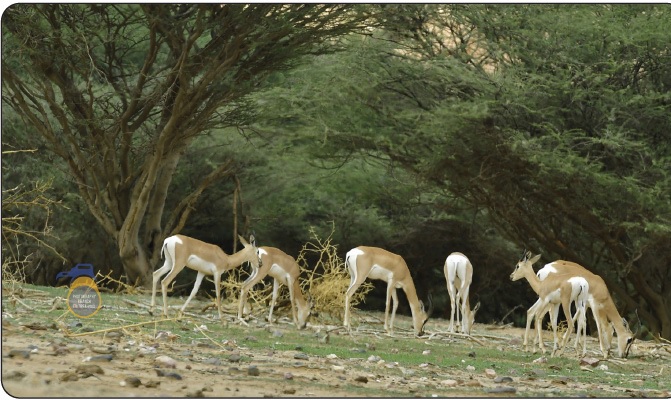
Eritrea’s boundless beauty is forged by the ethos of “Unity in Diversity,” a principle that harmonizes the profound solidarity of nine distinct ethnic groups with the nation’s stunning natural landscapes. This fusion creates a timeless aesthetic where cultural heritage and the natural world are deeply intertwined. Among the many elements drawing local and international tourists to Eritrea’s rich cultural canvas, few are as captivating as the symbolic relationship between the gazelle and Eritrean traditions. This connection is most vividly expressed in the traditional choreography of the country’s nine ethnic groups.
For centuries across Africa and the Middle East, the gazelle has been celebrated as the ultimate symbol of beauty, grace, and elegance. This enduring status in ancient poetry and love literature stems from several distinct physical and behavioral qualities. First, the animal possesses an aesthetic form marked by slender, elongated legs and a delicate neck that grants it an air of natural royalty. At the same time, its well-balanced, S-curved horns create striking lines of poise and symmetry. Second, the gazelle’s large, dark, and glossy eyes convey a profound sense of innocence, depth, and gentle vulnerability.
Third, it is universally praised for its fluid agility and weightless movement, able to leap high into the air or shift directions mid-run with effortless ease. This ability to navigate treacherous terrain flawlessly makes its agility a beautiful metaphor for grace under pressure. Finally, the gazelle maintains a regal presence through its constant poise and alertness, remaining hyper-aware of its surroundings by lifting its head high and keeping its spine straight in a proud posture that projects dignity and quiet confidence. Etymologically, the word “gazelle” is derived from the Arabic root ghazal, which refers to sweet, lyrical love poetry. Consequently, across various cultures, writers and lovers have long used the gazelle as a powerful metaphor for the women they adore.
Historically, Eritrea was home to a diverse array of wildlife until the colonial period caused environmental degradation, disrupted animal migration, and led to localized extinctions. Following independence, however, the government’s dedicated environmental recovery efforts have paved the way for many wild animals to return. Though slow, their growing numbers are highly encouraging. Among these returning species is the Heuglin’s gazelle, scientifically known as Eudorcas tilonura, also known as the Eritrean gazelle.
Today, Eritrea is home to three distinct gazelle species, each thriving in its own unique habitat. The most common of these is the Dorcas Gazelle (Gazella dorcas), found predominantly across the coastal plains and the arid lowlands of the Gash-Barka region. Along the Red Sea coast, the southwestern mainland, and the Dahlak Archipelago, one finds the Soemmerring’s Gazelle (Nanger soemmerringii). Notably, the population on Dahlak Kebir Island has uniquely adapted over generations, developing a distinct dwarf body size. The third species is the Heuglin’s Gazelle. This endangered animal was feared missing from the region for several decades until it was recently rediscovered in the Dige sub-zone and the eastern coastal mountains.
In Eritrea, the iconic beauty of the gazelle is celebrated by all nine ethnic groups, particularly through dance movements that mimic the animal’s behavior during periods of excitement or heightened alert. A prime example is stotting—the behavior where a gazelle springs high into the air with all four legs stiff, creating an illusion of complete weightlessness when excited or sensing danger. This thrilling energy is beautifully channeled across Eritrea’s diverse choreographies.
In Saho choreography, male dancers keep their upper bodies perfectly upright while exploding into rapid, high vertical hops on alternating legs. Making contact with the ground for only a microsecond, they perfectly mimic the spring-loaded power of a bounding gazelle. This contrasts beautifully with the Kunama dances, which feature sudden, explosive bounds and intricate, rapid footwork that imitate a gazelle sharply shifting directions to outmaneuver a predator in the wild. Meanwhile, the famous Tigrinya dance style, Guayla (or Quda), features dancers moving together in a unified circle characterized by a hyper-precise, rapid vibration of the chest and shoulders. This distinct muscular movement reflects the high-alert, twitching energy of a wild gazelle scanning the horizon.
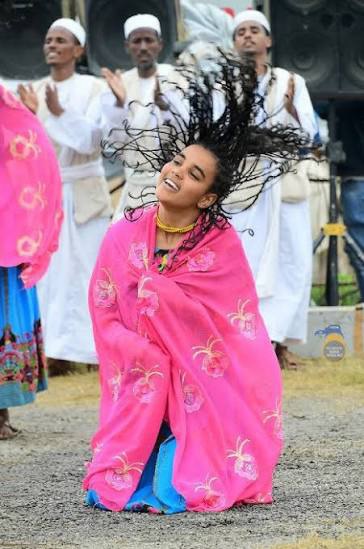
The communal spirit of the herd is also captured visually through dance. When a group of Nara dancers shifts their body rhythm in a sudden, uniform direction, they evoke the striking visual of a unified herd of gazelles cutting across an open plain simultaneously. In a more peaceful cadence, the Tigre possess smooth, gliding steps that transition seamlessly into rhythmic upper-body sways, mirroring a gazelle herd drifting untroubled through the lowlands. The Bidawyet are also known for fluid, sweeping spinal waves, in which the dancers’ long, drawn-out horizontal movements reflect the graceful, unhurried stride of a solitary gazelle traversing vast open spaces.
Seasonal celebrations also draw directly from nature. The Afar are famous for a joyous dance style called Galawi Yabal, performed during the rainy season when the land turns green. Dancers bounce enthusiastically and kick up dust in pure excitement, capturing the exact, erratic bounding energy of wild gazelles celebrating fresh water and sweet grass. Gendered expressions of grace also mimic the animal; in Bilen choreography, women gracefully swing their long, braided hair, known as Shelil, while tilting their heads in perfect rhythm with the beat of the drums, evoking the proud yet gentle head gestures of grazing gazelles. Finally, the Rashaida practice a powerful dance featuring deliberate, high-stepping jumps accompanied by the rhythmic clashing of swords. Dancers keep their spines perfectly straight and their heads held high, channeling the regal, defensive posture of a dominant gazelle protecting its herd.
Beyond physical movement, the gazelle is deeply embedded in Eritrean love songs and oral literature. A premier example is the famous song titled Raymoc. Derived from the Bidawyet language, Raymoc is a compound word combining Ray, meaning neck, and Moc, meaning gazelle. Together, the “neck of the gazelle” serves as a powerful symbol of love, beauty, gracefulness, creativity, and deep respect. This metaphor remains highly popular among both the Bidawyet and Tigre ethnic groups. Throughout Eritrean culture, the long, elegant neck of the gazelle remains the gold standard of physical beauty. This visual legacy is why Eritrean women across various cultures dance with such grace, shaking and tilting their necks in movements that directly echo the animal’s natural poise.
In conclusion, Eritrea’s boundless beauty is anchored in its “Unity in Diversity,” which bridges rich cultural expressions and the wonders of the natural world. Watching the nine ethnic groups express love, grace, and resilience through movements that mirror the agile gazelle reveals a profound, historical bond between the Eritrean people and their environment. This relationship goes far beyond dance; it is woven into the very fabric of national identity and shapes how the people see themselves. To experience the cultural rhythms of Eritrea is to travel through a timeless landscape where life, nature, and community are celebrated in their truest, most beautiful forms.
Fonte: Shabait