Compartilhar
Mega road and railway projects position Kenya’s Coast as investment hub
The government’s sustained investment in mega road and railway infrastructure is transforming Kenya’s Coast into a prime destination for capital-intensive investments, with a proposed 700,000-barrel-per-day oil refinery expected to anchor the region’s industrial growth.
The Sh2.2 trillion refinery project by Nigerian billionaire Aliko Dangote, set for Lamu, is expected to guarantee a steady supply of refined petroleum products while reducing East Africa’s dependence on imported fuel. Once launched, the refinery will become the country’s largest private-sector investment and is projected to create about 60,000 jobs.
The refinery will be Dangote’s second after his 650,000-barrel-per-day refinery in Lekki, Nigeria, which commenced operations in January 2024.
Expected to break ground before the end of 2026, the investment comes at a time when Kenya and the wider region are grappling with rising fuel prices driven by the conflict in the Middle East and disruptions caused by the closure of the Strait of Hormuz.
The decision to locate the refinery in Lamu has drawn mixed reactions from residents and leaders. Once considered marginalised, the county is now emerging as a major beneficiary of government-led infrastructure projects and private-sector investments.
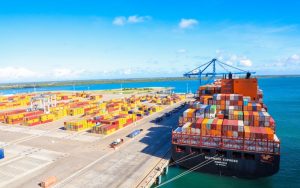
The Lamu archipelago, a UNESCO World Heritage Site, hosts the Lamu Port, the first component of the Lamu Port-South Sudan-Ethiopia Transport (LAPSSET) Corridor project. The port is planned to have 23 berths, with three already operational, featuring a draft of 17.5 metres and a turning basin of 500 metres.
According to the LAPSSET Corridor Development Authority, Phase Two of the port will include a liquid bulk terminal and an agri-bulk terminal to meet the projected regional demand of 70 million tonnes of agricultural bulk cargo by 2045 and Kenya’s estimated refined petroleum demand of 16.3 million tonnes.
Once a sleepy coastal town, Lamu has become a hive of economic activity since the commissioning of the first berth in 2021. The port currently handles transhipment cargo destined for the United Arab Emirates, Mozambique, Tanzania, Zanzibar, Seychelles, Comoros and Madagascar, including containerised cargo, bulk goods and motor vehicles.
The government is also pursuing a landlord model for some port operations to enhance efficiency and competitiveness. The Lamu Port Container Terminal berths and the Lamu Special Economic Zone are earmarked for development and operation through Public-Private Partnerships (PPPs).
The broader LAPSSET Corridor project includes highways linking Lamu to Isiolo, Isiolo to Juba in South Sudan, Isiolo to Addis Ababa in Ethiopia, and Lamu to Garsen, alongside the establishment of a Special Economic Zone.
Other flagship components include a crude oil pipeline from South Sudan through the Lokichar oil fields to Lamu, a refined products pipeline from Lamu to Ethiopia via Isiolo and Moyale, and a 3,000-kilometre single-track Standard Gauge Railway linking Lamu Port to Juba and Addis Ababa.
To further strengthen regional connectivity, the government is fast-tracking the Multinational Bagamoyo-Tanga-Horohoro/Lunga Lunga-Malindi Road Project.
The Sh15 billion project, jointly financed by the African Development Bank, the European Union and the Government of Kenya, is divided into two sections. Lot One, covering the Nyali Bridge-Mtwapa Bridge stretch, is 56 per cent complete after works began in November 2022 and is expected to be completed by August 2027.
Lot Two, covering the Mtwapa-Kwa Kadzengo-Kilifi section, has reached 76 per cent completion despite earlier delays caused by land acquisition challenges.
Once complete, the road is expected to improve regional connectivity, facilitate trade and significantly boost tourism along the Coast.
Meanwhile, construction of a Liquefied Petroleum Gas (LPG) storage facility by Taifa Gas at the 3,000-acre Dongo Kundu Special Economic Zone in Mombasa is nearing completion.
Last year, the African Export-Import Bank (Afreximbank), the Kenya Ports Authority and the Special Economic Zones Authority signed a lease agreement for the development of the Dongo Kundu and Naivasha Special Economic Zones.
Afreximbank is financing the two integrated industrial parks with an investment of US$1 billion (approximately Sh128.5 billion) in support of the government’s Bottom-Up Economic Transformation Agenda, particularly on value addition and export-oriented manufacturing.
On the railway front, the government in April launched the revival of the 130-kilometre Voi-Mwatate-Taveta Metre Gauge Railway line at a cost of Sh5.5 billion.
The project is expected to enhance cross-border trade with Tanzania, lower the cost of doing business and improve the livelihoods of communities along the railway corridor.
It also includes the construction of a dry port in Voi and new railway stations at Voi, Mwatate, Bura, Maktau and Taveta.
Transport Principal Secretary (PS) Mohamed Daghar reaffirmed the government’s commitment to expanding and modernising the country’s port, railway and road infrastructure to strengthen trade and logistics within Kenya and across the region.
PS Daghar noted that the entire Metre Gauge Railway from the Port of Mombasa to Malaba has now been rehabilitated, with the Voi branch line being the final missing link.
“We are determined to extend the Standard Gauge Railway from Suswa to Kisumu, covering 262 kilometres, with a branch line to Kisumu Port,” he said.
He added that plans are also underway to extend the railway from Kisumu to Malaba, a further 607 kilometres, connecting Kenya to the Ugandan border and strengthening regional trade integration.
By Sadik Hassan
Fonte: Kenya News