Compartilhar
Preserving Tradition Through Innovation

Engineer Amanuel Asgedom’s Improved Top-bar Beehive for Eritrean Beekeepers
Innovation often begins with observing everyday challenges and finding practical solutions. For Engineer Amanuel Asgedom, Head of the Ministry of Agriculture Office in Keren Sub-Zone, Anseba Region, that journey began while working closely with farmers during agricultural extension visits. At the Eritrean National Festival-2026, Engineer Amanuel presented an improved beehive that combines Eritrea’s traditional beekeeping heritage with modern scientific principles. His innovation demonstrates that meaningful progress can be achieved without abandoning local knowledge and practices.
Building on Tradition
For generations, Eritrean farmers have relied on traditional cylindrical beehives made from locally available materials. While these hives have served as the backbone of honey production across the country, they also present several management challenges. Harvesting honey can be difficult, hive inspection is limited, and transporting or maintaining the hives often requires considerable effort.
Rather than replacing these traditional hives with expensive imported alternatives, Engineer Amanuel chose a different approach. “We wanted to preserve the traditional hive while integrating modern scientific improvements,” he explains.
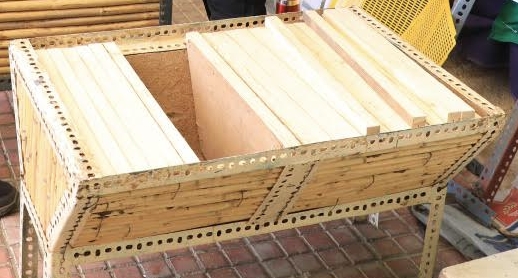
His design retains the familiar structure and uses materials that farmers already know well—bamboo, tree-branches, straw, grasses, and clay. The major innovation is the addition of a lightweight, inexpensive welded metal frame built to internationally recognized standards. The improved top-bar hive also incorporates removable wooden frames that allow bees to construct honeycombs naturally while making hive management significantly easier.
A Farmer-Friendly Innovation
One of the greatest strengths of the improved top-bar beehive is its accessibility. Most of the construction materials are readily available in local communities, allowing farmers to build and repair the hive themselves with minimal expense. Only a few standardized metal components require fabrication, making the overall cost affordable for small-scale beekeepers. Beyond affordability, the design offers practical advantages. It is easier to inspect, maintain, transport, and harvest from, while still preserving the natural environment that bees require for healthy colony development.
From Field Observations to National Recognition
The idea for the improved hive emerged during agricultural extension work in 2024, when Ministry of Agriculture staff visited farming communities throughout Keren Sub-Zone. During these visits, they identified the difficulties farmers faced in managing traditional hives. Motivated by these observations, Engineer Amanuel developed the improved design and presented it at the Anseba Regional Innovation and Technology Competition. The innovation attracted considerable attention and was later showcased at a regional exhibition organized in collaboration with development partners.
Strong Institutional Support
Engineer Amanuel credits much of the project’s success to the support of the Ministry of Agriculture, agricultural extension experts, development partners, and local institutions. Technical specialists have provided professional guidance to refine the design, while exhibitions and public demonstrations have helped introduce the innovation to farmers and the wider public. According to Engineer Amanuel, visitors frequently spend considerable time discussing the new hive and asking questions about its construction and use. The response has been overwhelmingly positive. Farmers appreciate that the hive is affordable, easy to maintain, and built using familiar materials.
Looking Ahead
Although the innovation has already gained recognition, Engineer Amanuel believes continued collaboration will be essential for its long-term success. He emphasizes the importance of strong coordination among government institutions, development partners, researchers, and agricultural extension workers. Careful planning, regular evaluation, and recognition of successful innovators will encourage further improvements in Eritrea’s agricultural sector. He also encourages professionals and extension staff to spend more time with farmers in rural communities, where valuable innovations often originate.
“Scientific knowledge and innovation should reach every part of the country,” he says.
A Vision Rooted in Local Knowledge
Engineer Amanuel’s improved top-bar beehive is more than a new agricultural technology—it represents a thoughtful blend of tradition and innovation. By respecting indigenous knowledge while applying modern engineering principles, he has created a solution that is practical, affordable, and well suited to Eritrea’s rural communities.
As the Ministry of Agriculture continues to promote improved beekeeping practices, innovations like this demonstrate how locally developed solutions can strengthen food and nutrition security, increase honey production, improve farmers’ livelihoods, and contribute to sustainable agricultural development across Eritrea.
Prepared by: Tsinat Yibrah
Translated by: Sophia Fekadu
Public Relations Division, Ministry of Agriculture
Fonte: Shabait