Compartilhar
Zenawi Zakarias: a Pioneering Innovator of Organic Solution for Pest and Disease Control
Q:Tell us about your background.
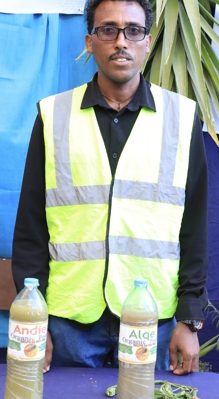
Thank you for giving me this opportunity. My name is Zenawi Zakarias. I work as a Plant Protection expert at the Ministry of Agriculture in the Southern Region, May-Mine subzone. I was born and raised in Adi Chigono, May-Mine Subzone and attended Adi Chigono Elementary School from grades 1 to 5. I had my middle and secondary school education at May-Mine School, walking about two hours each way from my village to the school. In the 2011/2012 academic year, I went to Sawa (25th Round) to complete my final year of secondary school and fulfill my national service. Having earned the required grade for admission to college, I joined Hamelmalo College of Agriculture.
Q: What did you study in college?
I specialized in Plant Protection. I chose Plant Protection because it is closely related to Biology, which I like. After completing my studies, I was assigned to the Ministry of Agriculture in the Southern Region, May-Mine subzone, where I have been working as a Plant Protection expert for the past ten years.
As the son of a farmer, I grew up working on farms and herding livestock. Like my parents, I have a deep love for farming and animal husbandry. I firmly believe that agriculture is the backbone of our nation’s economy, and this conviction has made me passionate about agriculture from an early age.
Q: You were given an award for developing an organic bio-pesticide in May 2026 by the National Union of Eritrean Youth and Students. Could you tell us more about your innovation?
It is disconcerting to see farmers in our communities dealing with crop pests by resorting to chemical pesticides because they have few alternatives. I was greatly concerned about the harmful effects of chemical pesticides, and when you witness such a problem, you cannot simply stand by and do nothing. Moreover, the Ministry of Agriculture’s strategy encourages the promotion of organic agriculture, including organic pest-control methods. So, inspired by my observation of the problems farmers were facing and the ministry’s strategy of promoting organic agriculture, I began doing research on natural pesticides.
Q: What materials did you use to develop the organic pesticides, and what makes them unique?
When I began developing the organic pesticides, my goal was to create an effective alternative to chemical pesticides. Using two local tree species known as Alqe (Cissus quadrangularis) and Andel (Capparis tomentosa), I developed two organic pesticides. Both products are made entirely from natural plant materials found in our local environment.
Alqe and Andel are plants, and I used their leaves and tender stems to prepare the pesticides. Before introducing them to farmers, I tested them on crops affected by aphids, which both damage plants directly and spread fungal diseases, making them particularly destructive. The results were very encouraging.
I, then, tested them on cabbages, oranges, tomatoes, lemons, and other crops and fruit trees. In every case, they performed very well. The pesticides successfully put under control a wide range of pests, including aphids, leaf miners, and even pests affecting taff. These initial trials produced solid results and, therefore, I was so confident to introduce them to farmers.
Q: What was the farmers’ reaction after using the organic pesticide?
Before distributing the pesticide, it was essential to raise the farmer’s awareness and provide them with training. To do this, I traveled all over the areas of May-Mine subzone, conducting awareness raising campaigns and training sessions. Farmers accepted the innovation enthusiastically and adopted it.
Initially, the farmers produced and used 1,142 liters of the Alqe and Andel pesticides. Some even stored additional quantities for later use. After seeing the results in their farms, they gave us very positive feedback. Later on, following the Farmers’ Day and its coverage on Eri-TV, more farmers became convinced of the effectiveness of the pesticide and began making requests for large amounts. At present, around 500 farmers are producing and using the organic pesticide.
Q: Why have farmers embraced the organic pesticides?
They have adopted them because they are inexpensive, easy to prepare, and made from materials that are readily available nearby. They require very little financial investment and can be produced using simple methods. Preparation mainly involves collecting leaves from the trees, crushing them, and processing them into the pesticides. Because it is so practical and affordable, farmers have readily accepted the innovation.
Q: Did you check whether the products have any side effects?
To date, we have found no evidence that the Alqe and Andel pesticides pose any risk to human health. They do not pollute the environment or harm the ecosystem.
In addition, our observations show that the preparation provides three important benefits to crops. They protect plants from pests, serve as natural nutrients and act as organic fertilizers, helping plants grow healthier. As a result, plants develop stronger, broader, and healthier leaves, which ultimately contribute to higher agricultural productivity.
Q: Now, let’s come back to your award.
This innovation was first presented during a Youth Week in May-Mine subzone, where it was recognized as an outstanding innovation. It later advanced to the regional and national levels, receiving many valuable suggestions, and finally a first-level award.
Q: What is the secret behind your success?
I believe this innovation is both timely and environmentally friendly, offering farmers an excellent alternative to chemical pesticides. It also has the potential to reduce many of the harmful effects associated with synthetic pesticides.
Q: Do you have plans to expand the innovation?
I will continue doing everything in my capacity to expand this work. My goal is to be able to package the pesticides in a quality standard, just like other agricultural products, and make them available to every farmer throughout the country. When that’s achieved I hope to be able to export them. To achieve this, I hope the Ministry of Agriculture will continue supporting me as it has done so far and that other relevant institutions will also provide the necessary assistance.
We wish you success in your future endeavors!
Prepared by: Berhane Andemeskel
Translated by: Sophia Fekadu
Public Relations Division, Ministry of Agriculture
Fonte: Shabait