Compartilhar
Afro Verse: Where Eritrean Heritage Meets Virtual Reality

A traditional Hidmo stands quietly inside a digital village. Its walls, household utensils and surroundings are rendered in three dimensions. Outside, water flows, vegetation moves gently, mountains rise in the distance and the sounds of nature fill the virtual landscape. The sun swaps across the sky, changing the light and shadows around the village. But this is not a village that can be reached by road. It exists inside Afro Verse, an AI-powered virtual reality (VR) platform developed by three Eritrean developers that have spent nearly five years turning an idea about cultural preservation into an immersive digital experience.
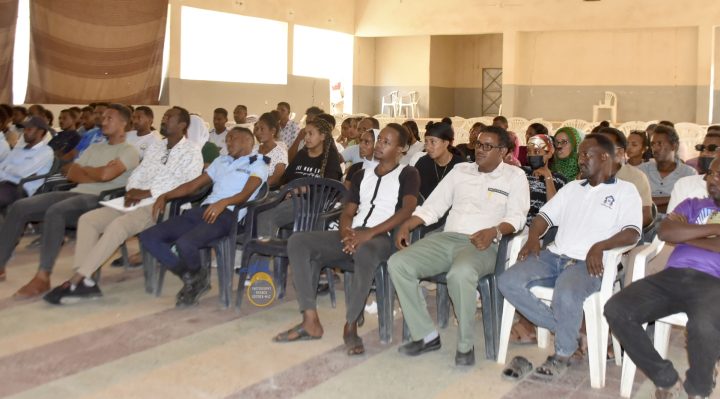
The software, currently in its first demo version, was introduced to the public on 27 August at the conference hall of the National Confederation of Eritrean Workers in an inaugural event sponsored by Warsa Enterprises PLC. The gathering brought together technology professionals, cultural enthusiasts and invited guests to see the demonstration, discuss the project and offer suggestions for its next stage of development.
What emerged from the event was a picture of a project, which is still in its early stages but carries an ambition far greater than its current demo, to preserve Eritrean cultural heritage through technology.
For Mr. Naod Michael, the founder and developer of Afro Verse, an expert of Computer Generated Images (CGI) and game developer, the story began not at a technology laboratory but during a conversation with his father.
His father was explaining the traditional Hidmo house—what it looked like in earlier generations, how it was used and how its appearance and surroundings had changed over time. The conversation prompted Naod to think about how quickly cultural knowledge can disappear as lifestyles change. Thus, he wanted to document it and imagined something people could actually enter and experience rather than producing a collection of photographs or written descriptions,
“That conversation with my father” became the starting point for the project, Naod explained at the event. The aim was to preserve genuine cultural elements through VR simulation, allowing people to experience aspects of traditional life rather than simply read about them.
The project was initially considered under the name “Hidmo Verse.” The developers eventually chose Afro Verse because they felt the original name was too narrow. As Mr. Mulugheta Kusmu, CEO and President of Warsa Enterprises PLC, and the team discussed in the developmental process, the new name was found to reflect a much wider ambition.
The current version begins with cultural assets associated mainly with the Tigrinya ethnic group, but the developers say the ultimate goal is to include the diverse cultures and history of Eritrea. Beyond that, the name leaves room for an even broader African vision.
For now, users entering the simulated village of “Adi Hagos Sinqom” encounter a virtual community of about 800 residents. The environment includes people, mountains, wilderness, caves, animals, vegetation, rivers, nature sounds and houses. Inside the Hidmo, traditional household objects and utensils are recreated in three dimensions.
The virtual experience is designed to be interactive. Users do not merely watch the environment unfold on a screen. Wearing a VR headset, they can enter the simulated surroundings and explore them from within. That distinction was central to the developers’ presentation. A conventional documentary can show a traditional house. Afro Verse attempts to let the user walk into a virtual environment and explore everything presented there.
The software’s visual presentation is one of the most striking aspects of the demonstration. Rivers appear to flow, water splashes, vegetation fills the landscape and the changing light creates an impression of different times of a day and seasons. Reflections, rays and shadows are carefully incorporated into the environment. Static images are transformed into animated elements, requiring extensive CGI and animation work.
Michael Berhane, assistant developer of Afro Verse, and Nahom Mebrahtu, animator and visual effect artist, worked hard for the success of the project while Israel Mehari, a computer engineer and specialist in robotics and AI, and Natnael Mulusew, CGI expert, review the project.
Natnael said the project has also become a learning experience for him. Working on the virtual reconstruction of the Hidmo has given him an opportunity to learn about a cultural environment that he had not previously understood in such depth.
Israel described the result as the product of commitment as much as technology. The work, he said, reflected the effort required to turn individual images and pieces of research into something that moves and feels real. The realism is intentional. The developers want users to feel that they are experiencing real environment rather than simply observing a computer-generated presentation.

Artificial intelligence is also incorporated into the platform through interactive features, adding another layer to the virtual experience. Yet the developers are careful to present the current software as a beginning rather than a finished product. That became particularly clear during the discussion session following the demonstration. Participants praised the initiative but also challenged the developers to think beyond the boundaries of the current version. Several called for the inclusion of important historical and cultural sites from across Eritrea. Among the suggestions were the ancient ports of Adulis and Zula, the historic trenches of Nakfa and other sites that form part of Eritrea’s cultural and historical heritage.
Others suggested expanding the number of interactive characters. At present, two of the approximately 800 village residents are designed to undergo physical development, allowing users to experience a more dynamic form of interaction. Participants proposed that more characters should eventually be developed in this way. Another recommendation was the creation of a guiding character ¬- who could accompany users through the virtual environment, explain what they are seeing and respond to questions.
Language was another important issue. The current version operates primarily in English, a choice that makes the platform more accessible to international users but potentially limits its reach among local audiences. Participants suggested incorporating Tigrinya and other Eritrean languages into future versions.
The developers welcomed the criticism. Rather than defending the demo as a finished achievement, they openly accepted the recommendations and said the comments would help shape the professional version. The plan is to expand both the scope of the cultural material and the technical capabilities of the software.
Afro Verse is intended to be an open-source platform. The developers do not envision the project as a product that belongs exclusively to its original creators. Their intention is to make the software accessible to interested developers who, with the necessary permission, can contribute to its development and expand its applications.
The team has devoted approximately four years and six months to the development process, with the broader journey stretching beyond five years when the research and preparatory work are considered. For them, the project has been as much about commitment as it has been about coding. The potential applications discussed at the event extend well beyond cultural documentation.
Abraham Mokonen, an Eritrean software engineer, IT expert and Website developer, who joined the event from the United States through Zoom, said the platform could offer Eritreans living abroad a new way to maintain a connection with their homeland. Someone thousands of kilometres away could potentially enter a virtual Eritrean village, explore traditional architecture and learn about local livelihoods without physically being there.
He also pointed to possible educational applications. Medical students could potentially use virtual environments for simulated procedures, while engineering students could practice in virtual settings. Other disciplines could similarly use simulation to provide practical experiences that may be difficult to reproduce in the classroom.
For Mr. Mulugheta, the platform represents a foundation for possibilities yet to be explored. What has been developed, he suggested, should not be viewed simply as a cultural program. Its open-source nature means it could eventually be adapted for education, professional training, culture and other sectors.
The involvement of Warsa Enterprises has extended beyond financial sponsorship. Naod noted that Mr. Mulugheta had also served as a guide and source of support throughout the development journey.
The developers now face the challenge of turning their promising demo into the much broader platform envisioned by its supporters. The professional version is expected to incorporate recommendations raised during the inaugural event, including broader cultural and historical coverage, additional interactive features and potentially greater language accessibility.
The ambition is substantial: to document both the tangible and intangible heritage of Eritrea through VR technology. That could mean traditional houses and household objects as well as landscapes, livelihoods, oral traditions, historical places and everyday activities.
The significance of Afro Verse, therefore, may ultimately lie less in what its first version can do than in what its open-source foundation makes possible. The developers have spent years attempting to answer a simple but increasingly urgent question: how can culture be preserved in a rapidly changing world? Their answer is not a museum behind glass or a book on a shelf. It is a virtual world.
Afro Verse currently begins with a digital representation of Tigrinya cultural heritage, but its creators hope it will grow into something much larger—a platform where Eritrean history and culture can be experienced, studied and developed by generations to come. As Naod reflected at the event, passion alone is not enough. It takes commitment, perseverance and people willing to share the vision. For Afro Verse, the inaugural event may have marked not the completion of a five-year journey, but the beginning of its next chapter.
Fonte: Shabait