Compartilhar
Making Heroes Beginning From Zero
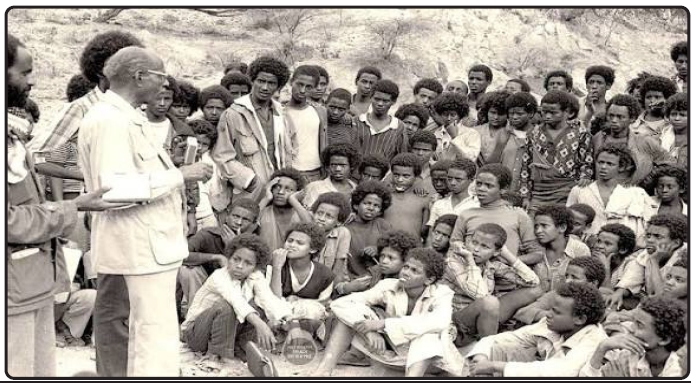
“Zero” is a deep historical valley where the Eritrean revolutionary school was first born. The name originated as the strategic radio communications code name for a remote base situated in the Zagre Mountains of the Sahel region. While local residents popularly call the area “Gumun,” certain parts of the valley are known as “Bea’t BiChay.” With its rich variety of tree species and a stunning stream flowing over gleaming valley rocks, Zero was an enchanting landscape—a place naturally suited to sustain human settlement under extreme conditions.
Zero welcomed its first batch of students in the summer of 1976. Formally named “The Revolutionary School,” this boarding institution opened its doors to children arriving from refugee camps in Sudan as well as from across liberated territories. Many were orphans whose parents had fallen to colonial atrocities; others were young children who were already actively contributing to the revolution in various capacities. The school officially launched its core mission in September 1976.
Despite severe material shortages, the school was driven by a deeply devoted faculty and support team. Acting as surrogate parents, these staff members provided the children with unconditional emotional warmth and holistic care. They prepared meals, supervised hygiene, tended to health needs, and maintained the facilities. The support team also included technical personnel who managed electricity and vehicle fleets, tailored children’s clothing, directed logistics, and secured the perimeter against potential attacks.
Though it lacked physical infrastructure in its earliest days, Zero’s organizational framework was exemplary. It was built entirely from scratch, guided by a far-reaching strategic vision. Over time, the school transformed structurally and materially, evolving into a robust institution capable of fulfilling its mission against all odds.
Students were organized into specific units based on age, with each group taking the name of its assigned leader:
• Under 8 years old: Cared for by freedom fighter Abeba Ghide.
• Ages 9–12: Managed by Zaid Russom.
• Middle youth: Guided by Haregu Ghebremedhin.
• Ages 13–15: Overseen by Ismail Mohammed.
Due to the shifting military dynamics of the war for independence, the Revolutionary School was forced to relocate several times before total liberation. Alongside other liberated bases, it remained a constant target of colonial aggression.
Under Ethiopian rule, indigenous Eritrean languages, history, and culture had been systematically suppressed. The Revolutionary School reversed this injustice by publishing the first modern textbooks written in native tongues, starting with Tigrinya and Tigre. The educational model combined rigorous academic theory with practical application. Even while operating out of makeshift trenches or under the canopy of trees, the school maintained high standards across sciences, mathematics, history, political education, humanities, and practical technical skills. Based on their aptitude, students were eventually assigned to various institutional sectors within the liberation movement, sparking a powerful social transformation.
Extracurricular activities were equally prioritized to cultivate physical fitness, mental sharpness, and leadership. Students organized into specialized clubs—including science, health, athletics, and fine arts—where they gained deeper hands-on knowledge.
Moreover, art was viewed not as a mere hobby, but as a core pillar of the curriculum. Through the renowned Keyahti Embaba (Red Flowers) cultural troupe, the school actively preserved and celebrated the music, dance, and traditions of Eritrea’s nine ethnic groups—turning cultural heritage into a potent weapon of resistance against forced assimilation.
The founding of the school reflected the visionary foresight of the EPLF leadership, who recognized the need to prepare a young generation for the complex task of post-war nation-building. They understood that education was the foundational bedrock of a free, sovereign, and prosperous Eritrea. Following independence, the Revolutionary School served as the primary blueprint for a national educational system rooted in identity and self-reliance.
The institution proved that a society could achieve true self-reliance under the harshest imaginable circumstances. It did not merely educate children; it forged the core professional class of the future state. When Eritrea achieved independence in 1991, alumni of the Revolutionary School became the nation’s first generation of homegrown doctors, engineers, diplomats, teachers, and pilots.
When the celebrated Tanzanian diplomat, journalist, and Pan-Africanist Abdulrahman Mohamed Babu visited the liberated zones in 1984, he famously observed of the movement: “I have seen the future of Africa, and it works.” His praise was inspired by the impressive self-reliance achieved by the EPLF. He witnessed a movement standing firmly on its own feet to resist colonial rule and liberate its people. In visiting these field institutions, he saw firsthand the heroes being forged out of Zero.
Today, those very heroes—alongside the public—are commemorating the school’s Golden Jubilee. On the morning of September 16th, celebrations kicked off with a historical photographic and artifact exhibition at the Asmara Municipality Hall under the theme: “Vibrant Commemoration: New Impetus for Nation Building.” The exhibit displays roughly 260 historical photographs, political cartoons, paintings, and original artifacts used at the Revolutionary School.
During the opening ceremony, invited guests revisited their childhood memories and reflected on the long journey toward a sovereign nation now undertaking major development initiatives. Among the items on display is a poignant 1987 photo taken in Shilalo by Taizaz Abrha, one of the revolution’s prominent photographers. The image captures a female freedom fighter shielding two young students while enemy aircraft circle overhead.
That freedom fighter was Tsega Yohannes, who was both a student and an instructor in the literacy campaign at the time. While conducting class, enemy aircraft appeared in the sky—a routine threat for fighters and civilians alike. The photograph preserves the moment Tsega sheltered two young children under her care while they looked up at the sky in wonder.
Today, Tsega Yohannes continues her calling as an educator in a sovereign Eritrea. She founded “Hana Kindergarten” in the Paradiso sub-zone of Asmara—named in honor of a fallen comrade—where she continues to mold the young minds of a new generation.
Ultimately, the legacy of the Revolutionary School remains a pillar of the nation. It established the bedrock of an educational philosophy designed to raise skilled and well-rounded youth. Through this foundation, Eritrea continues to safeguard its sovereignty, advance its national development, and stand resilient.
Happy Golden Jubilee Commemoration! Let us celebrate this milestone and continue building the nation with renewed energy and purpose.
Fonte: Shabait