Compartilhar
Hoye Hoye: Ritual, Renewal, and the Art of Togetherness
Eritrea’s diversified and multi-cultural calendar is stitched with rituals that deeply bind the communities to history, the Christian and Islamic faiths, and the land.
Among these, kudus Yohannes and Meskel for the Christian communities stand out as moments when time itself seems to fold: ancient liturgy meets village life, and the ordinary becomes ceremonial. Known locally through the practice of Hoye Hoye, this season of observance is not a singular event but a cycle of three linked celebrations that weave together Old Testament memory, Christian transition, and the discovery of the Cross. In Eritrean towns and highland villages, these festivities act both as a spiritual hinge and a communal festival—a time when men and women assume distinct but complementary roles in preparing for collective renewal.
Hoye Hoye is a living tradition that punctuates the year with three major commemorations. The first, Aba Abraham, recalls the biblical narrative of Abraham and his decisive turn toward faith. It is a celebration of spiritual conversion and the renunciation of former beliefs—a theme that resonates deeply in communities where identity and devotion have long been intertwined.
The second observance is Kudus Yohannes, which takes place on September 11 and marks a transition from the rainy season to harvest. And in terms of religion, it represents a transition from the Old Testament era into the promise of the New Testament—a spiritual passage that communities honor through ritual, songs, and symbolic acts of letting go to begin anew. The third celebration commemorates the finding of the True Cross, marking the moment of discovery and veneration of the instrument of Christ’s sacrifice. Together, these three observances form a profound theological arc: call, transition, and revelation.
According to artist and cultural researcher Mehari O.Michael, preparations for the celebrations begin long before the first church bells chime or processions form. Twenty days prior, men and boys from the age of fourteen set out into nearby woodlands to gather branches and foliage. This is no casual foraging; it is a carefully organized communal enterprise. Men divide into groups, appointing experienced leaders who know precisely which species to collect and how to harvest them sustainably before moving through the landscape with purpose.
The branches most commonly sought are tahses and qoleqal. These plants are selected for their durability and symbolic qualities—resilience, fragrance, and the distinctive way they burn or rustle. They are sturdy enough to be fashioned into processional bundles, ceremonial arches, and decorative structures. The group leaders, often elders with deep ecological knowledge, instruct the younger generation on sustainable harvesting techniques and the ritual meanings attached to each species. The act of gathering is itself a sacred rite: it reaffirms communal bonds, transmits ecological wisdom, and consecrates the surrounding landscape as an integral part of the festival.
Once harvested, the branches are bound into dense bundles, arranged into artistic patterns, and preserved for the upcoming days of celebration. In several villages, friendly rivalries emerge as groups take immense pride in the size and craftsmanship of their bundles, turning preparation into a spirited competition that heightens anticipation.
While men engage in these preparations, women and young girls participate in Wudasie, a vibrant celebration marked by dance, song, and colorful attire. Young girls dress in traditional garments—such as the zuria or shifon—and adorn their hair with grass and fresh flowers. They go from house to house singing melodic verses, receiving gifts or monetary blessings in return. Their songs make reference to historical events, express romantic longings, and offer subtle social commentary, effectively keeping oral traditions alive.
The visual language of Wudasie— vibrant cloth, sunflowers crowning the forehead, rhythmic movement, and layered jewelry—balances the earthy, botanical aesthetic of the men’s processional bundles. Together, these elements forge a rich sensory harmony: fragrant green branches paired with the bright, human choreography of women in celebration. It also serves as a vibrant space for social exchange, where stories are shared, courtships are quietly observed, and generational knowledge is passed along.
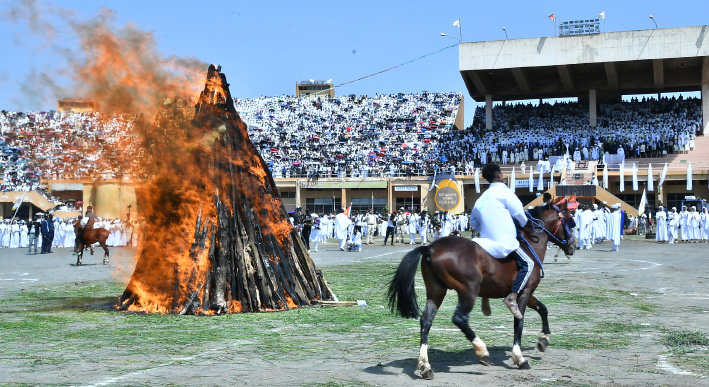
On the day of Kudus Yohannes, the village undergoes a complete transformation. Processions wind through narrow lanes and open fields, led by men bearing the heavy tahses and qoleqal bundles. Priests and deacons chant in Ge’ez—the ancient liturgical language—while congregations respond with hymns that have echoed through the centuries. The soundscape is layered and evocative: the low drone of liturgy, the staccato rhythm of drums, the soaring ululations of women, and the synchronized rustle of branches. Once the formal religious festivities conclude, the youth remain behind, continuing the celebration well into the break of dawn.
Visual symbolism infuses the entire landscape. Bundles are often constructed into arches under which children pass to receive blessings. Branches are burned in controlled fires to symbolize purification, and the Finding of the Cross is reenacted with profound solemnity and collective joy.
At its core, Kudus Yohannes is a conversation across time: between elders and youth, and between the land and its people. It is a festival that demands active participation, where every branch gathered and every verse sung serves as a reaffirmation of belonging. For artists and cultural practitioners, the festival offers a wealth of creative material—motifs, rhythms, and narratives that can be translated into visual art, music, theater, and literature without stripping them of their living communal context.
As Eritrea navigates the swift currents of modernity, Kudus Yohannes remains an essential cultural touchstone – a season when the past is not merely remembered, but actively lived. The tahses and qoleqal bundles, the Wudassie dances, and the liturgical chants in Ge’ez together form an enduring cultural choreography, demonstrating the endless capacity of religious communities to renew themselves
Fonte: Shabait