Compartilhar
Beyond the Politicized Narrative
Last week, the 2026 Social Forum, an annual meeting convened by the Human Rights Council and chaired by Mr. Habtom Zerai in his capacity as Chair-Rapporteur, concluded following two days of substantive and engaging discussions. The discussions focused on the contribution of international cooperation and solidarity, including South-South cooperation, to the realization of the right of everyone to the enjoyment of the highest attainable standard of physical and mental health.
The Forum addressed five thematic areas: international cooperation for the right to health amid declining international health financing; securing sufficient policy and fiscal space to enable countries to meet their health-related human rights obligations; equitable access to medicines, vaccines, medical equipment and health products; the protection of the right to health and to development in armed conflict; and fostering an inclusive and rights-based digital health transformation.
Bringing together Member States, civil society organizations, national human rights institutions, and other stakeholders, the Forum provided an important platform for dialogue on pressing global health challenges. To mark its conclusion, the Permanent Mission of Eritrea to the United Nations hosted a reception for participants, expressing appreciation for their valuable contributions.
While Eritrea’s chairmanship of the Forum was welcomed with pride by many Eritreans at home and abroad, as well as others who recognized its significance, it was also met with unwarranted criticism. Indeed, this criticism continues a broader, long-standing campaign of hostility and disinformation against the country, while also being totally detached from the Forum’s substance and objectives, reflecting a persistent pattern of politicization rather than genuine engagement with Eritrea’s contribution to international cooperation and the right to health.
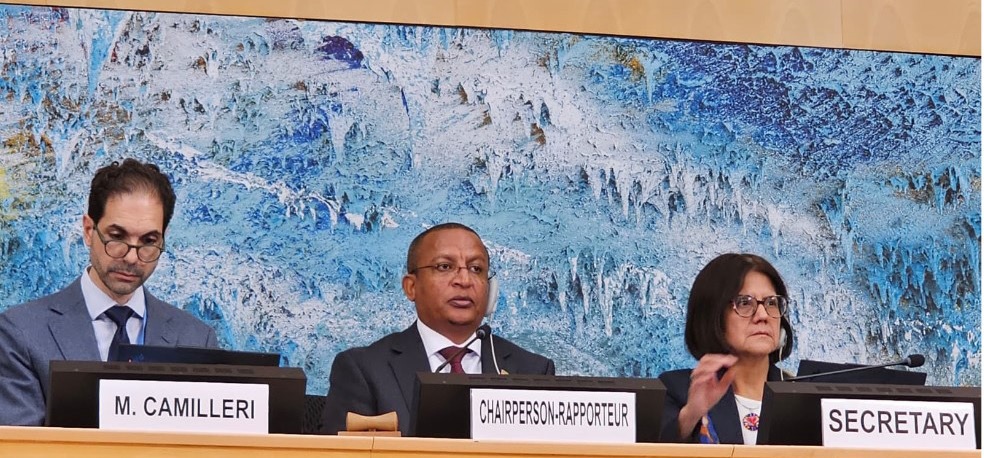
It is useful to recall that the Social Forum serves as a platform for discussing challenges related to human rights and development, bringing together diverse perspectives and experiences. Its effectiveness depends on meaningful participation, constructive engagement, and the recognition that countries with different histories and development trajectories can contribute to addressing shared global challenges.
Eritrea’s chairmanship was entirely consistent with these principles. Its experience as a developing country confronting resource constraints, climate-related challenges, and external pressures offers perspectives relevant to discussions on international cooperation, health financing, and the realization of socioeconomic rights.
What is more, Eritrea has made notable progress in health, education, and other social sectors despite difficult circumstances. Its emphasis on social justice, self-reliance, and the mobilization of domestic capacities provides valuable insights into development approaches grounded in national ownership and sustainability. These experiences are particularly relevant at a time when declining international health financing and widening global and regional inequalities threaten progress toward the right to health.
More broadly, Eritrea’s engagement with the Social Forum reflects the country’s longstanding commitment to international cooperation and partnership. Setting aside deeply rooted misassumptions and problematic narratives, the truth is that over the years, the country has maintained relations and collaborated with a wide range of states, international organizations, UN agencies, and other institutions, guided by the principles of mutual respect, sovereign equality, mutual understanding, and shared interests. These partnerships, irrespective of differences in political systems or development approaches, underscore Eritrea’s conviction that meaningful international cooperation must be grounded in respect for national sovereignty, non-interference, and the pursuit of common objectives. This longstanding approach aligns closely with the principles underpinning the Social Forum and reflects Eritrea’s continued commitment to constructive multilateral engagement.
Importantly, Eritrea’s successful chairmanship and the constructive conclusion of the Forum also speak for themselves. Beyond the criticism and attempts to question its suitability, Eritrea demonstrated its capacity to assume the responsibility entrusted to it, facilitate substantive discussions, and bring together diverse stakeholders around issues of shared international concern. Ultimately, the legitimacy of such a role is reflected not in the rhetoric of detractors, but in the ability to discharge its responsibilities constructively and contribute meaningfully to the process. The Forum’s successful conclusion therefore stands as a tangible demonstration of this.
Against this backdrop, the intensity of the criticism surrounding Eritrea’s chairmanship warrants closer examination. For years, Eritrea has been subjected to sustained politicized campaigns and negative portrayals, often driven by misinformation and disinformation. The reaction to its appointment as Chair-Rapporteur of the 2026 Social Forum is another manifestation of this broader pattern.
Rather than engaging with the Forum’s agenda or the substance of its discussions, some detractors have sought to undermine Eritrea’s role through attacks that serve little purpose beyond reinforcing an established negative narrative. Such efforts do not advance the right to health, strengthen international cooperation, or contribute meaningfully to the challenges the Forum was convened to address.
Overall, the successful conclusion of the 2026 Social Forum underscores the importance of inclusive multilateral dialogue and international solidarity. Eritrea’s chairmanship provided an opportunity to contribute to these efforts, while the Forum’s discussions highlighted the urgent need for cooperation in advancing the right to health. Attempts to politicize Eritrea’s participation do little to change this basic reality or diminish the value of the contributions it has made.
Fonte: Shabait