Compartilhar
“ኮራለይ/My Coral”: Eritrean Women’s Timeless Beauty
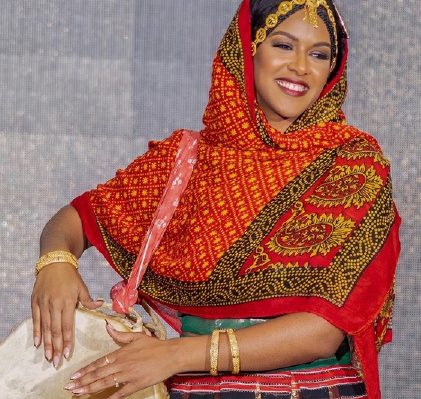
One of the most dominant global topics across several social media platforms is the Miss Universe in Vietnam, and Snit Habteab, an Eritrean neuroscientist, Montessori educator and disability rights advocate, is representing Eritrea. Through this prestigious world stage, she is promoting Eritrean beauty.
Snit’s strong conviction that is prevalent in her interviews by the media is a testament to her intellect, compassion, resilience and pride in her culture. As I learn more about what she is manifesting at the global stage, I have discovered Eritrean women’s timeless beauty in her inspiring life journey, captivating smile, graceful body motion, and very-well informed briefing.
When I started looking for the right word that can capture Eritrean women’s remarkable beauty, a widely popular love song ኮራለይ a Tigrinya word for “my coral,” crossed my mind. I felt the majestic beauty of a coral reef could capture Eritrean women’s timeless beauty and Eritrea’s essence as a maritime nation.
Both demonstrate the value of “unity in diversity”. They embody a flawless harmony of their several distinct internal diversities. For instance, Eritrean women’s diverse traditional hair braids can be likened to the intricate organic architecture of coral reefs. Also, both share common unwavering spirit of resilience: Eritrean women’s endurance during catastrophes such as war and draught and coral reefs’ endurance in the face of global warming and other human-induced environmental disasters.
In terms of “unity in diversity,” a coral reef is a mosaic composed of hundreds of different species of hard and soft corals, anemones, and marine life, each sporting its own vivid hue, unique texture, and specific role. The reef’s ultimate beauty lies not in a single dominant strain, but in the harmonious blending of its vast, internal diversity.
In precisely the same manner, the Eritrean woman is a magnificent living mosaic beautified by nine distinct ethnic groups, each contributing its own signature aesthetic, cultural and traditional values to the national identity.
For instance, women of the Tigrinya ethnic group display classic elegance that is often magnified by their pristine white cotton gowns and fine and delicate facial jewelry.
In the Tigre and Saho ethnic groups women offer a transition into the rolling hills and coastal plains, where their beauty is celebrated through intricate silver adornments and a stunning variety of hair-weaving techniques that reflect the fluid motion of the landscapes they inhabit.
Women in the Afar and Rashida ethnic groups, who live along the searing Red Sea coast, bring a fiery, unforgettable vibrance. Rashida women are famous for their elaborately embroidered traditional veils, stitched with metallic threads and heavy silver jewelry, while Afar women embody a striking, regal nomadic grace, adorned with bold, geometric beadwork.
In the Kunama, Nara, Bilin, and Hedareb ethnic groups, women beautify their natural hair textures through warm golden skin tones and earthy, symbolic bodily ornamentations that honor their deep connection to the land.
When these nine distinct threads are woven together, they create a national aesthetic that is breathtakingly rich. Just like the coral reef, the beauty of Eritrea is magnificent because it refuses to be a monolith; it is a thriving, collective ecosystem of diverse human expression.
When we see deep into the architectural beauty of Eritrean women’s astonishing hair braiding artistry and coral reefs, we discover a flawless beauty. For instance, in the Tigrinya ethnic group, the “ኣልባሶ” type of a hair-braid, is a structural marvel. A skilled braider spends hours creating thick, perfectly parallel cornrow ridges that rise dramatically off the scalp like rolling waves before allowing the remaining hair to cascade into a voluminous, magnificent afro cloud at the back.
The distinct and united artistry of traditional textiles and jewelry also adds color to the beauty of the women. For example, the “Tilfi”, the traditional Eritrean cross-stitch embroidery that lines the borders of hand-woven cotton dresses is a dazzling display of multi-layered, multi-colored geometric shapes. When an Eritrean woman moves, the vibrant, angular patterns of her dress mimic the shifting, sunlit patterns of a shallow coral garden.
This often is crowned by gold spherical beadwork worn across the forehead or neck. The golden spheres catch the light exactly like tiny, radiant air bubbles trapped in a sun-drenched reef, proving that the human instinct for adornment in Eritrea is deeply attuned to the beauty of the natural world.
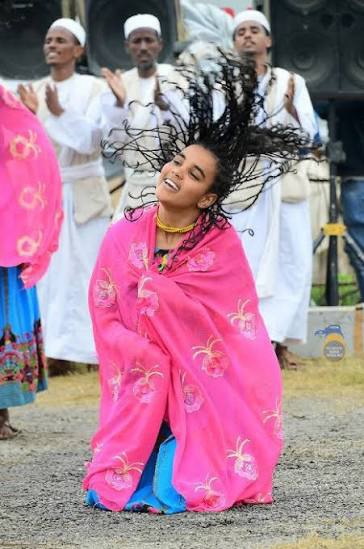
Another common element of beauty that likens Eritrean women to the coral reef is the value of resilience. Both have the undeniable common bond of absolute resilience. A coral reef is not a fragile decoration. It is a biological fortress. Positioned at the edge of deep waters, it acts as a vital barrier that protects shallow lagoons and coastlines from the catastrophic fury of ocean storms. It absorbs the immense, crushing energy of massive waves day after day, year after year. It confronts rising temperatures, shifting currents, and environmental pressures, yet it adapts, calcifies, heals itself, and continues to stand. The reef survives because its internal structure is dense, unified, and anchored deeply into the bedrock of the earth.
This is the true heartbeat of Eritrean beauty. The history of Eritrea is an epic narrative of survival, an unyielding struggle for self-determination and independence that lasted for generations. Throughout this turbulent history, Eritrean women were the bedrock of the revolution. Representing over 30% of the liberation fighters, Eritrean women fought on the front lines, handling heavy weaponry, commanding units, and enduring the unimaginable hardships of a brutal, decades-long war.
This historical legacy completely redefined the meaning of beauty in Eritrea. The beauty of an Eritrean woman is a beauty that has looked into the face of hardship and refused to bow. It is etched into the dignified, upright posture of an elder matriarch who raised a family through wartime. Similarly, Snit Habteab has been able to win undeterred by the challenges she faced — the disability of her sister and the untimely death of her mother.
Represented by Snit Habteab, Eritrea is taking part at Miss Universe for the first time. Through this platform, she is sharing Eritrean boundless beauty globally. Therefore, let us all give our support to Snit. We wish Snit all the best.
Fonte: Shabait