Compartilhar
“The people of Eritrea are just amazing. They are warm, kind, and deeply patriotic”
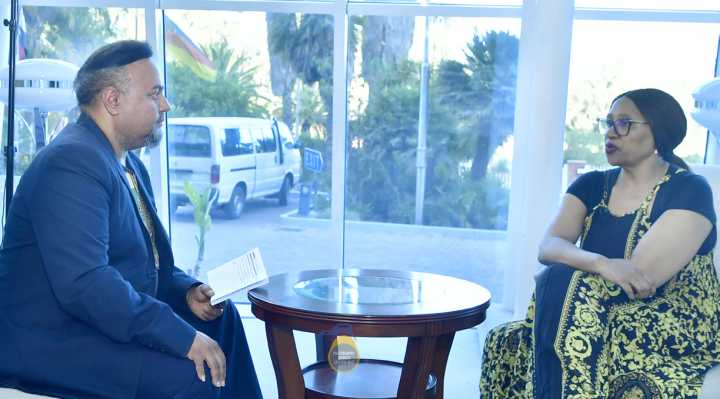
Ms. Nandi Mandela, the granddaughter of the late global icon of freedom Nelson Mandela, recently concluded a week-long visit to Eritrea. As a seasoned professional with over 32 years of extensive experience spanning corporate sector management, development consulting, property development, and stakeholder management, Ms. Mandela brings a unique and strategic perspective to global partnership building. During her stay, she engaged in high-level meetings with senior government officials and toured several major developmental and agricultural infrastructure projects in the country. Additionally, she headlined a special panel discussion centered on preserving and carrying forward her grandfather’s enduring vision, titled the Mandela Legacy Dialogue, aimed at fostering a unified Pan-African narrative and deepening bilateral ties. Upon concluding her visit, Ms. Mandela sat down with Eri-TV’s Raffaele Giuseppe. Excerpts follow.
During your visit, you held high-level discussions with President Isaias Afewerki and various government ministers. What were the core focus areas of these exchanges, and how do you envision the future of the economic partnership between South Africa and Eritrea?
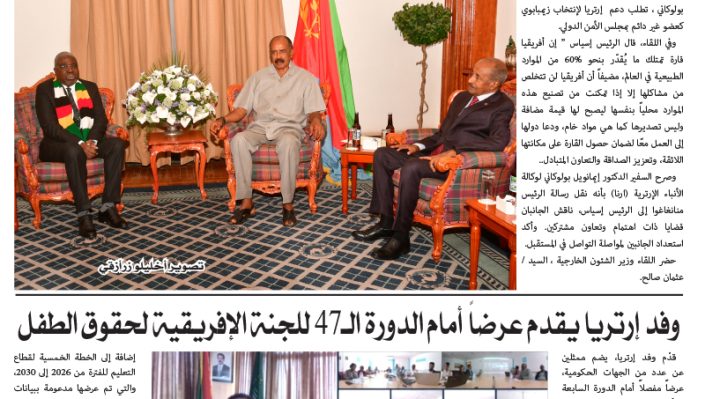
Thank you so much for that question. I had an amazing time during my visit to the State of Eritrea. I had the greatest honor and privilege to meet His Excellency, the President of the country Isaias Afwerki, and we had an incredible meeting.
The President is deeply passionate about nation-building and about African countries finding ways to collaborate so that the mission of our forefathers can be accomplished. Our forefathers did so much to create a lasting legacy, and now it is the challenge of the next generation to take that legacy forward. Primarily, our goal must be to ensure that our countries which have been blessed with abundant natural resources actually use these resources to benefit their own citizens.
Therefore, the President made a specific request that we establish bilateral relations to help ensure that local residents are the primary beneficiaries of these resources. He emphasized that Africa as a continent, and each country within it, possesses amazing resources. He is keen to see partnerships that are truly equal; he believes we should share, but not from a standpoint of dependency or subordination, but rather as equal partners.
He made a specific request to carry forward the legacy of Nelson Mandela. By harnessing the relationship between our two countries, we can achieve a vision that has not been realized until now, the economic liberation of the people of both nations.
We share a very similar background, having both fought for self-determination and independence. Your country just celebrated 35 years of independence about 13 days ago and South Africa trails shortly behind you in terms of years. With 35 years for the State of Eritrea and 32 years for South Africa, we are peers. There is immense value in our two countries operating as peers to enhance all of our programs, specifically those aimed at driving economic development.
We have achieved political independence, but we still have a long way to go to ensure that our natural resources economically enhance the lives of the citizens in both countries. If we succeed, we can then spread that success to the rest of the continent.
It’s quite amazing because, again, our two countries are very similar on the commitment to empower our people. I shared with the Ministers the type of work we do in South Africa. Historically, Black people, specifically African people, in our country have been excluded from certain fields such as engineering, construction, accounting, and many other industries. With the current dispensation, the country is very intentional about redressing the imbalances of the past. We have policies in place targeting these disparities to close the gap, with specific programs successfully implemented across various industries.
Given your extensive background in housing and town planning, what opportunities do you see for collaboration on sustainable infrastructure following your discussions with the Eritrean ministries?
In my interactions with the Eritrean Ministers, I learned that the education department is doing amazing work. They have sent students from various sectors, including the Ministry of Justice, from Eritrea to universities in South Africa specifically UNISA to enhance their skills. They run a very intense training program. We also visited the National Union of Eritrean Women, which has training centers throughout the country and in the diaspora. These are valuable lessons we can take back with us.
I am particularly impressed by the education system and the Sawa program. Bringing all the different language and religious groups together into one community at Sawa builds deep patriotism, nation-building, and social cohesion. Having these young people share a space for a year after their 11th grade where they are not only trained but also serve their country, is a phenomenal system. It grooms the next generation to have a sense of pride in themselves and their nation. It allows these young people to build lifelong friendships across different regions, interact with diverse communities, and learn multiple languages.
I also noticed within the Department of Justice that young people are being groomed to take on leadership positions, which shows immense confidence in the youth of the country. I firmly believe that if a country does not look after its youth and the next generation, it is shooting itself in the foot, because it is the youth who must carry the torch to the next level. It is incredibly exciting to exchange knowledge on the unique strengths that each of our countries possesses.
Having visited some of the sites within the agricultural project, what impressed you the most?
The people of Eritrea are just amazing. They are warm, kind, and deeply patriotic. I have only been here for a week, and the comrades I have engaged with have been incredibly welcoming. The reception I received has been somewhat overwhelming. This was my first visit to this beautiful country and my first time in this part of the world; though I have traveled to England, Belgium, and the UAE, I had never been here, and it has been a true eye-opener for me.
The projects I visited were absolutely mind-blowing. I saw a few of the dams though I understand there are hundreds across the country and I think that is a phenomenal investment in the future. Water is life; without it, you cannot plant, you cannot nurture crops, and you cannot survive as a human being. We visited a beautiful dam that features a powerful sculpture of the soldiers who started the revolution. There is no symbol more powerful than that to say, “This is where we started, this is not where we end, and we are going to build our own infrastructure.” I am completely blown away by the scale of that dam, especially knowing it was built entirely with the country’s own resources. It is truly tragic that we don’t get to hear about this outside of the country. Visiting this beautiful nation and the city of Asmara has shown me what can be achieved when we are focused on a vision, dedicated to nation-building, and, most importantly, focused on serving our citizens.
As if that experience wasn’t mind-blowing enough, we also visited a nearby dairy farm where they are breeding thousands of cattle. Most of them are dairy cows, and the facility is run with incredible professionalism by people who are truly committed. Seeing how the water supply flows seamlessly from the dam to the farm, and then to the local communities, is unbelievable and again, it is completely self-funded. This sends the perfect message to the rest of the continent: let’s stop relying on foreign funding and focus on trade, not aid. That message came through over and over again in my interactions with various ministries.
I have learned a wealth of things, and I am eager to share these insights with my friends and business partners when I return home to see how we can harness this new relationship. We want to start simply and build toward the complex. Since I met with about seven ministries, it won’t be possible to do everything all at once, so we need to choose our starting point. To that end, the President made a specific request for us to develop a concept paper, which we will then share with the people we met, all the way up to the presidency.
Empowering women in leadership as a strong global advocate for breaking down barriers for women in business and governance, how did your conversations touch upon women’s roles in the nation’s progress, and what strategies can both countries share to thrust more women into leadership?
That’s very important. We met with the national women’s organization, and they showed us the work that the women of this country have done. What I like about the country’s training and education programs is that they specifically target women to be trained in fields that women are not normally exposed to.
Some examples were very striking for me, such as women taking exams right after giving birth. Being pregnant doesn’t mean that you need to forget about your future or how you can enhance your capability to empower yourself. Secondly, women globally constitute more than 50% of the population. If you leave more than 50% of the population behind, it will become a problem because you are leaving a big chunk of the population unable to contribute to the progress of that country.
So, ensuring that you give them areas of responsibility and groom them to be better leaders of tomorrow that’s how we grow. And that’s exactly what’s happening here. Because if you feed a woman, you feed a nation.
On preserving the Mandela legacy, Nelson Mandela always emphasized that collaborative projects have a unique power to unite people across regional divides. In what ways do you see your visit to Asmara serving as a bridge to deepen cultural exchange and foster a stronger, unified Pan- African narrative?
I love that because most people talk about governance models based on Western principles. I think when we make a concerted effort to promote an African focus in how we run our institutions, it will be the breakthrough we have always been looking for.
Regarding the legacy of my grandfather, even during the time he was called the Black Pimpernel and worked underground, he sought the assistance of people throughout the continent. Not just South, East, or West but everyone. We haven’t done enough of that in this generation. This visit could be the beginning of enhancing that. Of course, we have institutions in place that are supposed to be harnessing this unity, but the disappointing reality on the ground is that we haven’t seen the Pan-African vision manifest into changing the lives of the people economically. And that is exactly the responsibility we now carry.
Fonte: Shabait