Compartilhar
Virtual laboratories offer reprieve for CBC system
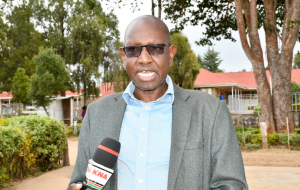
As the laboratory challenge in Junior Secondary schools persists, there is a reprieve on the matter as the Centre for Mathematics, Science, and Technology Education in Africa (CEMASTEA) offers an ingenious solution to the challenge.
The institution, under the Ministry of Education, is currently training over 7000 junior secondary school teachers across the country to implement the virtual lab after the official launch of the program a week ago.
Speaking during the closure of a 3-day workshop at Solian Girls Secondary School in Eldama Ravine, CEMASTEA’s Coordinator for Partnership and Linkages Dr. Mary Sichangi, said the virtual lab was developed to mitigate inadequate laboratories or material resources in schools across the country.
Dr. Sichangi said that the program comes on the backdrop of the realization that most teachers teach science subjects theoretically making it difficult for learners to understand the key concepts.
“Through several years of research, CEMASTEA has established that the challenges that face teaching of STEM subjects is teaching them theoretically since our research is for action and the action is training. We noticed that you cannot train a teacher and tell them this is how to teach without providing them resources on how to teach. Virtual labs, thus, come as a central intervention to enhance teacher capacity,” explained the coordinator.
Dr. Sichangi said that the teacher will now have a wealth of available resources, which is innovative and will improve learners’ participation in the subject, attitude, and ultimately performance.
“STEM subjects are quite practical, and we need to engage learners in practical activities, conducting experiments and exploring abstract concepts in mathematics,” said Dr. Sichangi, noting that teachers have been introduced to CEMASTEA’s developed virtual laboratories.
The Trainer further noted that the teachers explored features and used the system to prepare ICT integrated lesson that uses a virtual science or mathematics laboratory.
Dr. Sichangi said that the platform is freely accessible, and all one needs are ICT gadgets and an internet connection.
She stated that through simulation and manipulation the learners can easily grasp the mathematics and science concepts, as the mode of teaching is exciting to the learners and will motivate more learners to take up the STEM pathway.
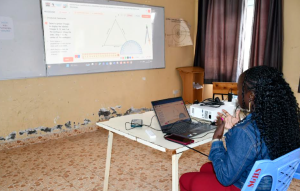
Sichangi said the interest of the teachers in virtual lab was exciting and they are looking forward to their feedback so that they can improve the platform
On his part, County Director of Education Dr. Kipruto Kosgei, who officially closed the workshop that trained 240 teachers, urged junior schools across the county to embrace virtual laboratories to improve practical learning.
He said the programme would also equip teachers with skills to support learners through virtual practical lessons, adding that these laboratories will allow learners to repeat science practicals several times while also introducing them to Information Communication and Technology (ICT) and online learning.
Kosgei added that primary schools had already been supplied with at least one laptop, projector, and routers in areas where they experience network challenges and called on primary schools’ head teachers to surrender the ICT Resources to Junior Secondary wings to be utilized for the virtual labs.
“We are appealing to head teachers going forward to ensure that all the digital learning devices available in schools are issued to respective teachers for planning and lesson delivery,” he said.
Kosgei further asked schools experiencing challenges with the equipment to report the issues, saying that there are ICT interns who were placed in every county so as to help in addressing technological problems.
He noted that some teachers were yet to undergo the training and assured that all the remaining teachers would be trained by August 2026.
Kosgei described virtual laboratories as a complementary approach to physical laboratories and said they also enhance students’ safety since learners are not exposed to actual practical experiments.
Ruth Kochei, a teacher at Ngubereti Junior Secondary School, referred to virtual laboratories as a game changer, noting that most schools do not have adequate laboratory facilities, and they will now easily transfer the knowledge to the learners.
Another teacher, Cheburet Kiptoo from Kabel Junior Secondary School in Mochongoi Division, said the virtual lab will be successful since the learners have a lot of interest in mobile phones and ICT gadgets.
He said the assistance they have received from CEMASTEA will go a long way in enabling them to deliver knowledge.
By Naomi Kipsang and Christopher Kiprop
Fonte: Kenya News