Compartilhar
A longstanding Commitment to the Empowerment of Eritrean Women
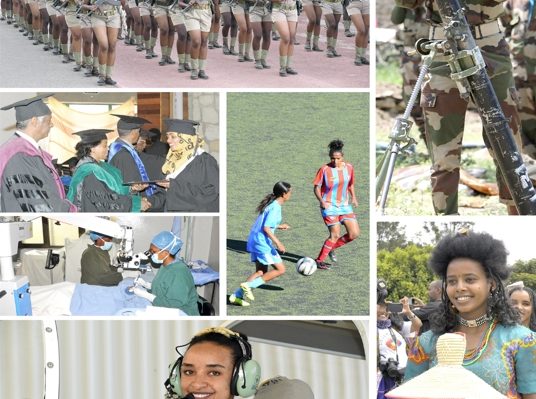
Women’s empowerment is essential to building an equitable, resilient, and prosperous society. In Eritrea, the advancement of women is deeply connected to the country’s struggle for independence and its subsequent efforts toward national development. At the forefront of this journey has been the National Union of Eritrean Women (NUEW), an organization that has worked for decades to expand women’s opportunities, promote gender equality, and strengthen their participation in public life. From the battlefields of the liberation struggle to today’s classrooms, workplaces, and communities, the NUEW has played an important role in advancing women’s rights and shaping Eritrea’s social, economic, and political landscape.
Established in 1979 with the support of the Eritrean People’s Liberation Front (EPLF), the NUEW emerged during a decisive period in Eritrea’s history. Its establishment reflected the recognition that women’s participation was indispensable to the liberation struggle and that national emancipation needed to be accompanied by social transformation. Beyond mobilizing women for independence, the organization helped raise awareness of gender equality and challenged traditional attitudes that restricted women’s roles and opportunities.
Eritrean women made remarkable contributions to the struggle for independence, serving in combat and assuming responsibilities in leadership, intelligence, logistics, education, and healthcare. Women constituted nearly one-third of the combatants, demonstrating exceptional courage and determination under difficult conditions. Their participation challenged entrenched social perceptions and established a powerful precedent for women’s involvement in national affairs.
Importantly, the experience of the liberation struggle helped transform attitudes toward women’s capabilities and responsibilities. Women demonstrated that they could contribute equally to the pursuit of national objectives, while the NUEW helped strengthen awareness of their rights and potential. This legacy continues to inform the organization’s mission and its commitment to ensuring that women are active participants in Eritrea’s development.
Following independence, the NUEW transitioned into an autonomous, non-governmental organization focused on improving the status of women and girls. Its priorities expanded to include education, economic empowerment, legal awareness, healthcare, and participation in decision-making. The central objective has remained consistent: enabling Eritrean women, regardless of their background or place of residence, to exercise their rights and contribute meaningfully to society.
Over the decades, the NUEW has broadened its membership and activities, establishing a presence in communities throughout Eritrea. Through its grassroots networks, the organization has worked to reach women in towns, villages, and remote areas, promoting awareness and encouraging participation in development initiatives. Its activities also extend beyond national borders through branches and chapters in Africa, Europe, North America, the Middle East, and Australia. These international networks help maintain connections among Eritrean women, facilitate the exchange of experiences, and support initiatives in Eritrea through fundraising, training, awareness campaigns, and other forms of cooperation. This international engagement reflects the shared commitment of Eritrean women at home and abroad to advancing equality and supporting national development. By connecting communities across geographical boundaries, the NUEW has sustained a broad network of participation and solidarity.
The NUEW’s work has focused on practical measures to improve women’s opportunities and address barriers to their advancement. Education and skills development have been central to these efforts. Through vocational and professional training initiatives, the organization has sought to strengthen women’s capabilities and improve their prospects for employment and self-employment. In collaboration with the Ministry of Education, it has also supported efforts to increase girls’ school enrolment and reduce illiteracy.
Legal awareness is another important component of its work. Through legal counselling services, the Union has helped women understand their rights and address issues relating to divorce, alimony, paternity, inheritance, and land ownership. These services provide valuable information to women navigating legal and social challenges, while wider awareness initiatives seek to counter discrimination and promote equal treatment.
The NUEW has also contributed to efforts to improve women’s health and well-being. Awareness campaigns have addressed women’s health concerns and harmful traditional practices, including female genital mutilation and child marriage. Such initiatives seek to protect girls’ health, promote informed decision-making, and encourage social attitudes that respect women’s dignity and rights.
Economic empowerment has remained equally important. Through microcredit programs, entrepreneurship training, and small-scale financial assistance, the organization has sought to help women establish income-generating activities and strengthen their financial independence. Access to finance and business skills can improve household livelihoods while enabling women to participate more actively in the economy.
Together, these initiatives reflect the interconnected nature of empowerment. Education strengthens knowledge and skills; legal awareness helps women understand their rights; healthcare supports well-being; and economic opportunities expand independence and participation.
Eritrea has recorded advances in several areas associated with women’s well-being and participation. Figures cited by national and international organizations indicate progress in financial inclusion, business activity, education, and representation. For example, life expectancy has risen from fewer than 50 years in 1991 to approximately 72 years. Women’s participation in the national microcredit and savings scheme has also increased significantly. According to national estimates, women account for approximately 56 percent of beneficiaries, compared with around 16 percent in 1995.
Women have also established a substantial presence in business and professional life. Available national figures indicate that they hold approximately 48 percent of business licences nationwide, constitute around 51 percent of the formal labour force, and occupy roughly 46 percent of managerial positions. Meanwhile, in terms of political representation, women account for approximately 22 percent of members of the National Assembly and 29 percent of members of the Regional Assemblies. These figures demonstrate women’s participation in public institutions while also highlighting the importance of continued efforts to expand their representation in leadership and decision-making.
The progress reflected in these indicators is associated with broader national development efforts, including initiatives to improve access to education, healthcare, financial services, and employment. The NUEW has contributed through advocacy, awareness-raising, capacity-building, and programs intended to connect women with opportunities and support.
Education remains one of the clearest indicators of progress toward gender equality. National figures cited in previous reports indicate that literacy among young women exceeds 93 percent, with the difference between female and male youth literacy estimated at approximately one percentage point. Gender parity has reportedly been achieved in middle-level education and is approaching completion at pre-primary and secondary levels. Enrolment in tertiary education has also moved closer to parity. These developments represent an important shift from earlier decades, when girls faced greater barriers to educational access.
Of note, progress in healthcare and social welfare has also contributed to improving women’s well-being. Government initiatives to expand access to essential services, together with the work of organizations such as the NUEW, have supported efforts to address harmful traditional practices and improve awareness of women’s rights and health.
Women’s access to land and financial services is another important dimension of empowerment. Equal legal rights to land, when effectively implemented, can strengthen women’s economic security and productive capacity. Similarly, access to credit and savings facilities can help women develop businesses, meet household needs, and pursue greater financial independence.
Of course, the improvements highlighted above do not automatically eliminate all obstacles. Social expectations, unequal access to resources, and differences in opportunities among communities can continue to affect women’s experiences. Sustained education, effective implementation of rights, and accessible support services remain important to consolidating progress.
Overall, the story of the NUEW is inseparable from the story of Eritrean women: their courage during the struggle for independence, their contributions to nation-building, and their continuing efforts to advance dignity, opportunity, and equality. Through its longstanding commitment to education, advocacy, and empowerment, the Union remains an important part of Eritrea’s ongoing journey toward a society in which women’s rights are respected, their capabilities recognized, and their contributions fully valued.
Fonte: Shabait