Compartilhar
CEMASTEA virtual labs training programme targets 7,000 junior school teachers
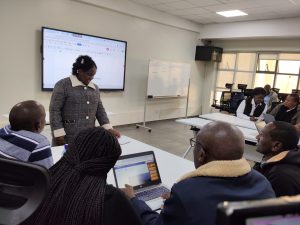
240 Junior School County Trainers from 47 counties have successfully completed a three-day intensive training on the use of virtual laboratories at the Centre for Mathematics, Science and Technology Education in Africa (CEMASTEA).
The training programme is aimed at enhancing the teaching and learning of Science, Technology, Engineering, and Mathematics (STEM) subjects in junior schools by equipping teachers with digital simulation capabilities to support their practical lessons, particularly in schools lacking physical laboratory facilities.
Speaking to media during the closing ceremony at CEMASTEA in Karen, Acting Director, STEM Training at CEMASTEA, John Livingstone Makanda, said the programme will equip teachers with digital simulation tools that enable practical learning even in schools lacking physical laboratory facilities.
Makanda said the programme seeks to bridge gaps in access to practical STEM learning by integrating technology into classroom teaching, ensuring learners acquire essential technical skills.
He noted that the initiative is designed to equip teachers with the knowledge and competencies needed to effectively use virtual laboratories in teaching, therefore enhancing their delivery and learning of STEM subjects.
“We are rolling out a massive training for junior school teachers; these virtual labs are simulations that will support our teachers to deliver practical lessons even in cases where they do not have physical laboratories,” he added.
Makanda explained that the initiative was informed by a study conducted by CEMASTEA and the Ministry of Education in 2023 and 2024, which established that many schools still face challenges in accessing adequate laboratory facilities.
“This is as a result of a study that we did as a centre together with the Ministry of Education in 2023 and 2024 that found that there is still a bit of a shortage of physical labs in the schools,” said Makanda.
He said the workshop, themed “Harnessing Virtual Labs for Effective Learning in STEM Subjects“, will equip trainers with cutting-edge digital tools and innovative teaching approaches designed to address resource shortages and enhance the delivery of STEM content in classrooms.
He added that 240 County Trainers will support the nationwide rollout of the virtual laboratories programme.
Makanda revealed that beginning next week, approximately 7,000 junior school teachers teaching STEM subjects will be trained countrywide to enhance their capacity to support learners through practical and technology-driven STEM instruction.
He also said the training is expected to improve access to quality teaching and learning resources while advancing digital literacy, which he noted is a key competency under the Competency-Based Curriculum (CBC).
“We believe this initiative will go a long way in addressing the shortage of teaching and learning resources in junior schools while enhancing digital literacy, which is one of the core competencies in the new curriculum,” he said.
Makanda noted that CEMASTEA continues to collaborate with key stakeholders in the education sector to support the effective implementation of competency-based education and strengthen teachers’ capacity to deliver STEM subjects.
He also highlighted encouraging progress in learner participation, noting that enrolment in the STEM pathway at the junior school level has surpassed 50 per cent.
“The enrolment of learners in the STEM pathway in the junior school has also been quite good; more than 50 per cent of them are enrolled in the STEM pathway,” he revealed.
“To us, that is a significant achievement and an indication that the country is on the right trajectory in popularising STEM subjects among learners,” he said.
He further cited ongoing support from the Information and Communication Technology Authority (ICTA), which is providing schools with smart screens and other digital resources.
“These resources will support this initiative and help us reach every school, every STEM teacher and every learner in the STEM classroom,” he said.
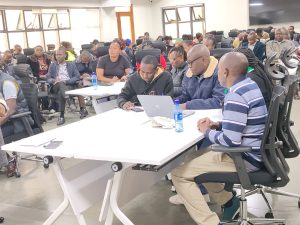
Participants expressed optimism that the initiative will strengthen STEM education, as it will provide practical and interactive learning experiences in classrooms.
James Ondieki Ratemo, a County Trainer from Nyamira County, described the programme as transformative, noting that the training exposed participants to new innovations and digital skills.
Ondieki noted that the 240 trainers who attended the workshop will begin cascading the training to teachers in their respective counties from next week.
“From this training, we will now be cascading to our counties and meeting junior school teachers. The virtual labs will help us address the challenge of inadequate resources while improving the teaching and learning of STEM subjects,” he said.
He added that the initiative will increase student participation in STEM pathways.
“With virtual labs, you can address a huge number of learners with ease,” he said.
“Going forward, we may still require more funding so that schools can acquire the necessary gadgets.”
On the other hand, Zaituni Ali, a trainer from Mombasa County, said the virtual laboratory initiative would help bridge the gap caused by limited learning resources in schools.
“We are optimistic that the programme will empower teachers and bring resources virtually, helping bridge the gap caused by limited infrastructure.”
By Ian Chepkuto
Fonte: Kenya News