Compartilhar
Eritrea and The Legacy of Archaeological Research
Archaeological research illustrates that early humans first migrated out of Africa into Asia approximately 2 million years ago, reaching Europe between 1.5 and 1 million years ago. Modern humans (Homo sapiens) populated the rest of the world much later — reaching Australia roughly 60,000 years ago and the Americas approximately 30,000 years ago. Because evidence of human origins older than 2 million years is found exclusively in Africa, the continent is rightly celebrated as the ‘Cradle of Humanity.’
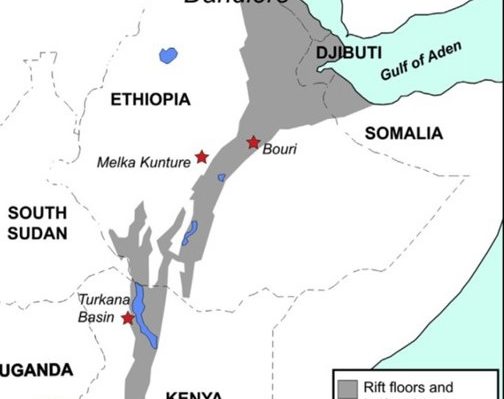
Most evidence regarding human evolution is found along the East African Rift Valley, a massive geological trench formed by the separation of the Nubian and Somalian tectonic plates.
The Eritrean portion of the Rift Valley has provided unparalleled evidence of our ancestors. The now-harsh Danakil Depression was a hospitable home to our predecessors roughly 1 million years ago.
Eritrea’s ancient history is remarkably complex, shaped by its geostrategy, diverse landscapes, and favorable habitats within the Horn of Africa. With over 1,200 kilometers of Red Sea coastline, the country spans arid lowlands and fertile highland escarpments. This region has been a magnet for life for millions of years; for instance, the area attracted large mammals from the Arabian Peninsula nearly 27 million years ago — a period of evolutionary history that remains largely mysterious to science.
The Eritrean Danakil Depression
Located within the Afar Triangle, the Danakil Depression is a geological ‘V-shaped’ basin. It is one of the hottest places on Earth, with temperatures often reaching 125°F (50°C). Despite its current desert scrubland biome, it hosts a resilient wildlife population, including the last viable population of the African wild ass.
The Engel Ela-Ramud basin (launched in 2012 as part of a joint Eritrean-Spanish research initiative) is located at the northernmost end of the Eastern African Rift Valley. It is crucial for understanding the Pliocene and Pleistocene eras. Located less than 500 km from where the famous “Lucy” (Australopithecus afarensis) fossil was found in Ethiopia, this site contains stone tools from the Oldowan and Acheulian periods. Discoveries of fossilized pigs, tree trunks, and other artifacts suggest that the site may contain records dating back much earlier than the Buia site, a critical window for human evolution.
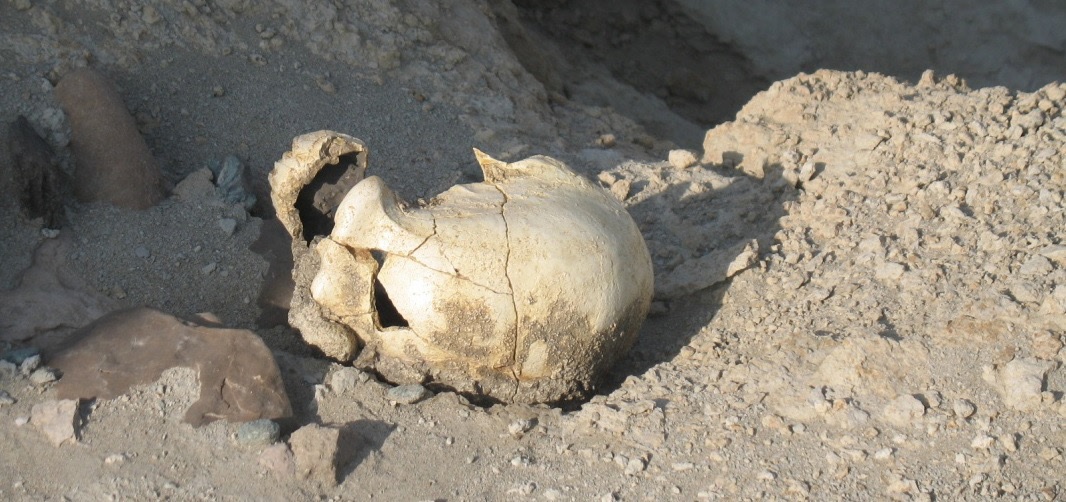
The Buia Project and ‘Mis Buia’
Launched in 1994 as a joint Eritrean-Italian venture, the Buia Project achieved a massive scientific breakthrough in 1995 with the discovery of a nearly complete human cranium near Mountain Aalad. The ‘Buia Lady’ (nicknamed Mis Buia or Hawa/Eve) is approximately 1 million years old. This human fossil is exceptionally significant because it fills a ‘morphological gap’ in the fossil record between Homo erectus (1.4 million years ago) and Homo heidelbergensis (0.65 million years ago). The site revealed that humans lived alongside diverse wildlife in a lush, savannah-like environment, despite the era’s unstable climate.
Survival on the Red Sea Coast
Around 125,000 years ago, modern humans (Homo sapiens) began adapting to the maritime environments of the Red Sea. Sites such as Abdur and the sites within the Buri Peninsula show evidence of Middle and Late Stone Age tools found in association with marine shells.
This transition proves that our ancestors moved from inland savannahs to the coast, incorporating seafood into their diets. These coastal habitats were likely instrumental in the survival, sedentary transition, and eventual global dispersal of the human race. Today, Eritrea’s landscape stands as a well-documented archive of the journey our ancestors took millions of years ago.
Fonte: Shabait