Compartilhar
“Eritrea is Unapologetically Itself!” A Conversation with Michael B. Decker
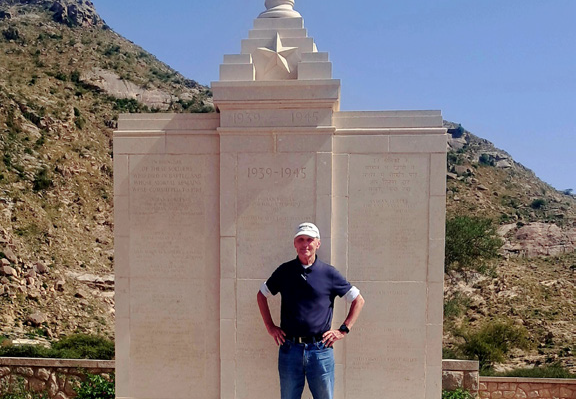
Michael B. Decker is no ordinary traveler. With a passport stamped in 185 countries, he has traversed the globe, immersing himself in cultures, histories, and landscapes that most only dream of exploring. A historian by passion and an explorer by nature, Decker comes from a lineage deeply intertwined with pivotal global events, including the American Revolutionary War and World War I. This family heritage has shaped his profound appreciation for legacies of conflict, resilience, and identity.
For Decker, travel is not merely about ticking off destinations; it is about connecting with people, architecture, and untold human stories. Recently, he added Eritrea to his extensive list, spending two enriching days exploring Asmara and Keren. In his interview, Decker shares his impressions, emotions, and reflections on his brief yet impactful visit.
- Tell us a little about yourself and your background.
I’m originally from Dallas, Texas, and much of my career has been spent in private equity, investing in diverse private companies, including serving on the investor group behind Wells Fargo.
Today, I serve as Advisory Board Chair for the Carr Center for Human Rights Policy at Harvard University. Earlier in my career, I was CEO of the Trammell Crow Company, where I led the restructuring of what was then the largest real estate firm in the U.S., and before that, President of Huffco Group, Inc. My earlier roles included management consulting at The Boston Consulting Group and serving as an Investment Officer at the World Bank.
Academically, I hold an MBA from Harvard Business School, an MA from Oxford University, and an AB from Princeton University. Beyond business, I’ve long been engaged in policy and education— serving on the Dallas Committee on Foreign Relations, supporting medical research initiatives, and teaching Creative Writing as an Adjunct Professor at Southern Methodist University (SMU). My wife, Debra, and I have three children—Josephine, Emily, and Matthew—and five grandchildren who keep life wonderfully full.
- You have traveled to so many countries. What first inspired this passion for world travel?
My journey began with my first role at the World Bank. In my very first year, I insisted on doing fieldwork—something rarely granted to newcomers. My persistence paid off, and I was sent to Somalia, based out of Nairobi, followed by an assignment in Tanzania. Those early experiences ignited my passion for global exploration.
I found myself deeply energized by meeting new people, discovering new places, and observing how communities navigate their daily lives. Even when people didn’t hold a Harvard degree—or any degree at all— they were rich in life experience, resilience, and resourcefulness. That realization taught me how much there is to learn beyond formal classrooms. From then on, I became determined to travel to every corner of the globe, absorb its lessons, and eventually write a book sharing these insights with travel enthusiasts—and perhaps even more importantly, with those hesitant to see the world in its true colors.
- You began your Eritrean journey in Asmara. What were your first impressions of the capital?
Asmara is unlike any other African capital. Stepping into the city felt like entering a living time capsule of early 20th-century Italian modernist and Art Deco architecture. The buildings are remarkably preserved—each façade tells a story of a bygone era. The Fiat Tagliero Building, with its futuristic airplane-wing design, was a personal highlight. It is rare to see such architectural integrity maintained so beautifully across an entire city.
- What was your impression of the Eritrean people during your interactions?
I was deeply moved. The people were so comfortable in their identity—proud, confident, and genuinely welcoming. As I mentioned to someone during my walk: “They take pride in who they are, and that pride gives them confidence as individuals and as a community.” It is rare to see such seamless harmony between personal and collective identity. There is a quiet dignity in how Eritreans carry themselves, and it is contagious.
- Did you notice how this sense of identity connects to the city’s day-to-day atmosphere?
Absolutely. Asmara’s streets reflect that exact confidence. The cafés are lively, the markets are orderly, and even the simplest greetings carry warmth. There is a distinct rhythm to the city—a balance between tranquility and vibrancy. It isn’t a place rushing unthinkingly toward modernity; it is a place that has already defined its own version of it.
- Were there any particular moments in Asmara that stood out to you?
Sitting at Café Roma, sipping a macchiato while watching Asmarinos go about their day, was surreal. The city has an effortless rhythm—a blend of African warmth and Italian dolce far niente (the sweetness of doing nothing). I honestly don’t know why Eritrea isn’t officially dubbed the “macchiato capital,” because the coffee culture here is world-class.
I was also invited into a local family’s home for dinner and coffee, which was a tremendous experience. It felt like being welcomed by a second family in another universe. The traditional coffee ceremony, complete with its array of snacks, was irresistible. To become better acquainted with injera—the slightly sour flatbread I saw everyone enjoying—I was encouraged to bake one myself. I normally don’t cook (I often joke that I try to spare people from my culinary attempts), but I made an exception. Pouring the fermented teff batter in a smooth spiral onto the hot clay oven was the easy part; the real challenge was coaxing the bread off the surface. More than once, I found myself jokingly ordering it to jump off the oven on its own!
- Moving on to your second day—Keren is known for its rich history. What was your experience there?
Keren was profoundly emotional. I visited the Shrine of Our Lady of Keren, built inside a massive baobab tree—a remarkable fusion of faith, history, and nature. It is one of those sacred places that makes you pause and reflect.
I also visited the Italian and Commonwealth war cemeteries, which commemorate those who fought during World War II. Coming from a family with generations who served in conflicts from the American Revolutionary War to World War I, I felt a deep personal connection. Standing among those graves reminded me of the universal cost of conflict. It is humbling to see how respectfully and serenely Eritrea maintains those sites.
- You’ve seen many war memorials around the world. How did Keren’s compare?
They carry a unique stillness. Many memorials elsewhere are grand and monumental, but Keren’s are quiet and intimate. You can feel the individual human stories behind each name. The landscape itself—the surrounding hills and the quiet air—adds to the solemnity. It isn’t about glorifying war; it is about remembering humanity. Eritrea’s approach to remembrance is deeply humane.
- Did visiting Keren alter your perspective on Eritrea’s place in global history?
It did. Eritrea’s history is often presented predominantly through the lens of struggle, but what I witnessed was resilience. The country has endured immense challenges, yet it preserves its dignity and heritage. Keren, in particular, demonstrates how memory and identity coexist—how a nation can honor its past without being trapped by it.
- How would you compare the atmosphere of Keren to that of Asmara?
Keren has a raw, untamed beauty. The landscape feels different, and the atmosphere is even more laid-back. The local market was vibrant filled with spices, colorful fabrics, and the scent of fresh bread. What stayed with me most was the juxtaposition of spirituality and historical memory. That baobab tree shrine, for instance, is a living monument—a true synthesis of nature and faith.
- What message would you share with fellow travelers considering a visit to Eritrea?
Come with open curiosity and respect. Eritrea is not a place to rush through; it is a destination to absorb. Walk its streets, talk to its people, and listen to its stories. You will leave with far more than souvenirs—you will leave with a new perspective.
- Finally, how would you summarize your impression of Eritrea in a single sentence?
It doesn’t cater to tourist clichés or manufactured attractions. You won’t find artificial resorts or contrived cultural performances. Instead, it is a nation where history and identity walk hand in hand, offering travelers a rare, authentic glimpse into a truly remarkable culture.
Fonte: Shabait