Compartilhar
Eritrean Iconic Beauty Captured in a Smile
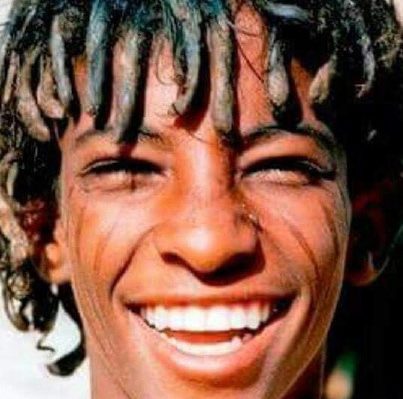
In 1965, American photojournalist James P. Blair captured one of the most widely circulated, deeply beloved, and fiercely contested images in the modern history of the Horn of Africa. The photograph was taken in Tessenei, a vibrant border town in the Gash-Barka region of Eritrea, during an assignment for National Geographic.
Blair’s camera met the eyes of a young boy whose radiant, pearly-white smile captivated hearts worldwide and came to define Eritrean warmth and beauty. The photograph captured a striking portrait of traditional identity: a brilliant, natural smile balanced by distinct facial markings and a meticulously crafted hairstyle.
The young boy’s hair grew into a dense, cloud-like crown on top, framed by tightly coiled ringlets along the jawline. His cheeks bore vertical incisions— traditional scarification serving as a rite of passage, a marker of clan lineage, and a symbol of aesthetic heritage.
That boy was Omar Muhammad Idris Haji Ali Goret. His image traveled across the globe, mirroring Eritrea’s renowned hospitality, resilience, and the core national value of “unity in diversity.”
Hospitality, Resilience, and Heritage
A genuine smile is the foundation of exceptional hospitality. Transcending language barriers, it diffuses tension and creates an approachable environment. Omar’s sparkling smile manifested the very spirit of welcome for which Eritreans are widely praised.
The image resonates deeply because it reflects common cultural traits found across Eritrea’s nine ethnic groups. For instance, those in the Bidawyet/ Hedareb ethnic group carve three prominent vertical or horizontal parallel slits onto the cheeks to highlight tribal identity, clan lineage, aesthetic beauty, and rites of passage. In the Tigrinya group, small and subtle parallel vertical slits are carved onto the temples or next to the outer edge of the eyebrows; these are believed to serve as a folk-medical remedy to prevent eye infections and act as a regional cultural marker.
In the Afar ethnic group, intricate geometrical patterns are cut into the cheeks or forehead to mark a rite of passage signaling maturity, bravery, and ancestral lineage. Among the Nara, thick and prominent vertical or horizontal parallel cuts on the cheeks serve as vital markers of tribal identity and clan lineage. In Bilen (Blin) culture, facial tattooing (called Nishani) on the chin, neck, or lower jaw is used by women to show aesthetic beauty and marital status, while small incisions are made on the temples of children to prevent eye ailments.
Among the Tigre, three vertical parallel slits are sliced onto both cheeks during infancy for tribal identification and as a traditional medical treatment to relieve facial swelling and infections. The Kunama generally do not practice facial scarification for tribal identity, relying instead on distinct hairstyles, body jewelry, and cultural body modification. In Saho culture, small, subtle vertical incisions are located near the temples or at the outer edge of the eyebrows, used almost entirely as a preventive folk-medical remedy for eye health and headaches.
Distinctly, the Rashaida ethnic group has no facial markings; the practice is strictly forbidden by cultural taboo, with aesthetic expression focused instead on the intricate, heavily embroidered veil.
The Art and Science of Scarification
Globally, facial marking was once a widely practiced cultural tradition across diverse societies. Scientifically called scarification, it is a form of permanent body modification that involves cutting or burning a pattern or design onto the skin.
Traditionally, within indigenous cultures, people performed scarification for ritualistic purposes, such as rites of passage or preparing children for adulthood. The procedure often involved using a wooden hook, thorn, or razor blade on the skin to create a design. Practitioners would sometimes pack the wound with ash or mud to prevent clean healing, thereby creating a deeper, raised scar.
Today, scarification is less common among indigenous communities as traditional practices gradually decline. However, it remains preserved in select cultures as a way to reconnect with ancient heritage. Medically, scarification carries a high risk of infection due to the historical use of unsterile equipment.
A Symbol of National Fortitude
When Blair took the photo, the Eritrean armed struggle had already begun. The Eritrean lowlands, where Blair met Omar, served as the cradle of the revolution. Because the Eritrean people were enduring colonial oppression, Omar’s image came to symbolize unbreakable national resilience.
Bright, sparkling smiles that shine through difficult situations evoke profound admiration. We often expect smiles only in moments of joy, yet in Eritrea, a smile also emerges during hardship as an emblem of fortitude—a cherished national value nurtured across generations. Consequently, it became a familiar sight during the Eritrean armed struggle to see freedom fighters sharing captivating smiles amid severe adversity.
In an era where maintaining dental health is more crucial than ever, Omar’s image holds unique cultural and aesthetic significance. It offers a powerful reminder of nature’s inherent beauty and the timeless elegance of a healthy smile.
Unfortunately, Omar never saw his image become iconic during his lifetime. He passed away in 1981, a decade before national liberation. Though his physical body has returned to the earth, his image—alongside other historic photographs—remains an enduring symbol of Eritrean national identity.
Finally, digital historians, grassroots artists, and cultural advocates should continue working tirelessly to collect, preserve, study, and share these valuable archives. These efforts will help counter external misrepresentations and firmly place Eritrea’s timeless beauty in its rightful global frame.
Fonte: Shabait