Compartilhar
Exclusive Q&A: ‘We Consider Eritrea a Pillar of Stability’; Egypt’s Foreign Minister, Dr. Badr Abdellaty
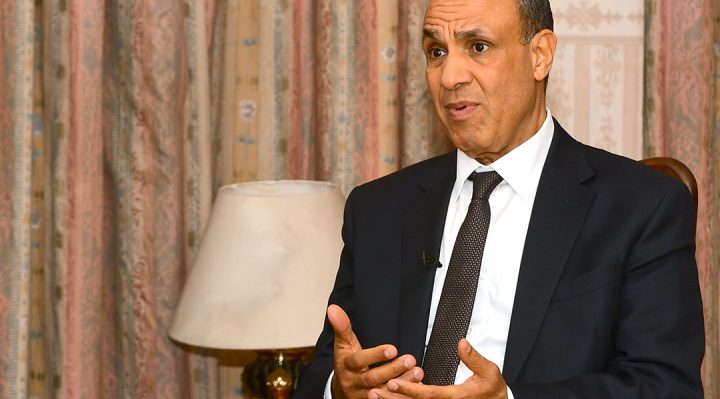
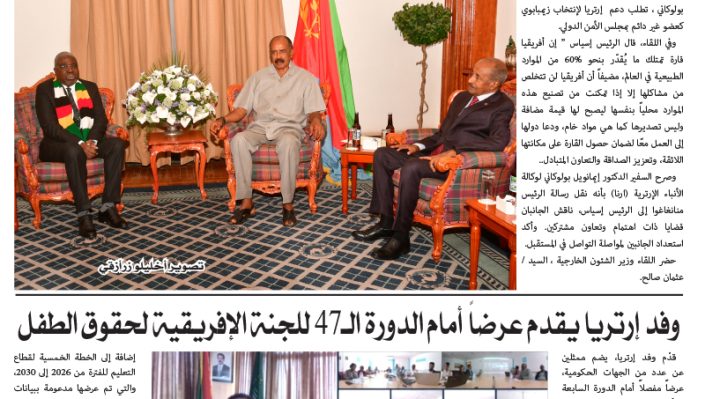
A senior Egyptian delegation led by Foreign Minister Dr. Badr Abdelatty, along with Egypt’s Minister of Transport and CEOs from key transport, energy, and mining sectors, visited Eritrea on the weekend and held discussions at the Denden Guest House with President Isaias Afwerki. The talks focused on deepening all-rounded bilateral ties and shared regional and international issues. On that occasion, the two sides also signed a Maritime Transport Agreement to develop cooperation in the shipping sector. Eri-TV’s Salahadin Hussien sat down with Egypt’s Foreign Minister to unpack the outcome of the visit, the vision for bilateral economic collaboration, and the broader regional implications. Excerpts follow.
* * *
Q. To begin with, can you tell us about the purpose of the visit and its role in strengthening the historic bilateral relations between Eritrea and Egypt?
I am very happy to be here in my second home, the sisterly State of Eritrea. I am here on the direct instructions of His Excellency President Abdel Fattah El-Sisi, within the framework of continuous communication with Eritrea, to demonstrate our full solidarity and to work towards a qualitative leap in bilateral relations. This is especially important in light of the directives issued by President El-Sisi and President Isaias Afwerki to strengthen relations, particularly in specialized and commercial fields, in addition to ongoing consultations with my brother, Foreign Minister Osman Saleh, regarding regional issues in the Horn of Africa.
This visit comes amidst several important occasions, most notably the approaching celebration of the 35th Anniversary of Eritrea’s Independence. Heartfelt congratulations on this auspicious occasion. I am carrying a message from President El-Sisi to his brother President Isaias – a message of empathy, brotherhood, friendship, support, and solidarity. The visit also comes at a delicate time given escalating threats. Egypt and Eritrea live in a turbulent region, both in the Horn of Africa and the Middle East. We consider Eritrea a pillar of security and stability in the Horn of Africa. Therefore, there is a strong Egyptian leadership commitment to further consolidate relations between our two countries.
I was honored to have a very important meeting lasting over an hour and a half with President Isaias. We thank him for his generosity. There was a convergence of views and a clear political will from both leaderships to enhance relations in all fields. I am accompanied by a large delegation including the Egyptian Minister of Transport and more than eight Egyptian companies operating in agriculture, mining, manufacturing, pharmaceuticals, and maritime transport. We benefited greatly from President Isaias’s wise vision regarding industrial relations, economic cooperation, and the region’s future. I conveyed President El-Sisi’s verbal message and an official invitation for President Isaias to visit Egypt, which His Excellency graciously accepted.
Q.That leads us to the Agreement signed during this visit. What role will it play in enhancing cooperation between Eritrea and Egypt and in implementing joint projects?
Indeed, God willing, this will begin a major effort to link Egyptian and Eritrean ports and establish direct shipping lines, boosting trade and economic cooperation. The Agreement was signed in the presence of President Afwerki, sending a clear message of political commitment in both countries.
Also, as I mentioned, a delegation from major Egyptian companies is here, including two of the largest in Africa: Arab Contractors and Elsewedy Electric. These companies have built projects across Africa, including the Julius Nyerere Dam in Tanzania – a massive dam generating 600 megawatts with a storage capacity of 42 billion cubic meters of water, constructed using purely Egyptian technology without Western reliance. Technology transfer and vocational training programs have been facilitated. Other companies in the mining sector have also joined us.
I want to emphasize an important point: these Egyptian companies are not here merely for temporary commercial deals, but to invest and remain in Eritrea. This is due, firstly, to the modernization plan led by President El-Sisi, and secondly, to the favorable environment and full support from President Isaias, who stated his full support for Egyptian companies in mining, pharmaceuticals, construction, electricity, and irrigation. God willing, there will be tangible results in the coming period with Egyptian investments entering the Eritrean market, alongside new financing and development models based on mutual gain, knowledge transfer, and technical education.
Q. Excellency, both Eritrea and Egypt are Red Sea basin states. What cooperative mechanisms exist between them and other basin countries to maintain the sea’s security and stability, harvest the benefits that accrue from its resources, and make use of this vital strategic corridor?
I have already addressed this issue. During my meeting with President Isaias, the issue was very important. There is a strong alignment between Egyptian and Eritrean viewpoints that all matters related to the governance and security of the Red Sea and the Gulf of Aden are solely the responsibility of the littoral states. This is crystal clear and non-negotiable.
Discussions are currently underway among the littoral states – particularly with Saudi Arabia, Eritrea, Egypt, Jordan, Yemen, and Somalia – to activate the Council of Arab and African States Bordering the Red Sea and the Gulf of Aden. The focus is on activating this council as quickly as possible to ensure that governance and security of the Red Sea are a reality, not just rhetoric. This necessitates activating the council’s mechanisms, which will be headquartered in Saudi Arabia. There are clear visions for linking ports and fostering logistical cooperation among Red Sea ports of the littoral states. Security, too, must be the sole responsibility of the littoral states and no other parties. This is a clear and non-negotiable point.
Q. You mentioned that fate has placed Eritrea and Egypt in this volatile region – the Horn of Africa and East Africa – which witnesses many conflicts and instabilities. What joint efforts are being made to resolve these problems and achieve security and stability in the region?
Firstly, we view Eritrea as a fundamental pillar of stability in this troubled region, the Horn of Africa. We admire President Isaias’s wisdom in managing relations with a high degree of tact, balance, and de-escalation. Secondly, there is a shared vision between the two Presidents regarding managing relations in the Red Sea and Horn of Africa. We manage these relations based on dialogue, focusing on improving living standards, enhancing economic and technical cooperation, and avoiding military escalation or rash adventures with unpredictable consequences. We cannot afford such situations; we already have more than enough problems.
We must focus on dialogue, de-escalation, and promoting peaceful solutions. With political will and a shared vision, we can achieve a great deal. In addition to the Council of Red Sea States, there is the Egyptian Stream Initiative, on which we are cooperating with Eritrea and other Red Sea countries regarding environmental cooperation, maritime rescue, logistics, and port connectivity. This is what we need, far removed from any military adventures by parties seeking hegemony and control. Such adventures are unacceptable. We must focus on our commonalities, shared goals, and shared destiny to enhance economic and trade cooperation.
Q. The Middle East and Gulf region are going through a very difficult period due to the war between the US and Israel on one side and Iran on the other. In your opinion, what viable vision do you see for resolving this crisis and achieving security and stability?
The vision is clear and must be based on a set of general governing principles. First, there are no military solutions to this problem. We must focus on dialogue and peaceful solutions. We have witnessed more than forty days of fighting, and it has not achieved anything. Therefore, we are working to de-escalate and promote dialogue. Second, respecting the principle of good neighborliness is paramount – refraining from aggression, respecting the sovereignty, unity, and territorial integrity of states, and non-interference in internal affairs. These are established principles in international law and the UN Charter.
We are now pushing for mediation and dialogue, encouraging the Iranian and American sides to sit at the negotiating table directly. There is a document to negotiate, commonalities, and some outstanding issues. But with goodwill and political will, we are confident a consensus can be reached. Once again, we condemn anything targeting our brothers in the Gulf Arab states, and we reject any armed aggression or interference in internal affairs. If states want to address regional security frameworks, they must avoid hegemony, whether by Israel or any other regional party. Dialogue must be the only means to resolve differences. Good neighborliness and non-interference should be the guiding principles, especially between Iran and the Gulf states. It is necessary to stop aggression and interference in the Gulf states’ internal affairs and respect their legitimate security concerns.
Q. Your Excellency, this visit to Eritrea comes as Eritrea celebrates its 35th Independence Anniversary. Do you have any words or a message you would like to convey to the people and government of Eritrea on this occasion?
We extend our heartfelt congratulations and blessings from the Egyptian leadership, people, and government to the wise Eritrean leadership, the brotherly Eritrean people, and the State of Eritrea on this auspicious occasion – 35 years since the cherished achievement of independence in 1991. We appreciate all the achievements realized under the wise leadership of President Isaias Afwerki. The climate of security, stability, and development that Eritrea enjoys amidst this highly turbulent regional environment reflects the wisdom of the Eritrean leadership. We wish the brotherly Eritrean people continued progress, prosperity, and stability.
We also reaffirm Egypt’s unwavering commitment to strengthening bilateral cooperation between our two countries and brotherly peoples, based on shared interests and mutual benefit. Given the long-standing ties and bonds between us, and with the political will of our wise leaders, President Sisi and President Isaias, we can achieve much more. We look forward to President Isaias’s gracious visit to his second home, Egypt, in the near future.
Thank you, Dr. Badr Abdelatty.
Fonte: Shabait