Compartilhar
Farmers encouraged to embrace beekeeping for food security and income
The Government is intensifying efforts to promote beekeeping as a key economic activity aimed at improving household incomes, enhancing food security, and increasing Kenya’s honey exports to premium international markets.
Speaking during the World Bee Day celebrations held in Mombasa County, Principal Secretary (PS) for Livestock Development, Jonathan Mueke, said the government is stepping up efforts to transform beekeeping into a major economic activity capable of boosting rural incomes, empowering women and youth, and increasing exports to international markets, such as Europe.
The celebrations were held under the global theme, “Bee Together for People and the Planet—A Partnership that Sustains Us All,” which highlighted the critical relationship between people and pollinators in sustaining food systems, biodiversity, and environmental health.
Mueke noted that beekeeping is among the few economic activities that provide opportunities for men, women, and youth at the grassroots level due to its low start-up costs and accessibility.
He said bees play a critical role in impacting crop production, nutrition security, and ecosystem balance, making their protection essential for sustainable food systems.
Mueke identified Kitui, Baringo, Taita Taveta, and Tana River counties among the leading honey producers in the country and encouraged more Kenyans to venture into beekeeping since it can be practised even within homesteads.
The PS said the government has continued to support the sector through subsidized beehives, training programmes and collaboration with partners and the State Department of Forestry to establish hives in forest ecosystems where bees thrive best.
“We have also strengthened the National Beekeeping Institute, which offers short courses on modern beekeeping, hive management and value addition through products such as beeswax, lotions, soaps, and medicinal products,” he said.
Mueke added that the government has developed a residue monitoring plan to ensure Kenyan honey meets international export standards, particularly for the European market where demand for quality honey remains high.
“Our aim is not only to produce honey here in Kenya but also to produce high-quality honey that can be exported to premium markets such as Europe, where there is high demand,” said the PS, adding, “This will help our farmers earn more income and improve their livelihoods.”
According to the PS, the government has nearly doubled the budget allocation to the National Beekeeping Institute in the coming Financial Year due to increasing demand for training.
The celebrations also featured tree-planting activities at Ronald Ngala Comprehensive Primary School in Mombasa aimed at supporting pollination and environmental conservation while sensitizing learners on the importance of bees.
The PS emphasized the importance of involving learners in environmental conservation efforts, as schools remain key platforms for shaping awareness among the younger generation
Food and Agriculture Organization (FAO) Representative to Kenya Farayi Zimudzi underscored the important role bees play in food production and environmental conservation.
“Without bees, we would not have enough food because bees are essential in pollinating food crops and trees,” she said.
Zimudzi noted that apart from honey production, bee products such as bee venom and beeswax have economic value in medicinal and cosmetic industries.
She called for the protection of bees through environmentally friendly farming practices, warning that excessive use of harmful chemicals on farms threatens bee populations and food security.
“We need to protect our bees and our environment because if we fail to do so, at some point we may not produce enough food to feed ourselves,” she said.
Mombasa County Executive Committee Member for Agriculture, Livestock, and Blue Economy, Ibrahim Khamis, said the event emphasized the important role bees and other pollinators play in keeping both people and the planet healthy, while also drawing attention to the growing challenges threatening their survival.
Khamis called for increased efforts to improve the abundance and diversity of pollinators while supporting sustainable beekeeping practices.
He noted that residents and youth in the County can embrace beekeeping as an opportunity to create jobs and improve their livelihoods.
Biovision Africa Trust Interim Executive Director, Fredrick Ochieng, said bees play a critical role in pollination, contributing significantly to agricultural productivity and biodiversity conservation.
Ochieng added that through empowering farmers, women and youth in apiculture, stakeholders continue to support biodiversity conservation and resilient livelihoods
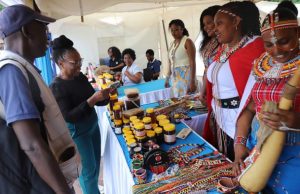
He said that as part of the celebrations, the Organization supported local farmers to showcase and exhibit a variety of bee products, providing a platform to promote local innovations, market access, knowledge sharing, and the economic potential of beekeeping.
“We must continue working together to conserve bees and ensure sustainability in our food production systems,” he said, adding that the LDF project in Kitui implemented by Biovision Africa Trust is strengthening climate resilience through agro-ecology, with beekeeping as a key enterprise.
He said that the project is currently working with 180 farmers, primarily organized in groups primarily women and youth, as key drivers of implementation and sustainability
Ochieng urged communities to adopt agroecology and environmentally friendly farming methods and conserve natural ecosystems to ensure the survival of pollinators that are critical to agricultural production and sustainable development.
Apiculture Platform of Kenya Chairman, Robin Mbae, said this year’s World Bee Day celebrations in Mombasa attracted more than 40 stakeholders drawn from institutions, cooperatives, corporations, and financial organizations involved in the beekeeping value chain.
Mbae said the Organization works closely with stakeholders to build capacity, support beekeeping enterprises and train farmers across the country.
World Bee Day, observed annually on May 20, provides an opportunity for governments, organizations, farmers, civil society, and citizens to promote actions aimed at protecting pollinators and their habitats, improve their abundance and diversity, and support sustainable beekeeping practices.
The event brought together stakeholders from the national and county governments, development partners, financial institutions, cooperatives, and beekeeping associations.
By Anita Omwenga
Fonte: Kenya News