Compartilhar
JAPAN STEPS IN WITH M20m TO FEED MORE THAN 50,000 PRE-PRIMARY LEARNERS IN LESOTHO.
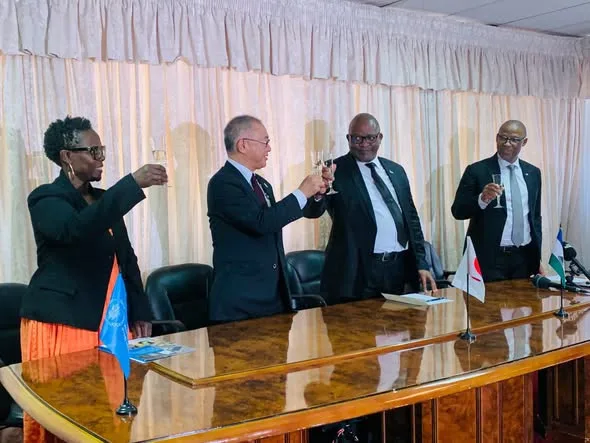
More than 50,000 pre-primary learners across Lesotho are expected to receive nutritious school meals in 2027 following a M20 million contribution from the government of Japan towards the country’s school feeding programme.
The assistance, provided through the World Food Programme (WFP), will consist of 81 metric tonnes of canned fish, 400 metric tonnes of fortified maize meal and 30 metric tonnes of pulses.
The agreement was formalised through an Exchange of Notes signed in Maseru.
Speaking at the ceremony, minister of foreign affairs and international relations, Honourable Limpho Tau, said the assistance would help address food insecurity among children, particularly as climate change, recurrent droughts and changing rainfall patterns continue to affect agricultural production and household food supplies.
He said the contribution followed a similar agreement signed on 31 July 2025, under which Japan provided 200 million Japanese yen, equivalent to approximately M20.7 million, to support food assistance for 50,000 pre-primary learners through the WFP.
He proposed regular bilateral discussions to identify development priorities and improve the implementation of joint projects, adding that his government is keen to strengthen cooperation in agriculture, climate resilience, health, infrastructure, trade and investment.
The Ambassador of Japan to Lesotho, His Excellency Shimizu Fumio, said the initiative, titled Food and Nutrition Assistance to Pre-primary School Children, went beyond addressing hunger, as nutritional security was fundamental to a child’s development, learning, growth and full participation in school and community life.
He noted that the food assistance project had been extended annually since 1982, reflecting more than four decades of partnership between Japan and Lesotho.
Meanwhile, WFP Country Director, Ms Anna Mukiibi-Bunnya, said school feeding was essential in addressing child hunger and improving access to education.
She said findings from the organisation’s school feeding programme showed that more than four in ten children arrive at early childhood care and development centres without having eaten at home. For many, the meal provided at school is their first of the day.
Ms Mukiibi-Bunnya said school meals improve attendance, strengthen learning outcomes and help children concentrate in class. She added that the latest contribution would improve dietary diversity and support children’s growth and development.
She said Japan had contributed more than one billion Japanese yen, equivalent to M343.6 million, towards food security and nutrition in Lesotho since 2014. The WFP also highlighted the importance of sourcing food locally, saying demand from schools provides opportunities for local farmers and supports the agricultural economy.
Meanwhile, Minister of Education and Training, Professor Ntoi Rapapa, thanked Japan for its continued support and stressed the need to ensure that the food reaches its intended beneficiaries.
Professor Rapapa also highlighted Japan’s contribution to inclusive education, saying it was providing M160 million to support four high schools with large numbers of learners with disabilities.
The continued partnership is expected to strengthen efforts to improve child nutrition and support access to early childhood education across Lesotho.
Source: Lesotho News Agency [LENA]
Fonte: Gov