Compartilhar
Kenya pledges support for flower industry as IFTEX 2026 opens
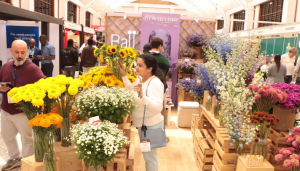
The government has reaffirmed its commitment to addressing challenges facing the floriculture sector.
This includes high air freight costs, delayed VAT refunds, and regulatory burdens to enhance Kenya’s competitiveness in global markets.
Speaking on Wednesday during the opening of the 13th International Flower Trade Exhibition (IFTEX) 2026 in Nairobi, Trade and Investments Cabinet Secretary Lee Kinyanjui said the floriculture industry remains a strategic sector under the government’s economic transformation agenda.
Kinyanjui noted that the sector generates about Sh110 billion annually in export earnings, employs more than 200,000 people directly, and supports millions of livelihoods across the country, remaining as Africa’s largest flower exporter, especially of roses.
“The government is engaging relevant institutions to improve VAT refund efficiency, streamline regulations, strengthen logistics infrastructure, and expand market access opportunities for Kenyan products,” the CS promised.
He urged international buyers and trade partners to support sustainable pricing, noting that Kenyan flower farms have made significant investments in renewable energy, water conservation, biodiversity protection, and worker welfare programs.
Kinyanjui expressed optimism about the future of the industry, saying growth will be driven by innovation, sustainability, value addition, technology, and market diversification.
Head of the Trade Section at the EU Delegation to Kenya, Fillipo Amato reaffirmed the EU’s commitment to strengthening trade and investment ties with Kenya, citing the country’s floriculture sector as a key pillar of the partnership.
He termed Kenya’s flower industry as a major success story, noting that the country supplies over 40 percent of flowers imported into the European Union, and its largest market is valued at more than €500 million annually.
Amato attributed this growth to cooperation between government, private sector players, and international partners, adding that the EU continues to support the sector through the Economic Partnership Agreement, which provides duty-free and quota-free access to European markets.
Under the EU Global Gateway strategy, Amato said the bloc is investing in cold-chain infrastructure, including plans targeting the Nairobi Inland Container Depot, to reduce post-harvest losses and improve sustainable logistics for horticultural exports.
Kenya Plant Health Inspectorate Service (KEPHIS) Managing Director Prof. Theophilus Mutui said the floriculture sector remains a key foreign exchange earner, particularly for women and youth.
He cited plant health challenges such as false codling moth, fall armyworm, whiteflies, and thrips, thus urging stakeholders for continued compliance with phytosanitary standards.
“KEPHIS is committed to strengthening Kenya’s floriculture sector, and in the ongoing digital reforms we are currently finalizing on electronic documentation exchange via ePhyto systems to improve efficiency in certification and inspection,” Prof. Mutui said.
Prof. Mutui emphasized the importance of Plant Breeders’ Rights under Cap 326 of the Laws of Kenya, noting that KEPHIS has received 2,066 applications for new plant varieties, largely roses and cut flowers from the Netherlands and EU countries, underscoring Kenya’s strong position in global floriculture.
Kenya Flower Council (KFC) CEO, Clement Tulezi, said that Kenya has built a globally trusted floriculture industry through quality, reliability, professionalism, and sustainability.
“A flower harvested in Kenya can reach European markets within 24 hours and despite global economic uncertainty and supply chain disruptions, participation is at its strongest ever,” he added
He noted that freight costs continue to consume up to 40 per cent of production costs, while regulatory and tax burdens remain high; thus, it is high time that the industry be recognized, and he urged the government to accelerate VAT refunds, strengthen logistics, improve regulatory efficiency, and diversify markets.
“There must be a shared recognition that value must be fairly distributed along the supply chain and we are calling upon partners to engage in honest, transparent dialogue on pricing that reflects the true cost of production, sustainability investments, and resilience,” Tulezi insisted.
HPP International CEO Dick van Raamsdonk said IFTEX 2026 has set a new record with 210 exhibitors, describing Kenya’s floriculture sector as resilient and increasingly innovative despite global supply chain and regulatory challenges.
He added that Kenya continues to strengthen its position as a leading global supplier of cut flowers.
Kenya remains Africa’s top flower exporter and a key supplier to Europe, the United Kingdom, the Middle East, and Asia.
By Wangari Ndirangu
Fonte: Kenya News