Compartilhar
Keynote remarks by Minister Osman Saleh at the State of Africa’s Children report 2026
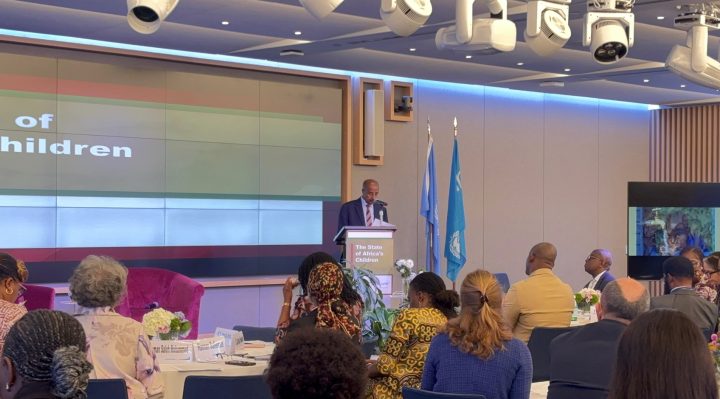
Keynote remarks by H.E. Mr. Osman Saleh Mohamed,
Foreign Minister of the State of Eritrea during the launch of The State of Africa’s Children report 2026, 23 September 2026
UNICEF House
Distinguished Excellencies, Delegates, and Experts,
I am honored to deliver these keynote remarks at the launch of The State of Africa’s Children 2026 report. Let me begin by commending UNICEF for this timely and valuable contribution to Africa’s development agenda.
We particularly welcome the report’s alignment with the African Union Theme of the Year 2026: “Assuring Sustainable Water Availability and Safe Sanitation Systems to Achieve the Goals of Agenda 2063.” By examining this priority through the lives and experiences of children, the report brings a vital and human perspective to our continental conversation. Let’s be reminded that behind every statistic is a child whose future depends on our collective action.
Africa has the experience, institutions and solutions required to accelerate progress. Our principal challenge is to translate commitments into sustained implementation. This requires stronger national institutions, sustainable financing, resilient infrastructure and reliable services that reach the most vulnerable, including children and families in remote and underserved communities.
Eritrea’s experience underscores the importance of national ownership, self-reliance and the mobilization of domestic resources and capacities.
Development partnerships have an important role to play, but their greatest contribution is made when they reinforce national systems, respect national priorities and help build sustainable, climate-resilient and nationally owned solutions.
Such partnerships must reinforce African ownership and leadership, as external support is most effective when it strengthens national systems, respects national priorities, and contributes to self-sustaining, climate-resilient, and nationally owned WASH systems. This means continuing to prioritize durable solutions built on African initiative, responsibility and ownership.
Excellencies,
Allow me to briefly share Eritrea’s experience. Eritrea was liberated in 1991. Since then, we have made important progress in advancing the survival, health, education, and wellbeing of our children. Child mortality has declined significantly, while immunization and access to essential health services have expanded. We have also widened access to education and strengthened systems that reach children and families, including in remote communities.
Yet geography presents its own challenges. A large part of Eritrea lies in the arid Sahel Belt, where water is not a distant concern but a daily reality. With low and erratic rainfall, water remains one of our foremost national priorities.
Against this backdrop, we have made transformative investments. Through the collective efforts of government, communities, and partners, we have increased the number of large and medium dams from 138 at independence to nearly 800 today, with hundreds of small dams built and dozens more under development.
In close cooperation with UNICEF and other partners, Eritrea is also implementing its 2019-2030 One WASH Strategy and Investment Plan,which provides a framework for progressively achieving universal access to safe water, sanitation and hygiene.
These efforts reflect a whole-of-society approach involving government institutions, communities, families, schools and health workers. UNICEF has been an important partner in this journey since the early years of Eritrea’s independence.
Excellencies,
Our national experience underscores a broader truth reflected in the UNICEF report. The human cost of inadequate WASH remains unacceptably high. Water- and sanitation-related diseases continue to cause preventable illness and death, particularly among children. Safe WASH is therefore much more than an infrastructure issue, it is fundamental to protecting children and investing in Africa’s human capital. Accelerating progress on WASH is integral to realizing the ambitions of Agenda 2063.
To conclude,
The water and sanitation systems we build today will shape the health, dignity, and opportunities of Africa’s children for decades to come. The human cost of inadequate WASH remains unacceptably high; water- and sanitation-related diseases continue to cause preventable illness and death, particularly among children. Safe WASH is therefore not merely an infrastructure issue; it is fundamental to protecting children and investing in Africa’s human capital, and integral to realizing the ambitions of Agenda 2063.
The evidence presented in this report should serve not only as a reflection of the challenges before us, but also as a call to action. Let us ensure that the experiences, needs and aspirations of Africa’s children remain at the center of our continental priorities.
I Thank you!
Fonte: Shabait