Compartilhar
Manipulating Perspectives: Prosperity Party’s Latest Repackaging of “Deflection”

Ethiopia’s official state media outlets, affiliated news agencies, as well as co-opted think tanks, including the Institute of Foreign Affairs (IFA); Horn Review; Ethiopian News Agency (ENA); and Fana Broadcasting Corporation; have yet again intensified their coordinated campaigns of rabid disinformation and reckless acts of belligerence against the State of Eritrea.
The campaign represents a desperate and deceitful repackaging of the Prosperity Party’s (PP) visceral hostility, combining its aggressive and provocative intent for acquiring “sovereign access to the Red Sea …by any means necessary” with malicious attempts to denigrate and delegitimize Eritrea’s statehood.
In their latest desperate attempts to sway international public opinion, PP media outlets have weaponized a string of fabrications – acute water supply shortages in Asmara; fallacious accusations of human trafficking; forging military alliances against Ethiopia; distortion of the events surrounding the hijacking of an Eritrean false-flagged oil tanker off the coast of Yemen; and pontificating in what they dub as “illicit bilateral ties”.
By sensationalizing and misconstruing these episodes as “evidence” of Eritrea’s “destabilizing and dysfunctional system”, the regime in fact exposes the flaws and deficiencies of its domestic and regional policies.
This rather petty narrative is indeed a transparent distraction from Ethiopia’s own systemic crises. Furthermore, it deliberately ignores a foundational truth: Eritrea’s judicious and widely acclaimed policies of social justice and equitable development throughout the entire nation.
While major infrastructure work is actively underway to rectify temporary water distribution issues in the capital, Eritrea’s long-term developmental record tells a story of remarkable progress that is predicated on rural and urban equity. According to data from the Eritrean Ministry of Land, Water, and Environment, verified by third parties including the United Nations organizations present in Eritrea, the transformation of the country’s water sector since independence is undeniable:
- In 1991, potable water coverage across Eritrea was a mere 7% in villages and only 30% in towns and cities.
- By 2025/2026, through a strategic state investment of over 125 billion Nakfa, clean water access has reached 80% in villages and 95% in cities, directly benefiting 85% of the total national population (Shabait , 2026).
In the event, it is ridiculous for PP’s surrogates and minions to fixate on a sporadic and isolated problem of municipal maintenance in Asmara while the Ethiopian state faces structural failure. Today, the PP government barely maintains administrative control outside the capital city Addis Ababa. The country is being torn apart by active, simmering conflicts across multiple regional states – most notably in Oromia, Amhara and Tigray. The hard macroeconomic indicators speak volumes about the true state of affairs in the Prosperity Party-led Ethiopia of today:
- More than 21.4 million Ethiopians currently depend on emergency humanitarian assistance to survive.
- Around 4.4 million people remain internally displaced due to rampant instability and conflict.
- Approximately 4.7 million people are officially unemployed.
- According to Food and Agriculture Organization (FAO), roughly 1 out of 8 Ethiopians – equivalent to 15 to 15.8 million Ethiopians faces extreme or acute hunger (FAO, 2026).
- Absolute or extreme poverty has risen exponentially under the current administration reaching around 43% (roughly 58 million) of the total population.
- Joint data from the UNDP and Oxford reveals that multidimensional poverty (severe deprivation in income, health, education, clean water, and electricity) affects more than 86 million (around 72%) of the total population.
When dissecting these numbers further, the infrastructural illusion completely shatters. Around 41.3 % of the population lacks access to standard drinking water, 95.4% has no access to basic sanitation, and 70% lives without electricity. This stands as damning indictment of a regime that boasts of being a ‘regional energy hub’ while exporting close to 7% of its generated electricity abroad, leaving majority of its citizens in the dark.
Compounding this economic collapse is the restrictive $3.4 billion IMF bailout, which along subsequent mandatory monetary devaluations and policy adjustment, has left millions of ordinary citizens unable to afford basic necessities. Coupled with the devastating impact of the ongoing El Niño-induced climate crisis, Ethiopia is sitting on a domestic tinderbox that the PP is desperately trying to conceal through foreign misdirection.
Furthermore, to build an international pretext for its hostility, the PP media apparatus has accused Eritrea of trying to construct a “long hostile buffer zone” spanning from Ethiopia through Sudan. The truth of the matter is that it is the Prosperity Party that is actively destabilizing the Horn of Africa. While Eritrea has maintained strict strategic patience, Addis Ababa has been immersed in incessant escalation of its war rhetoric for more than three years now; challenged international treaties; and actively hosted, trained, and financed subversive, sectarian proxy groups with an explicit “regime-change” agenda against Eritrea – including the “Red Sea Afar Democratic Organization (RSADO)” and various “color-revolution fringe groups.’
Similarly, PP trolls routinely weaponize human trafficking accusations against Eritrea. In reality, the State of Eritrea and its citizens have been the target of a well-documented, externally engineered, campaign of transnational human trafficking and “strategic depopulation” designed to drain the nation of its vital human capital.
Central to this dynamic is the UNHCR’s tailored Eligibility Guidelines/Guidance, an institutional apparatus engineered to incentivize and wean Eritrean youth out of their homeland. The Government of Eritrea has repeatedly exposed how UNHCR’s blanket asylum framework operates as a primary pull factor, fueling irregular migration by establishing a regime of virtually automatic “refugee status” to all Eritrean youth eligible for national service. This policy does not only wrongly classify routine economic migrants as “victims of forced displacement” but has and continues to encourage non-Eritreans to falsify their identity to claim preferential treatment. Indeed, assessments by the European Union Agency for Asylum (EUAA) confirm widespread nationality fraud and systemic misidentification. Host-country data sets further reveal that from 40% to 60% of recorded “Eritrean refugees” actually originate from neighboring states in the broader Horn of Africa, overwhelmingly from Ethiopia.
This manufactured distortion fuels a predatory feedback loop: inflated statistics are manipulated to justify expansive refugee mandates, which then drive further displacement; an abnormal dynamic generated not by so called “internal conditions” in Eritrea, but primarily by external structural inducements.
Meanwhile, Eritrea has consistently and unequivocally opposed the transnational criminal syndicates engaged in human trafficking and migrant smuggling – networks that operate across multiple jurisdictions and prey upon vulnerable populations throughout the region. Demonstrating this commitment, President Isaias Afwerki had formally apprised the UN Secretary-General of these exact risks and syndicates in a letter that was sent as early as 2013. Unfortunately, this representation has failed to elicit commensurate international response or corrective action to date.
Likewise, and in a bizarre diplomatic exercise, PP officials have and continue to wage a duplicitous smear campaign against Eritrea by accusing it of fostering “illicit ties” with Belarus and Iran, etc. Naturally, Eritrea has normative diplomatic ties with both nations although it does not currently have resident embassy in either Tehran or Minsk. Indeed, as a sovereign state and as a matter of international law, Eritrea has the absolute, independent, right to forge diplomatic partnerships and enter into bilateral agreements with any country of its choice. As such, this spurious line of attack collapses under the weight of basic diplomatic norms, and only exposes the profound hypocrisy of the PP regime:
- Furthermore, it is actually Ethiopia that is currently in discussions with Belarus to establish broader bilateral agreements. Additionally, it is Ethiopia that maintains a fully functioning embassy in Iran. Not long ago in December 2025, members of the Ethiopian Parliament conducted high-profile bilateral visits to Tehran. Most crucially, it is Ethiopia that has acquired combat drones from Iran.
- The drones that the PP has purchased from assorted sources have been actively and systematically deployed by the Ethiopian National Defense Forces (ENDF) against Ethiopia’s own civilian populations in the Amhara and Tigray regions, killing scores of innocent citizens and inflicting catastrophic material destruction on towns and infrastructure already shattered by years of civil war and neglect.
- Even worse, the PP regime is actively harboring, supporting, and abetting the Rapid Support Forces (RSF); thereby directly aggravating the humanitarian catastrophe across the border.
The bottom line is that the Prosperity Party is using Eritrea as a geopolitical scapegoat to shield itself from its own compounding domestic failures. The heavily hyped ‘Medemer’ philosophy, touted as an “indigenous and organic roadmap” for synergy and comprehensive prosperity has completely collapsed under the weight of its own internal contradictions. Instead of fostering social cohesion and sustainable growth, the implementation of Medemer has triggered the worst socioeconomic and political crisis in modern Ethiopian history.
Rather than delivering a wealth-creating private sector or stable public financial management, Medemer’s haphazard economic liberalization policies have hollowed out the state.
The fact is Medemer has barely brought prosperity; rather, it has dismantled the country’s economic foundations, leaving the vast majority of the Ethiopian population poorer while rapidly enriching a small, highly corrupt circle of PP cronies. Due to all of these, unsure of its popular legitimacy and facing intense internal resistance, the PP is thus attempting to radicalize, agitate, and mobilize the Ethiopian population by fabricating an existential external crisis.
These are of course internal matters that concern the Ethiopian population alone and we will not digress further into the self-inflicted quagmire that the PP has inculcated.
Pivoting back to the core argument, Eritrea has time and again firmly rejected the dangerous politicization of maritime access. Addis Ababa has continually shifted its goalposts – sometimes hiding behind the language of “regional integration”; at other times citing demographic scales and population size; and ultimately reverting to flawed historical revisionism to claim outright ownership of sovereign Eritrean waters as well as territories.
Eritrea has, for its part, always been open to peaceful and lawful commercial port access based on normative bilateral agreements. But it categorically rejects illicit demands wrapped up in coercion, duress, or threats against its sovereign domains. Eritrea’s inalienable right of statehood, secured through immense sacrifice, is indeed absolute. No amount of media and/or content repackaging or diplomatic manipulation by the Prosperity Party can alter that reality.
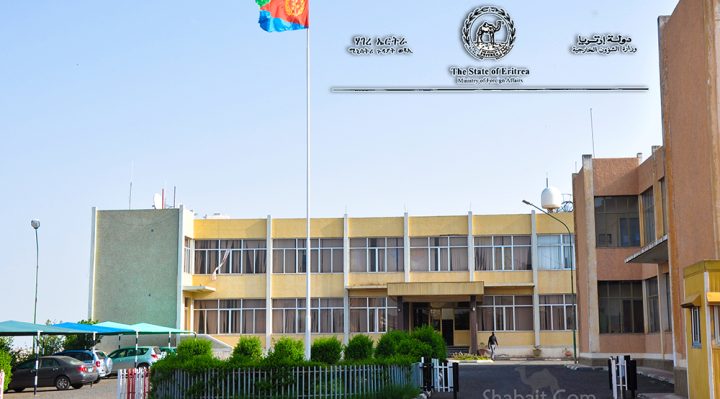
Ministry of Foreign Affairs of the State of Eritrea
Research and Documentation Division
12 September 2026
Fonte: Shabait