Compartilhar
Much More Than a Monetary Instrument
Nearly thirty years ago, on 8 November 1997, Eritrea introduced its national currency, the Nakfa, marking an important milestone in the country’s journey as an independent nation. More than simply a medium of exchange, the Nakfa was conceived as an expression of national identity, sovereignty, and the hard-won freedom for which generations of Eritreans had struggled and sacrificed. Its very name, drawn from one of the most iconic places in Eritrea’s liberation history, carries a powerful message of resilience, determination, and an unwavering commitment to self-determination.
Beyond its name, the Nakfa tells a broader story through its imagery and design. Its coins and banknotes showcase the country’s remarkable natural heritage, diverse people and cultural traditions, the importance of agriculture and maritime resources, and the enduring legacy of the independence struggle. Each image and symbol offers a glimpse into the values, experiences, and aspirations that have helped shape the Eritrean nation.
Now, as the Nakfa celebrates its 29th anniversary, it is an opportune moment to look beyond its monetary function and explore what makes it so meaningful. From the historical significance of its name to the powerful imagery displayed on its coins and banknotes, Eritrea’s national currency is much more than money: it is a reflection of the country’s history, identity, collective sacrifices, and hopes for the future.
To begin, the national currency of Eritrea is officially known as the Eritrean Nakfa (ERN), with its official symbol being “Nfk.” As alluded to above, the name “Nakfa” holds profound historical significance in Eritrea. Known as the “place of resilience” and the EPLF’s mountain fortress during the long liberation struggle, Nakfa is a small town that has become a powerful symbol of Eritrean determination and resistance to colonial domination. In 1977, after seemingly having been on the verge of victory, the EPLF was forced to undertake a strategic retreat to Nakfa following the massive intervention of the former USSR on behalf of the Ethiopian military junta, led by Lt. Col. Mengistu Haile Mariam.
At Nakfa, the EPLF, which came to be regarded as a highly organized and formidable revolutionary movement, built extensive fortifications, including a forty-kilometer-long, labyrinth-like defensive trench system in the surrounding mountains. Despite a long series of large-scale military campaigns and a seemingly endless stream of foreign financial and military support, the Ethiopian army was completely unable to dislodge the Eritrean liberation fighters from their stronghold.
Ultimately, Nakfa stands as a symbol of Eritrea’s proud history of resilience and reflects the nation’s inspirational fight for self-determination, making it an especially meaningful and fitting name for the country’s currency.
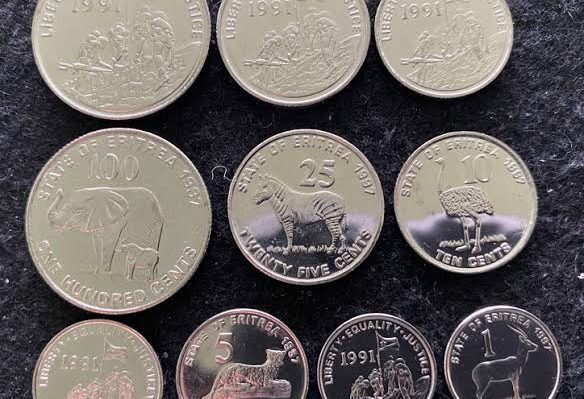
Since its introduction, the ERN has been issued in both coins and banknotes. The coins are denominated in 1, 5, 10, 25, and 50 cents, as well as 1 Nfk, while the banknotes are denominated in 1, 5, 10, 20, 50, and 100 Nfk. Despite their differing monetary values, they all incorporate unique images and symbols that hold special meaning.
For instance, various ERN coins feature images of different local animals. This highlights the fact that, despite being far from the largest country in terms of geographical area (Eritrea covers approximately 125,000 km²), the nation boasts a remarkably rich natural heritage and is blessed with diverse flora and fauna, both on land and in the sea, as well as in the air. The waters off Eritrea’s extensive coastline contain over 1,100 fish species and 44 genera of hard coral. On land, Eritrea has a unique northern African elephant population and the world’s only viable population of free-ranging African wild asses (donkeys). The country is also home to a number of other globally rare and endangered species, such as the Nubian ibex and several gazelles. In addition, while a number of surveys are still ongoing, it is believed that Eritrea has between 550 and 600 bird species, comprising a mix of resident and regular seasonal migrants.
One animal prominently featured on ERN banknotes is the camel, which is the national emblem of Eritrea. Historically, camels have been among the most important animals in Eritrea (and the wider region), serving as a reliable, no-nonsense means of transporting both goods and people, particularly in rural areas.
They also provide milk, an important source of nutrition for households and communities. Additionally, camels played a pivotal role during the decades-long struggle for freedom, where they were used extensively by the independence movement and highly valued for their hardiness, endurance, and adaptability in extremely harsh conditions and rugged, challenging terrain. Their prominent place on ERN banknotes thus serves as a tribute to their central role in Eritrean society and the liberation struggle, while also symbolizing the Eritrean people’s own tremendous patience and indefatigability.
Another common element in the design and imagery of Eritrean currency is the country’s people. For instance, some banknotes feature young people, symbolizing the country’s youth and the fact that they are, by far, Eritrea’s most important resource. Youth are, and have long been, a key population group in Eritrean society. They played a critical role in the independence struggle, comprise a large percentage of the population today, continue to protect the country’s sovereignty and territorial integrity, and meaningfully contribute to the nation’s developmental progress in countless and significant ways. Notably, elders are also depicted, highlighting their traditionally unique position within Eritrean society, along with the universal respect they command for their considerable wisdom and experience.
In addition to showcasing people of different ages, ERN banknotes display individuals from Eritrea’s various ethnolinguistic groups, thus celebrating the nation’s great diversity and the unique peaceful coexistence between its different communities. Eritrea is blessed with an array of religious and ethnolinguistic groups, all of which contribute to producing a colorful heritage and a rich national tapestry. Also significant is that, by featuring the country’s different groups, the ERN demonstrates the country’s unwavering commitment to equality.
Alongside the above, Eritrea’s national currency showcases various aspects of the nation’s socioeconomic life. Images of large vessels in harbor, for instance, emphasize Eritrea’s strategic location on the Red Sea, its vast coastal resources, and the potential for a thriving maritime industry. Meanwhile, images related to farming symbolize the central role of agriculture and pastoralism within Eritrean society and economic life.
Importantly, ERN coins and banknotes also depict freedom fighters, commemorating the nation’s struggle for independence and paying special tribute to those men and women who bravely fought and made immense sacrifices to deliver Eritrea’s freedom. Their presence on the national currency serves as a lasting reminder of the courage, determination, and selflessness that made independence possible.
Taken together, the various images and symbols featured on Eritrea’s national currency offer a fascinating reflection of the country’s history, identity, and collective aspirations. From the resilience embodied in its very name to the people, wildlife, livelihoods, and freedom fighters depicted on its coins and banknotes, the Nakfa captures many of the defining features of Eritrean society and the nation’s journey. Indeed, it is much more than a monetary instrument: it is a powerful symbol of the sacrifices that made independence possible, the values that bind the nation together, and the hopes and aspirations of its people for the future.
Fonte: Shabait