
Compartilhar
NIGERIA–BRAZIL AGRO-TRADE MARKET ACCESS: WE’VE MOVED FROM DIALOGUE TO DELIVERY, AGREEMENT TO IMPLEMENTATION – VP SHETTIMA
The Vice President, Senator Kashim Shettima, has declared that Nigeria and Brazil have moved from dialogue to delivery and agreement to implementation in the agro-trade market access initiatives as well as the operational rollout of the bilateral agriculture and livestock partnership between both countries.
He expressed deep satisfaction with the major milestones recorded by both countries under the Nigeria-Brazil Agro-Trade Initiative, noting that the coast was now clear for private sector operators in both nations to commence trade in the commodities involved in the partnership.
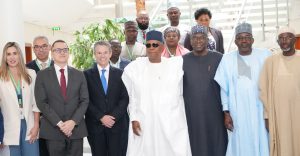
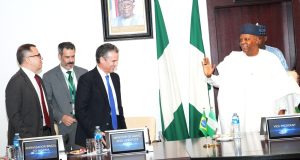
The Nigerian Vice President, who is co-chairman of the Nigeria-Brazil Strategic Dialogue Mechanism (SDM) alongside his Brazilian counterpart, Geraldo Alckmin, spoke on Monday during a High-Level Nigeria–Brazil Agro-Trade Market Access Milestone meeting with a Brazilian delegation led by its Minister of Agriculture and Livestock, Andre Carlos Alves de Paula Filho, at the Presidential Villa, Abuja.
Noting that the diplomatic commitment has transitioned into tangible results, Senator Shettima observed that the true measure of global partnership is not in the agreements signed but in their implementation and the benefits accruing to citizens of both countries who are the beneficiaries.
Specifically, VP Shettima described the engagement as “another movement in a symphony that began” following the state visit of President Bola Ahmed Tinubu to Brazil, and through the sustained labour of the Nigeria–Brazil Strategic Dialogue Mechanism, co-chaired by the Vice Presidents of the two countries.
“We have moved with deliberate steps from dialogue to delivery, from agreements to implementation, and from shared ambition to outcomes that can be counted, weighed and shipped. This is precisely how enduring partnerships evolve,” he declared.
Senator Shettima applauded the milestones recorded under the Nigeria-Brazil Agriculture and Livestock Cooperation Framework, established under the SDM, noting that the Joint Agriculture and Livestock Technical Working Group was now operational, with active thematic action sub-groups on diary and livestock genetics, soybean productivity, agricultural policy and agro-climatic risk zoning.
The Nigerian Vice President recalled that President Tinubu and his Brazilian counterpart, Luiz Inácio Lula da Silva, had observed during the Nigerian leader’s State Visit to Brazil that the volume of bilateral agricultural trade between the two economies fell far short of what both nation’s endowments permit.
He said the two leaders instructed the governments of both nations to identify the opportunities capable of accelerating trade, investment and technical cooperation, even as he explained that the milestones recorded so far were the product of months of disciplined collaboration.
 “I am pleased that we can today report the first tangible fruits of that presidential directive. The market access milestones we announce are the product of months of disciplined collaboration between our Ministries, our regulatory authorities, our technical experts and our private sector partners.
“They show what becomes possible when political leadership is matched by strong institutions and by the humility to do the unglamorous work of implementation,” he stated.
VP Shettima lauded Brazilian Minister of Agriculture and Livestock Development, André Carlos Alves de Paula Filho, noting that his presence in Abuja along with his delegation “speaks to the strength of a friendship that has outlived the passing seasons of politics.
“It affirms our shared determination to fashion a partnership that delivers practical benefit to the farmer in Jigawa, to the processor in Kwara, to the exporter in Lagos, and to the households in São Paulo and Brasília who will one day consume the fruits of our soil,” he added.
The VP expressed Nigeria’s sincere gratitude to the Government of Brazil for deepening its institutional presence in Abuja through the appointment of an Agricultural Attaché and recently through the growing engagement of EMBRAPA by way of the Embassy.
“These decisions have drawn our institutions closer, quickened our technical engagement, and helped translate ideas into programmes that touch the ground. We are grateful for such investment in our friendship.
“As these new markets open, your leadership will be indispensable in preparing farmers, cooperatives, processors and exporters to satisfy international standards, to add value at home rather than surrender it abroad, and to ensure that these opportunities ripen into jobs, into incomes, and into growth across your domains, he concluded.
Earlier, Brazil’s Minister of Agriculture and Livestock, André Carlos Alves de Paula Filho, expressed satisfaction with the progressive results emerging from the Nigeria–Brazil Accelerated Agricultural Trade Initiative, which, according to him, was borne out of the commitment made by President Tinubu and his Brazilian counterpart.
He noted that the commitments in areas of agriculture, food security, energy, defence, and investment reflect a shared vision of development and prosperity.
He said Brazil is equally committed to expanding access for Nigerian products to the Brazilian market, adding that, as part of the understanding reached between both governments, Brazil has committed to opening its market to Nigerian exports of hibiscus, sesame, and shea butter.
“I am pleased to inform you that the technical staff of Brazil’s Ministry of Agriculture and Livestock is in the final stages of preparing the phytosanitary certificate proposal required to enable these exports.
“Once this work is completed, we will also facilitate contacts between Nigerian exporters and potential Brazilian buyers, creating concrete commercial opportunities for these products in the Brazilian market,” he added.
On his part, the Governor of Jigawa State, Malam Umar Namadi, commended the Nigeria–Brazil partnership, stressing that Jigawa contributes 75 percent of the country’s non-oil exports.
He assured that the state government would play its part to ensure the success of the Brazil–Nigeria partnership.
Also, Nigeria’s Minister of Agriculture and Food Security, Senator Abubakar Kyari, said the agreement reached by President Tinubu and his Brazilian counterpart was already fast-tracking trade relations between the two countries.
He explained that Nigeria considers Brazil a model of a country that has transformed itself into one of the world’s most productive agricultural regions.
He assured that the renewed bilateral journey Nigeria has embarked upon with Brazil under President Tinubu’s administration is on course to fast-track agricultural exports.
Stanley Nkwocha
Senior Special Assistant to the President on Media & Communications
(Office of the Vice President)
13th July, 2026
Fonte: State House