Compartilhar
Remarks by Minister Yemane G/meskel at the 2026 UN Country Team Retreat
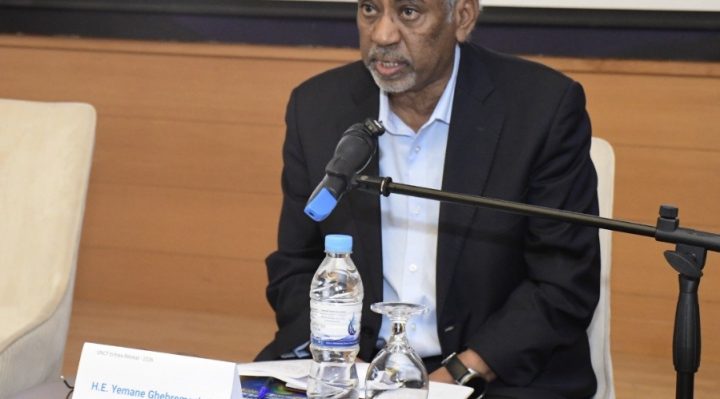
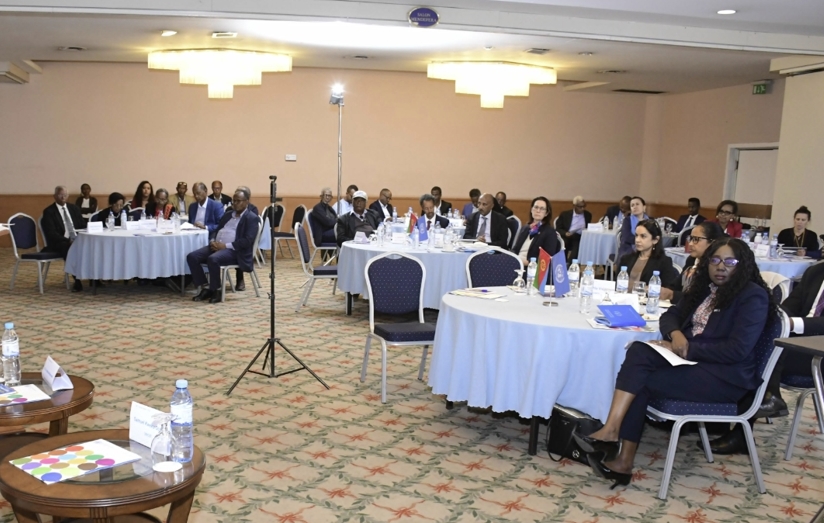
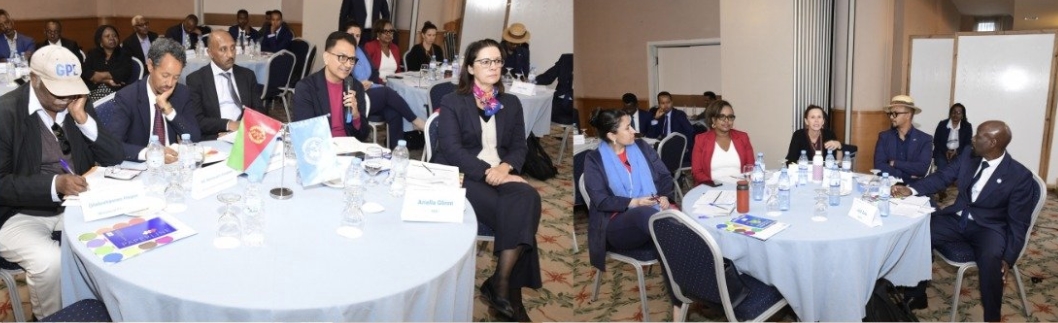
Remarks by Minister of Information, Mr. Yemane G/meskel, at the Retreat, held at Asmara Palace this week, of UN Resident Representatives/Regional Directors
Thank you for giving me this opportunity.
- Let me start by emphasizing one cardinal point.
- I am keenly aware that the issues I will raise in this session are a digression from the main agenda of the Retreat.
- Your main focus in the next two days will rightly be development: assessment of vital multi-sectoral achievements; various challenges confronted; and prospects for better results.
- We share and support these ideals.
- Indeed, in the face of enormous and adverse externalities, the Government has always emphasized on one overriding mantra: “that we should never be held hostage by adversity; that the perennial security threats we face from adversaries should not derail us from our developmental aspirations and goals”.
- These precepts are firmly held, and pursued, because we recognize the enormity of the developmental challenges that we face; the tasks we have to pursue with our development partners to lift our people and nation to where it should and can be.
- But at the same time, we cannot be oblivious to grave threats that are looming in the horizon. We cannot downplay Ethiopia’s declared war of aggression. We cannot bury our heads in the sand, like the proverbial Ostrich, hoping that it will dissipate; of and by itself.
- The fact is, the development plans that we chart out with all earnestness will ultimately be affected unless we summon the political will, courage, and collective action to galvanize deterrence in all its broadest dimensions and meaning.
- Comprehensive and objective appraisal of the impending threat will also be vital for practical and indispensable contingency planning.
- I raise these points knowing full well the mandate and other institutional barriers that you face.
- But even if these matters remain, legally and technically, within the purview of the political branches of the UN and the UNSC, your individual appreciation of the situation and associated moral voice has immense value to us.
- Now, let me revert to a brief analysis of the prevailing situation.
- To this end, I will focus on three parameters: i) the nature and magnitude of the impending threat, ii) its regional ramifications; iii) the options and prospects for preventive and deterrent action at this late hour.
- As you may remember, and unfortunate as it was, Eritrea and Ethiopia had gone through a vicious war from May 1998 to June 2000. This war claimed more than 150,00 lives and incurred massive economic devastation to both countries.
- But tragic as it was, the border war was at least triggered by arguably a good-faith dispute. As the two sides had different claims on, and interpretations of, the Colonial Treaties. As such, there was some room and latitude for bilateral talks; mediation through benevolent Facilitators; and, ultimately Arbitration.
- In Ethiopia’s current war of unprovoked aggression, these parameters are conspicuous for their absence.
- The sad reality is that Ethiopia has decided to go to war to acquire what is calls “sovereign access to the sea” and for the “establishment of a Naval Force in the Red Sea”. They tell us that the Naval force must have strategic depth, which will imply, in their own words, incorporation of Eritrea’s entire southern coastline until the Dahlak islands.
- Furthermore, the Ethiopian government has gone beyond contemplating limited territorial invasion to basically question Eritrea’s very existence and independence. The Prime Minister is on record for claiming, in a public address to the Parliament, that he has found no evidence in Ethiopia’s official archives – the Cabinet, Parliament, and other depositories – of proceedings or agreements on Eritrea’s Independence.
- Official discourse in Ethiopia’s senior political and military circles is replete with painting Eritrean independence struggle as an “Arab or Egyptian Project”.
- For three long years now, they have waged an intensive inflammatory campaign inside the country to prepare the population for a war to correct, in their own words, a “historical mistake”.
- And finally, the Ethiopian regime has notified, on 9 October last month, the UN Security Council that it is taking measures, or launching its war of aggression against Eritrea, by portraying itself as the invaded and aggrieved party.
- That Ethiopia is set to launch a massive war of aggression against Eritrea is not a matter for debate or speculation. One must also remember the ominous words of Ethiopia’s Deputy Chief of Staff, General Abebaw Tadesse, who stated on 27 September this year, that the ultimate objective of the Offensive launched in Tigray was to occupy Assab and install the Ethiopian flag in the Red Sea.
- Let me now briefly address the regional dimensions of this declared war.
- Ethiopia is at logger heads with Somalia as a result of the illicit and secret agreement that it signed with Somaliland in 2024.
- Ethiopia is also supporting the RSF in the Sudan by hosting a UAE-sponsored military training camp, in the western part of its country. This has prompted Sudan to lodge a protest with the UNSC against Ethiopia’s hostile intervention and exacerbation of the conflict.
- And finally, a few words on the options and prospects for deterrent action:
- Ethiopia’s war of aggression against Eritrea constitutes flagrant violation of foundational pillars of international law, the UN Charter, and the African Constitutive Act. The reasons that the Ethiopian regime has floated to justify its acts of destabilization are too ludicrous to merit discussion:
- Ethiopia has multiple accesses to the sea: indeed, as we often say it is a buyer’s market. Ethiopia can negotiate commercial access on preferential terms with Sudan, Eritrea, Djibouti, Somalia and Kenya.
- Red Sea maritime security falls within the purview of the Littoral States;
- Ethiopia’s arguments on “excessive port fees” is also untenable.
- The destruction and financial costs that would ensue by Ethiopia’s reckless war are exponentially higher than the annual 1.5 billion US dollars that it claims it is spending today.
- In the event, the only solution that one can contemplate is application of meaningful pressure on Ethiopia to abandon these reckless policies.
I thank you
Fonte: Shabait