Compartilhar
The Eritrean Diaspora
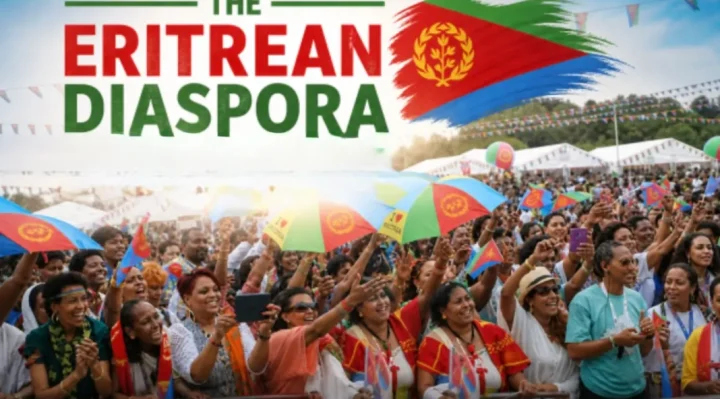
The Eritrean diaspora was forged in exile, united by purpose and bound by a memory no border could erase. Across continents, Eritreans carried a truth that history must preserve with clarity and reverence; they were not mere spectators to the liberation struggle. They were part and parcel of the legitimate and popular aspirations of the Eritrean people for nationhood.
They were a decisive front, a global front, and a living extension of the struggle itself. From the early 1970s through the late 1980s and into the decisive final years before national liberation in 1991, Eritreans abroad transformed exile into organization, distance into commitment, and displacement into disciplined national service. They organized, mobilized, sacrificed, and sustained the cause with their labor, their earnings, their advocacy, and their unwavering faith in Eritrea’s freedom.
Their homes became meeting places. Their wages became lifelines. Their voices became instruments of international awareness. Their cultural gatherings became schools of identity and political consciousness. Their discipline helped sustain morale, strengthen unity, and carry the Eritrean cause into the conscience of the world.
This was not charity. It was not sympathy from afar. It was participation: structured, sustained, and indispensable. The diaspora was a peaceful front, a battlefield without trenches, a political army without uniforms, and a global force whose sacrifices helped explain Eritrea’s struggle, defend its legitimacy, and support its ultimate victory.
Women Were at the Center of the Diaspora Front
No tribute to the Eritrean diaspora can be complete without honoring the women who carried so much of its burden. History must speak their names, even where the archives failed to record them. Eritrean women in the diaspora were among the unacknowledged leaders, organizers, fundraisers, protectors, and moral anchors of the Eritrean front abroad.
In Italy, they formed some of the earliest committees, raised funds from factories and domestic workplaces, sheltered activists, and preserved Eritrean identity in the heart of the former colonizer. In Saudi Arabia, Egypt, Lebanon and the Gulf, they labored under harsh, restrictive, and often exploitative conditions, yet still made some of the most consistent monthly contributions that helped fund medicine, communications, and the daily needs of the struggle. In Europe and North America, they organized demonstrations, built alliances with unions, churches, student groups, and progressive movements, hosted community meetings, prepared food for fundraising events, and mobilized youth into political consciousness.
Their labor was the economic backbone. Their resilience was the emotional backbone. Their sacrifice was the moral backbone.
Festivals as Stages of National Struggle
The Eritrean festivals of the diaspora, especially during the 1970s, 1980s, and 1990s, were far more than cultural gatherings. They were political stages of national identity. They were annual congresses of a global Eritrean nation.
Bologna in Italy became the beating heart of the diaspora, where strategy, culture, unity, and political education converged. Rome served as a hub of coordination, intellectual production, and community mobilization. Kassel became a stronghold of youth activism, fundraising, cultural revival, and political engagement.
Across North America, cities such as New York, Washington, DC, Chicago, Boston, Toronto, Oakland, and many others became centers of demonstrations, media outreach, lobbying, community organizing, and solidarity work. In these spaces, Eritreans did not simply remember the struggle; they renewed their commitment to it.
These festivals became the diaspora’s Barka and Sahel: places where Eritreans reaffirmed identity, strengthened unity, transmitted memory, and gathered the moral and political energy needed to continue.
Organization Became Engines of Resistance
The diaspora’s contribution was not spontaneous sentiment. It was organized, disciplined, and institutional. Eritreans for Independence in Europe (ኤናኤ) became a continental engine of political campaigns, solidarity committees, refugee support, public education, and media counter-narratives. In North America, the Eritrean Movement, known as Eritreans for Independence in North America (ኤ.ና.ሰ.ኣ) became a center of intellectual, political, and organizational strength. It mobilized Eritrean communities across the United States and Canada, exposed Ethiopia’s occupation and atrocities, built alliances with progressive forces, and countered misinformation in public forums, campuses, churches, unions, and media spaces.
These organizations were not peripheral to the liberation struggle. They were structural pillars of the diaspora’s contribution. They helped transform scattered communities into organized political forces and ensured that Eritrea’s cause was heard beyond the battlefield.
The median age of these young Eritreans in Europe and North America was likely only twenty-two or twenty-three. Yet their commitment, discipline, mobilization, and organizational capacity were extraordinary.
Many did not limit their service to activism abroad. Some left behind the relative comfort and security of life in Europe and the Americas to join the armed struggle inside Eritrea, where a number of them paid the ultimate price. Others brought their skills directly into the service of the revolution, working among the fighters as doctors, nurses, engineers, technicians, teachers, writers, and political cadres.
After independence, many continued their service, in various capacities, in the building of the new nation. Their youth was not a limitation; it was one of the struggle’s greatest sources of energy, courage, discipline, and renewal.
The Diaspora’s Pivotal Role
To say that the diaspora played a pivotal role is not exaggeration; it is historical accuracy. The diaspora supported the struggle materially, politically, diplomatically, and morally. It raised funds, sent supplies, challenged disinformation, built international awareness, defended Eritrea’s of decolonization, and preserved Eritrean identity among children born or raised far from home. It transformed exile from a condition of loss into a field of service.
Diaspora Festivals built cohesion and sustained morale. Diaspora women provided essential support with consistency, sacrifice, and devotion, inspiring others to serve with the same discipline. Diaspora youth carried the work of international advocacy forward and ensured generational continuity. Through organized communities abroad, Eritrea’s voice broke through the enemy’s channels of propaganda and reached the world.
In short, the diaspora did not merely assist the struggle. It amplified its just cause. It globalized Eritrea’s demand for decolonization. It helped carry the truth of Eritrea’s struggle beyond borders and into history.
Eritrea Extended
The diaspora is not outside Eritrea. It is Eritrea extended.
It is a global community, a cultural reservoir, a historical archive, and a living force. Its contribution is not a footnote, nor a sentimental appendix to the national story. It is one of the foundations upon which Eritrea’s modern history rests.
Preserving the Memory
To honor the diaspora is not an exercise in nostalgia. It is an act of historical responsibility. Future generations must know that Eritreans abroad did not simply watch history unfold from a distance. They helped make it. Diaspora children must understand the sacrifices made in exile: the long hours worked, the wages given, the meetings attended, the homes opened, the demonstrations organized, the festivals built, the communities sustained, and the faith kept alive across decades.
Eritrean history must remain whole, not partial. The contribution of the diaspora must be recorded, not forgotten. Its unity must be remembered as a source of strength. Its global identity must be recognized as part of Eritrea’s national story.
A Legacy That Belongs to All Eritreans
The story of the Eritrean diaspora belongs to all Eritreans. It is not the possession of one region, one generation, one city, one organization, or one political current. It belongs to every Eritrean whose life was shaped by exile, resilience, sacrifice, and a shared national purpose.
This tribute is a declaration of memory, not division; of identity, not ideology; of truth, not erasure. It honors a people who, though scattered across continents, remained bound to Eritrea by duty, love, and unwavering conviction.
The Eritrean diaspora was a front without trenches, a nation beyond borders, and a pillar of the struggle. It carried Eritrea in its heart when geography placed Eritrea beyond its reach.
This is the record. This is the legacy. This is the history.
Fonte: Shabait