Compartilhar
The Historical Trajectory of Eritrea’s National Service

The organization of national defense is among the most fundamental attributes of state sovereignty. Under international law, every sovereign State possesses the inherent right and corresponding responsibility to preserve its territorial integrity, political independence, constitutional order, and the security of its population.
This principle is firmly anchored in the Charter of the United Nations, particularly Article 2(1), which affirms the sovereign equality of States, and Article 51, which recognizes the inherent right of individual and collective self-defense. Consequently, the manner in which a state structures its national institutions, including systems of military or national service, falls primarily within its domestic jurisdiction, provided such institutions operate within the framework of national legislation and applicable international law.
At the same time, international law does not prohibit compulsory military service. On the contrary, it expressly recognizes that compulsory military service constitutes a legitimate exercise of state authority. Article 2 (2) (a) of the International Labour Organization’s Forced Labour Convention, 1930 (No. 29), excludes “any work or service exacted by virtue of compulsory military service laws for work of a purely military character” from the definition of forced or compulsory labour. Similarly, Article 8 (3) (c) (ii) of the International Covenant on Civil and Political Rights recognizes compulsory military service in countries where it exists. Furthermore, international practice demonstrates that more than 60 countries ranging from Finland to Israel to Cuba to South Korea maintain mandatory military or national service as a lawful component of their defense and public service systems.
The legality and legitimacy of a national service programme, therefore, cannot be assessed in the abstract or divorced from the historical, legal, practical, and security circumstances in which it operates. Like every sovereign institution, its evolution reflects the unique political, socio-economic, and security realities confronting the state that established it. Historical experience; perceived and/or actual threats; regional and global stability; and national development priorities; all influence the design, implementation, and adaptation of such institutions over time.
Thus, it is within this comprehensive framework that Eritrea’s National Service must be understood. Far from emerging as an exceptional or anomalous institution, it was established through Proclamation No. 82/1995 essentially as part and parcel of broader defense architecture in the immediate aftermath of Eritrea’s independence and against the backdrop of a massive demobilization programme of the relatively large EPLF army of freedom fighters. Its subsequent evolution cannot be separated from the extraordinary regional security environment that Eritrea has faced since independence, including armed conflict, occupation of its territories, and prolonged existential external threats to its sovereignty.
Against this backdrop, the following sections trace the historical evolution of Eritrea’s National Service, from the international decisions that shaped Eritrea’s struggle for statehood, through the country’s post-independence demobilization efforts and legislative framework, to the regional security challenges that fundamentally shaped its implementation trajectory. Only through such a historically grounded analysis can the National Service be assessed fairly, objectively, and in accordance with the realities that have defined Eritrea’s modern statehood.
In the mid-20th century, when the European colonial empires were being dismantled across the African continent, Eritrea’s legitimate right to decolonization and self-determination was openly compromised and bargained away in the corridors of the United Nations. Global powers chose to mollify their overriding geopolitical interests in the Red Sea corridor by forcibly federating and later allowing the outright annexation of Eritrea by the Ethiopian Empire, directly violating the visible and loudly expressed will of the Eritrean population.
For decades, the international community chose strategic convenience over international law, setting the stage for a bloody conflict that could have been avoided had regional and global organizations such as the United Nations and the African Union adhered to their foundational principles and shouldered their responsibilities.
Later, during the grueling thirty-year liberation struggle spanning from 1961 to 1991, the Eritrean people waged a long and arduous war for survival, identity, and independence entirely on their own. Throughout this generation-defining struggle, the international community largely left the Eritrean liberation movements to their own devices. No global powers rushed to offer humanitarian assistance or diplomatic recognition to the fighters in the field.
Instead, successive superpowers actively bankrolled, armed, and politically shielded the brutal occupying regimes in Addis Ababa, first the feudal empire of Haile Selassie, and later the Soviet-backed military junta known as the Derg.
Despite facing massive conventional armies backed by global empires, the Eritrean freedom fighters relied exclusively on the resilience, unity, and resourcefulness of their own population to achieve total military victory in 1991. This foundational experience deeply ingrained the principle of self-reliance into the nation’s political ethos, proving to the Eritrean people that their survival depended entirely on their internal cohesion rather than the fickle promises of international partners.
Sadly, this pattern of international apathy and overt hostility did not vanish after Eritrea achieved its hard-won independence and formal international recognition through a UN-supervised referendum in 1993.
When Ethiopia unleashed an all-out war of aggression from 1998 to 2000 under the pretext of a minor border dispute centered on the village of Badme, the international community relapsed into its traditional position of indifference. Even after both countries signed the Algiers Peace Agreement in December 2000, and the independent Eritrea-Ethiopia Boundary Commission (EEBC) delivered its final and binding ruling in 2002, the guarantors of that peace treaty, including the United Nations Security Council, the European Union, and the United States of America, stood by and watched silently as Ethiopia rejected the verdict and illegally occupied sovereign Eritrean lands for sixteen long years.
To revert to the main theme, the explicit military doctrine established at the dawn of independence was to maintain a small, highly professionalized standing army of roughly 35,000 troops, which would be supplemented by a broad civilian reserve army or people’s army. Accordingly, in 1992, prior to the declaration of formal independence following the Referendum, and at a time when the country was in complete ruins, the Provisional Government of Eritrea embarked on an ambitious, self-funded program to drastically scale down the 100,000-strong army of freedom fighters who had successfully executed the war of liberation. This bold initiative successfully reduced active military personnel by approximately 65 percent, returning tens of thousands of battle-hardened veterans to civilian life to participate in the reconstruction of the country. This design ensured that the young state would not bear the crushing economic burden of a massive standing military during peacetime, while still maintaining a robust defense capability that could be rapidly mobilized in the event of a grave external threat to national survival.
It was precisely within this defensive, civilian reserve army blueprint that the National Service programme was introduced by legal proclamation No.82/1995 in 1994.
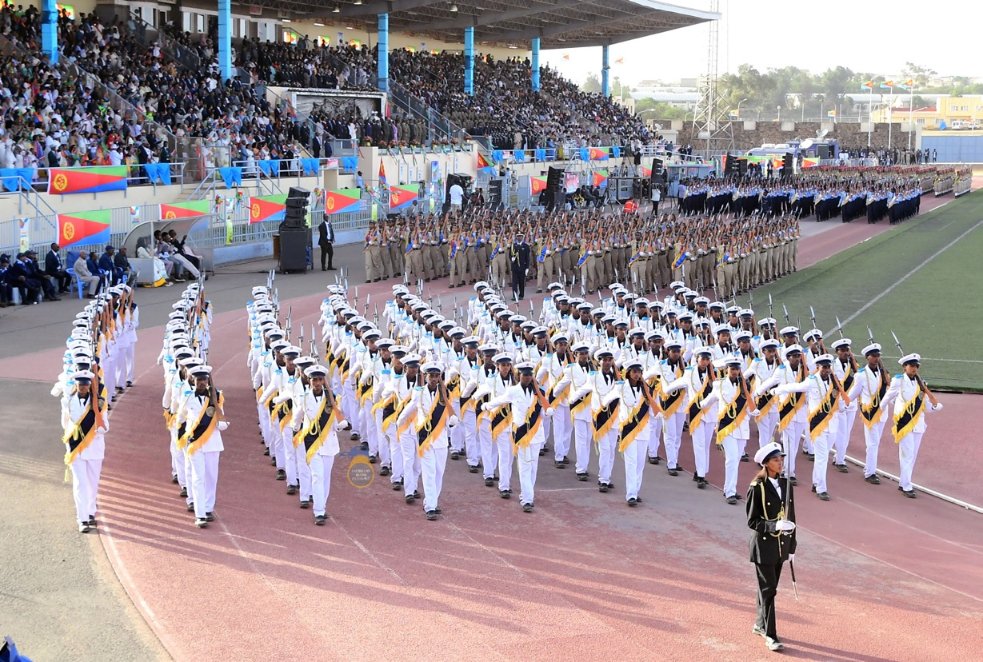
The institutional design of the service was clear, legally binding, and closely modeled after successful civic and military service frameworks found in several sovereign nations across Europe, Asia, and the Americas. By law, the active-duty component of the National Service was explicitly limited to 18 months. This period was carefully divided into two distinct phases: six months of military and civic training at the Sawa Academy, followed by a 12-month deployment in vital developmental, administrative, agricultural, or environmental projects across the country. From its inception until May 1998, this 18-month operational modality functioned exactly as intended, producing successive rounds of young citizens who completed their service on schedule and transitioned smoothly into higher education, specialized vocational training, or the civilian labour market.
Beyond its original utility as a defense mechanism, the National Service evolved with time and was celebrated as a powerful, indispensable mechanism for national integration. Eritrea is a multi-ethnic and multi-religious society composed of nine distinct ethno-linguistic groups who have coexisted peacefully for centuries. The Sawa Academy and the subsequent National Service deployments served as a grand melting pot, bringing together young men and women from every geographic region, social class, and cultural background to live, study, and work together. This shared experience fostered an unbreakable sense of national consciousness, social solidarity, and mutual respect among the youth, effectively insulating the country from the destructive forces of ethnic factionalism and religious division that have plagued many countries in the Horn of Africa. However, this normal, highly productive national developmental framework was disrupted only when Ethiopia’s unprovoked war of aggression transformed a peaceful nation-building project into an emergency existential struggle for survival and territorial integrity.
Even during the bitter and costly conflict, the Government of Eritrea continuously looked for the earliest viable opportunity to return to normalcy and resume its developmental agenda. Immediately following the Cessation of Hostilities and the signing of the Algiers Peace Agreement, the Government of Eritrea made the restoration of peacetime conditions a national priority. On 10 April 2001, it established the National Commission for the Demobilization and Reintegration Programme through Proclamation No. 113/2001, creating a dedicated statutory body mandated to implement a comprehensive demobilization and reintegration programme over a phased period of four to five years. Rather than viewing demobilization as a narrow military exercise, the Proclamation explicitly recognized it as an integral component of Eritrea’s broader nation-building and development strategy, emphasizing that successful reintegration could only be achieved within a coherent framework of individual rehabilitation, national reconstruction and economic development.
Unlike the self-funded demobilization undertaken in 1992, the 2001 programme was conceived as a comprehensive national reintegration initiative combining demobilization, reinsertion, and long-term economic and social integration. The legislation acknowledged that the programme would affect not only former National Service members, but also their families, dependents, and the wider community, requiring coordinated national planning rather than isolated rehabilitation measures. It further emphasized that the objective was not merely to discharge personnel from military service, but to equip beneficiaries with vocational skills, education, and productive employment opportunities that would enable them to reintegrate into society and contribute to national economic growth.
To achieve these objectives, Proclamation No. 113/2001 established a National Commission vested with broad responsibilities. These included coordinating national policies, mobilizing domestic and international resources, overseeing sustainable reintegration programmes, ensuring continuous vocational training, promoting literacy and free elementary education for demobilized personnel who required it, giving particular attention to the reintegration of women, and coordinating closely with government institutions, development partners, the United Nations, and non-governmental organizations. The Commission was further mandated to prepare detailed implementation plans, monitor programme performance, maintain transparent financial management, and establish regional structures with networks up to the lowest levels of the country’s administrative structures capable of supporting reintegration throughout Eritrea.
Recognizing the credibility and significance of Eritrea’s post-war transition strategy, the programme received substantial financial and technical support from the World Bank, the European Union, and other bilateral development partners. As a result, between 2001 and 2007, more than 105,000 National Service members were successfully demobilized, many of whom entered civilian public service, vocational training programmes, or received financial assistance and technical support to establish small private businesses and sustainable livelihoods.
The programme, however, was ultimately overtaken by circumstances beyond Eritrea’s control. This massive and highly successful demobilization effort was ultimately forced to a halt and shelved because of external political lawlessness. The incumbent Ethiopian regime, emboldened by the explicit diplomatic and financial protection of global powers and institutions such as the US, EU, UN, AU, and others openly reneged on its treaty obligations, rejected the final and binding ruling of the international boundary commission, and continued to occupy sovereign Eritrean territories – including the symbolic town of Badme – with complete impunity.
For nearly two decades, Eritrea was forced into a grueling “no-war, no-peace” stalemate, facing an aggressive neighbour that openly proclaimed its desire for “regime change” in Asmara, while maintaining a massive military buildup along the border.
In such an environment, where an existential threat loomed constantly over the horizon and the international community refused to enforce its own treaties, the Government of Eritrea had no choice but to depend on, and mobilize, its only national human resource and extend national service duties beyond the legal and normative peace-time duration of 18 months to safeguard its borders and prevent the outright erasure of its sovereignty. The extension of service was not a policy of choice, but a painful necessity dictated by the lawless behavior of its neighbors and their global sponsors.
The geopolitical landscape of the Horn of Africa has undergone dramatic shifts and realignments over the past decade, yet the underlying threat matrix facing Eritrea remains remarkably consistent.
The political mindset of successive leadership groups in Addis Ababa remains, in many fundamental respects, a continuation and aggravation of the misguided, expansionist, and deplorable policies of aggression practiced by their predecessors. Despite fleeting moments of diplomatic hope, hostile rhetoric regarding territorial irredentism, regional hegemony, and the questioning of legal, colonial-era borders continues to emanate from prominent regional actors and their intellectual echo chambers.
This persistent instability and volatile political climate require Eritrea to maintain a robust, highly adaptive, and deeply resilient defensive posture. These include, among others, the prolongation of national service duties, regular refresher military training to members of the reserve or people’s army, restriction on the movement of certain age groups of service men from foreign travel, and related obligations. A nation that lets its guard down in such a volatile neighborhood risks immediate destabilization, making the preservation of its defense architecture a matter of life and death.
Yet, even while managing these protracted, multi-faceted, security challenges during incredibly trying and difficult times, the Government of Eritrea has not remained static.
It has taken consistent, proactive domestic measures to mitigate the socioeconomic burden of the National Service on its citizens and adapt the institution to contemporary realities. Chief among these interventions was the introduction of a completely restructured and substantially higher Civil Service salary scale.
This economic reform ensures that National Service members deployed across various national institutions receive competitive remuneration aligned with their educational qualifications, effectively transforming the service into a sustainable livelihood and a viable pathway for personal advancement. Today, the overwhelming majority of National Service members are assigned to the civilian public sector, serving as the backbone of the nation’s development. They are the educators staffing rural schools, the healthcare professionals operating modern regional hospitals, the engineers building national transport infrastructure, the young diplomats representing their country abroad, and the agricultural technicians ensuring food security in arid regions. By channeling these human resources into vital public infrastructure, the state effectively fuses the requirements of national defense with the goals of sustainable national development.
Thus, any objective legal assessment of Eritrea’s National Service must begin with its historical trajectory. Detached from this context, legal analysis becomes incomplete and risks substituting political narratives for objective evaluation. No national institution emerges in a historical vacuum. The structure, purpose, and trajectory of any country’s defense and public service institutions are products of its unique historical circumstances, constitutional choices, geopolitical realities, and developmental priorities. Eritrea’s National Service is no exception.
The valuation of the institution must therefore begin not with contemporary political debates, but with the historical processes that forged the Eritrean State itself: the denial of self-determination, the thirty-year liberation struggle, the immense challenges of post-independence reconstruction, the devastating border conflict with Ethiopia between 1998 and 2000, and the 16 long years of occupation of Eritrean territory by Ethiopia that followed and the current dangerous rhetoric of “maritime imperative” from Ethiopia. Without this broader context, shallow analysis risks producing conclusions that are not only incomplete but fundamentally misleading.
Unfortunately, many contemporary portrayals of Eritrea’s National Service suffer precisely from this historical deficiency. Rather than examining the institution as part of Eritrea’s broader nation-building and security architecture, they frequently isolate it from the circumstances that necessitated its establishment and subsequent adaptation. Such approaches overlook the interaction between international law, regional security dynamics, and the sovereign responsibility of states to ensure their territorial integrity, constitutional order, and national survival. Moreover, the prevailing premise pushed by external critics that Eritrea is “an inherently militaristic society or resistant to demobilization” is flatly contradicted by the actual historical record.
Indeed, demobilization is not a foreign concept forced upon the country, but rather an Eritrean precedent initiated on the state’s own volition immediately after the liberation of the country.
When viewed through the objective lens of history, legal precedence, and actual regional security realities, the narrative surrounding Eritrea’s National Service shifts focus entirely. The renewed, highly coordinated, and aggressive smear campaigns peddled by certain external quarters are completely devoid of any genuine desire to foster regional peace, stability, or the welfare of the Eritrean people.
Those external forces who have traditionally abandoned Eritrea during its cyclical historical ordeals, and who actively enabled the lawless occupation of its territory, cannot now pose as good-faith partners offering unsolicited advice on how the nation structures its national security and protects its population. If these external actors truly cared about the youth of Eritrea, they would focus their diplomatic energy on enforcing international law, respecting international boundaries, and ending the unfair economic sanctions and politically motivated special mechanisms used to isolate the country and incite youth “exodus” through a subtly engineered scheme of “strategic depopulation”.
In this respect, the recent, coordinated resurgence of media and diplomatic attacks against Eritrea’s National Service is neither a novel phenomenon nor an isolated response to current regional dynamics. For nearly three decades, targeting this institution has been a core strategic objective for the country’s arch-enemies. The underlying calculation has always been transparent: hollow out the National Service, drain the nation of its human capital, and downgrade and compromise Eritrea’s independent defense capabilities, rendering the state vulnerable to external aggression and regional hegemony.
At the heart of the post-2000 political architecture following the non-implementation of the Algiers Agreement lays an insidious campaign of strategic depopulation. By deliberately engineering and incentivizing the continuous outward migration of Eritrea’s youth during a pivotal phase of post-independence nation-building, hostile external actors directly targeted the country’s ability to maintain equilibrium across defense, socio-economic development, and institutional growth. The primary multilateral vehicle for executing this depopulation policy was the United Nations High Commissioner for Refugees (UNHCR).
To cloak this demographic warfare in legal legitimacy, the UNHCR released two highly biased “Eligibility Guidelines” in 2009 and 2011. These documents advocated for the “blanket, automatic granting of asylum to all National Service members”, explicitly designating any youth eligible for National Service as a member of a “persecuted class”. This unprecedented blanket policy bypassed standard individual refugee status determination procedures. Coupled with direct recruitment incentives that actively urged youth to cross into neighboring states under the promise of “fast-tracked third-country resettlement”, these UNHCR guidelines became the chief engine driving Eritrean emigration over the last two decades. In this context, it must also be underlined that the scheme has impelled tens of thousands of young Eritreans to fall prey to transnational human trafficking syndicates, with all the perils that this entails.
The operational frontline for this structural hollowing-out strategy was anchored in the expansive refugee camps established in neighboring Sudan and Ethiopia. Run in collusion with hostile regional regimes and Western-funded non-governmental organizations (NGOs), these camps served as processing centers for a manufactured “exodus”. As a result, young Eritreans were systematically lured across the border with fraudulent promises of free Western higher education, guaranteed housing, and immediate Western visas. This orchestrated drain was designed to manufacture a false, media-friendly narrative of a permanent humanitarian crisis inside Eritrea, aiming to build an international pretext for foreign interventions. A direct consequence of this blanket, fast-tracked asylum policy was massive, systemic identity theft. Seeing an easy pathway to Western resettlement, tens of thousands of regional migrants from Ethiopia, Sudan, Somalia, and other neighboring states falsely claimed Eritrean nationality to guarantee automatic refugee status, artificially inflating the statistics of “Eritrean refugees” to further demonize Eritrea. Some research-based estimates put the proportion of Ethiopians (and others) who have obtained asylum status in various European countries by masquerading as Eritreans in this flawed system ranges from 40%-60%.
While Western powers and aligned international organizations dangled the illusion of “green pastures” to entice the youth away from their national duties, they simultaneously implemented a skewed policy of unilateral sanctions, diplomatic isolations, and “human rights” accusations that suffocated Eritrea’s economic growth.
The disconcerting irony is that those who harbour malicious agendas against Eritrea hypocritically demand that it demobilize its forces and scale back its National Service, even as the expansionist threat from the Prosperity Party (PP) in Addis Ababa remains as existential threat as ever.
Eritrea’s National Service is not a flexible policy open to external modification; it is the nation’s DNA and its ultimate shield. Built on the bedrock principle of self-reliance, it relies principally on internal strength rather than structural, donor-pampered, and debilitating dependency. It was the youth who won independence through thirty years of armed struggle, it was the youth who protected the state from Ethiopian invasion in the past, and it is the youth today who remain the sole guarantors of the country’s territorial integrity.
Hence, in a volatile, unpredictable neighborhood, institutional resilience and the National Service remain absolute necessities for survival. The institution remains Eritrea’s primary, time-tested mechanism for safeguarding its hard-won sovereignty, fostering deep-seated national unity across ethnic lines, and ensuring independent development free from external coercion.
Understanding Eritrea’s National Service historical trajectory, context and evolution is therefore indispensable. It reveals that Eritrea’s National Service was not conceived as an instrument of perpetual militarization, but as a legally established institution designed to balance national defense with civic responsibility, economic reconstruction, and social cohesion. Its subsequent transformation cannot be understood apart from the extraordinary regional circumstances that confronted the country after independence.
Equally, any meaningful discussion of its future must be grounded in an honest appreciation of both Eritrea’s historical experience and the continuing security environment in which the country exists.
Ministry of Foreign Affairs
Research and Documentation Division
13 August 2026
Fonte: Shabait