Compartilhar
United Nations Day: Address by Foreign Minister Osman Saleh
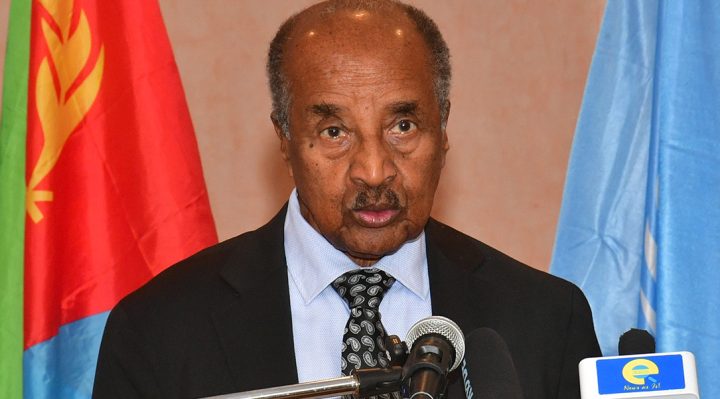
United Nations Day: Address by Foreign Minister Osman Saleh
Asmara, 23 October 2026
Honourable Ministers
PFDJ and Senior Government Officials,
UN Resident Coordinator,
Members of the diplomatic community and the UN family
Distinguished Guests, Ladies and Gentlemen,
It is a great honor to welcome you all today as we gather to mark United Nations Day, commemorating the entry into force of the UN Charter.
As we reflect on the founding ideals of the United Nations, peace, human dignity, sovereign equality among nations, and international cooperation, we do so against a backdrop of a complex and shifting global landscape.
Today, once again, offers us an important moment to evaluate not only the state of our world, but also the nature of partnership, mutual respect, and shared responsibility required to navigate the challenges of our time.
Indeed, we must ask ourselves: Does the United Nations remain an effective guardian of the sovereign equality of nations, or is its founding promise increasingly subordinated to the strategic interests of the powerful?
For Eritrea, it is a question shaped by a long history of colonial domination, the denial of self-determination, a protracted struggle for independence, and the continuing determination of our people to safeguard their hard-won sovereignty.
The United Nations was established to spare succeeding generations the scourge of war, reaffirm faith in fundamental human rights, establish conditions for justice, and promote international cooperation.
Eighty-one years after its founding, these aspirations remain indispensable. Yet the gap between the Charter’s principles and their selective implementation continues to undermine the credibility of the international system.
We must confront this contradiction honestly.
Excellencies,
While we do so, for Eritrea, sovereignty, national independence, and self-reliance remain the bedrock of our national identity. Our path has been shaped by resilience, hard-won sacrifice, and a steadfast commitment to determining our own destiny. We firmly believe that sustainable development and genuine peace cannot be imported or imposed from the outside; they must be cultivated from within, driven by the priorities, dignity, and active participation of our people.
At the same time, Eritrea recognizes the vital importance of constructive, principled international engagement. Through frameworks like the UN Sustainable Development Cooperation Framework, our nation continues to collaborate with United Nations agencies and international partners in areas that align with our national development goals.
We have made progress in public health, preventive medicine, immunization, sanitation, and community-based services despite considerable resource constraints. The United Nations’ 2025 results report for Eritrea recorded routine immunization coverage above 95 percent, skilled birth attendance rising to 85 percent, and approximately 250,000 people benefiting from more reliable solar-powered water systems.
These are meaningful advances. They demonstrate the importance of preventive health care, community participation, appropriate technology, and investment in essential services.
This momentum extends directly into rural development, where climate resilience, water security, and agricultural self-reliance are critical in narrowing the urban-rural divide.
Complementing these health milestones, significant strides in rural development and agricultural transformation have expanded the national road network from connecting more than 85 percent of cities and villages and increasing rural public transport buses from 267 to over 2,000. To counter arid vulnerabilities and enhance food security, water reservoir capacity has grown from roughly 138 dams at independence to approximately 850 water reservoirs, while the land area under irrigation has expanded to forty-one thousand hectares.
Furthermore, robust environmental and land management initiatives, including a national ban on cutting live trees, hillside closures, and student-led tree-planting campaigns, have resulted in the planting of roughly 150 million trees since 2006, expanding forest and woodland cover from under 1 percent in 1995 to 13.5 percent of the country’s land area alongside significant mangrove restoration.
Community resilience has been further reinforced through targeted rural packages such as the Minimum Integrated Household Agricultural Package (MIHAP) and the Small and Productive Farm Plot (SPFP) initiative spanning nearly 39000 active plots, supported by an improved farmer-to-extension worker ratio of 1:717 and the industrial-scale production of hundreds of thousands of liters of organic liquid fertilizers that boost crop yields by up to 50 percent.
At the same time, we recognize the challenges that remain. Food security, access to reliable water, climate resilience, employment, infrastructure, and economic diversification require sustained effort and investment.
Our objective is to strengthen these foundations while expanding opportunities for future generations.
We believe that development must be judged by its impact on human dignity. The wellbeing of a nation cannot be measured exclusively through aggregate economic growth, the scale of construction projects, or the volume of foreign financing received. It must also be assessed through access to health care, education, safe water, productive employment, food security, and the fair distribution of opportunities between urban and rural communities.
Development assistance, where provided, must support national priorities and strengthen local capacities. It must not become an instrument of political conditionality, strategic dependency, or external interference.
Partnership is valuable when it respects the development of its partners. Cooperation is sustainable when it is founded on mutual respect.
Eritrea therefore reaffirms its commitment to constructive international engagement that advances national development while safeguarding the country’s independence and freedom of policy choice.
Excellencies,
Against this backdrop, the promise of peace and collective security enshrined in the UN Charter is severely tested today. We meet at a critical juncture where the peace and stability of our region are being actively imperiled by ongoing escalations and unprovoked acts of aggression against our sovereignty and territorial integrity.
As Eritrea has made clear to the United Nations Security Council, our nation faces hostile provocations and aggressive posturing that flagrantly violate the UN Charter, international law, and the fundamental principles of good neighborliness. True multilateralism and the credibility of the international system are measured precisely by how it responds when the sovereign borders of a member state are threatened by external aggression. A “rules-based” global order cannot remain in complicit silent, nor can it indulge double standards, when regional stability is systematically undermined by bellicose actions of a habitual irredentist neighbor.
In the event, Eritrea remains steadfast in its sovereign right to self-defense and the protection of its hard-won independence. At the same time, we have always maintained that enduring stability requires honorable respect for sovereignty, absolute non-interference in internal affairs, and the peaceful resolution of disputes.
If the United Nations is to fulfill its foundational promise to succeeding generations, it must champion a fair and just global order, one that holds aggressors accountable, heeds the voice of the Global South, and actively defends the sovereign equality of every nation, without exception.
As we look ahead, let us renew our commitment to genuine dialogue, mutual respect, and the unyielding defense of our sovereignty. May the spirit of true international solidarity, grounded in justice and mutual accountability, guide our collective efforts toward a peaceful, stable, and equitable world.
I thank you.
Fonte: Shabait