Compartilhar
Vision for Berhan Ayny: Dr. Mengis Bairu on Eritrea’s Path to Medical Self-Reliance
Eritrea is forging a definitive path toward self-sustainability in specialized healthcare by transforming its domestic medical residency programs. Through a strategic partnership between the Ministry of Health, Orotta College, and the global Cure Blindness Project, top international ophthalmologists are arriving as visiting faculty to train and mentor local physicians on-site.
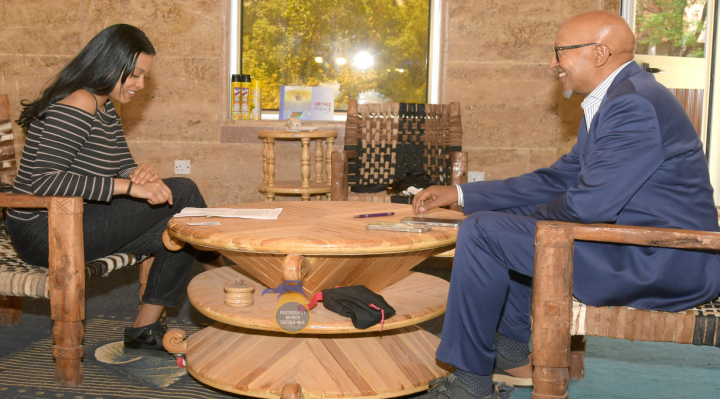
Leading this bridge between international innovation and domestic self-reliance is Dr. Mengis Bairu, an Eritrean-American physician, biotech entrepreneur, and philanthropist with over 30 years of global executive experience. In this exclusive interview, Dr. Mengis discusses the emotional reality of sight restoration, the deep-rooted cultural values driving his work, and his bold blueprint to establish the Berhan Ayny Ophthalmic Hospital as a world-class Center of Excellence.
- You have enjoyed an exceptional global career, from orchestrating multi-billion-dollar biotech deals to serving as an adjunct professor. What personal motivation drives you to dedicate your time and expertise to public health initiatives here in Eritrea?
I am asked this question frequently, and my answer always traces back to my roots—specifically to the lessons I absorbed from my parents. Long before we ever open a textbook, we as Eritreans learn from the actions of our elders. I watched how deeply my parents cared for their neighbors and our community. That upbringing instilled in me a lifelong desire to serve my fellow citizens rather than focus narrowly on personal gain.
As physicians, our clinical training teaches us to treat and heal patients one at a time. However, as your career evolves, you naturally begin to think about public health on a macro level—shifting your focus toward creating a sustainable, systemic impact on a much larger scale.
- The Cure Blindness Project has performed thousands of sight-restoring surgeries in Eritrea, including the country’s first corneal transplant. Could you share a specific moment or milestone from these medical missions that has left a profound impact on you personally?
Most of us take our vision completely for granted; you only understand its true value once it is gone. In our clinics, we routinely encounter patients who have been blind for 12 or 15 years. They undergo a highly specialized surgery that takes less than 12 minutes and costs under $100. The raw emotion the morning after the operation, when the bandages are finally removed, is second to none.
Nothing else in the medical field provides the instant gratification and deep human satisfaction that you get from ophthalmology, particularly with cataract reversals. One of my most cherished memories involves a mother who had not seen her children in over 14 years; witnessing the sheer explosion of joy on her face the moment she saw them again was unforgettable.
It is staggering to realize that nearly 18 million people worldwide remain needlessly blind, and our absolute mission is to reduce that number to zero. Crucially, these interventions go far beyond clinical success. There is a direct correlation between blindness and poverty. By restoring sight, we are not just healing an individual—we are directly accelerating the Sustainable Development Goals and lifting up the entire society.
- A key pillar of your mission is sustainability. The residency program at Orotta College is actively training Eritrea’s next generation of eye surgeons. How do you ensure this knowledge transfer is effective, and what has been the response from the local students and their mentors?
This concept of self-reliance is deeply woven into the historical fabric of Eritrea; sustainability is nothing new for us. I was fortunate to visit most of the liberated areas back in 1986, with a particular focus on the Sahil Orotta hospital. Seeing those fully functional underground hospitals was incredible. Even the origins of the Azel Pharmaceutical Company were in Sahil, manufacturing the majority of their own medications and IV infusions under the most challenging conditions. That principle of self-reliance was forged during the liberation struggle and naturally transitioned into today’s ministries and government frameworks.
Our organization simply contributes to a blueprint that the country already has in place. The residency program is the critical engine of that plan. Just a few years ago, Eritrea did not have an independent ophthalmology residency program. We launched a partnership with three initial residents at the college and the Ministry of Health, and they are graduating shortly this year. As more classes join the pipeline, Eritrea will be blessed with eleven new homegrown ophthalmologists within the next two to three years. Our job through the Cure Blindness Project is to ensure these doctors receive world-class training and have access to premium medical products, allowing us to advance at the exact same speed as global technology.
The visiting international faculty we send have been deeply impressed by both the residency curriculum and the local staff. We are working with people who are genuinely hungry for knowledge. When you bring in top-tier professors from institutions like Stanford University, our local doctors are receiving the finest training from the best minds in the world. The response from the residents has been exceptionally positive. The distinct advantage of this model is that they learn on-site and immediately apply those skills. They are already performing complex, specialized surgeries that would have been unimaginable without direct, hands-on mentorship from our visiting faculty. I see that same incredible drive across the board—from the medical staff to the leadership teams within Orotta College and the Ministry of Health.
- Beyond ophthalmology, Eritrea has made remarkable strides in public health, such as achieving exceptionally high vaccination coverage and reducing malaria mortality by over 99 percent. From your perspective, what has enabled these massive successes, and how do specialized eye care programs fit into this broader national healthcare strategy?
Public health has always been the absolute foundation of Eritrea’s medical infrastructure. This strategy traces its roots directly back to the liberation movement and the historic “barefoot doctor” model. The philosophy is simple: you do not wait for the patient to come to the clinic; you proactively send your healthcare providers out to the villages and remote rural areas.
The specialized services we provide are structurally integrated into this national framework managed by the Ministry of Health. The main difference is that we operate on a targeted, regional level to bolster the extensive national eye care program already in place.
Furthermore, a robust public health system provides the exact infrastructure needed to effectively combat sudden pandemics. Look at how the COVID-19 outbreak devastated many highly industrialized Western nations, including the United States. Eritrea’s defense wasn’t built on reactive mass vaccination by design; instead, the country relied on a highly aggressive, foundational public health protocol centered on patient identification, swift isolation, community-level tracking, and targeted treatment. This proactive public health mindset is one of Eritrea’s greatest national assets.
- Beyond fundraising and coordinating medical missions, what is your central message to other Eritrean professionals in the diaspora? What practical first steps would you advise for someone who feels a deep connection to the homeland but doesn’t quite know how to translate that into meaningful action?
A massive blessing we share as Eritreans is this fierce, unbreakable bond with our country and our people, no matter where we reside globally. There is an incredibly strong, collective desire to return to Eritrea and actively participate in its development journey. Almost every professional in the diaspora dreams of contributing, whether through private enterprise or public service.
To help channel this energy in the medical field, we founded the Eritrean-American Healthcare Association a few years ago. Our team meets regularly and maintains direct communication with various ministries, particularly Orotta College and the Ministry of Health. Together, we work to identify the most effective paths for structural interventions, teaching modules, and equipment deliveries before we arrive.
My primary advice to the diaspora is simple: just get engaged. Do not be discouraged by not knowing where to start. Many of us travel back home frequently; reach out to established networks, share experiences, and support one another so we can work collectively. The doors are wide open, the opportunities are vast, and our local embassies are always ready to help facilitate these connections. We are steadily building a formula that works, and it is a beautiful work in progress.
- You have achieved remarkable corporate and clinical success on the global stage, yet you consistently dedicate your time to coordinating these local clinics. What does the word “home” mean to you today, and what long-term legacy do you hope to leave behind in Eritrea?
I view myself simply as someone who has been blessed with the opportunity to participate in this incredible journey. There always have been, and always will be, exceptional Eritreans and international friends of Eritrea who step forward to make a massive impact. My contribution is just a very small piece of a much larger puzzle.
Sometimes, the global networks and connections we possess abroad are among our greatest strategic assets as a people. If we can successfully build a bridge that leverages those international networks to directly benefit domestic infrastructure, which is where the real transformation happens. The enthusiasm is completely there; it is just a matter of designing the logistics to make it happen. People often ask me how I manage it, but really, I am just recognizing an opportunity and acting upon it.
There is a very fundamental way I look at this: there is no “we” and “them.” If you approach your homeland with that divided mindset, you instantly become a guest in your own home. I refuse to see it that way. This is home. Every single Eritrean has a responsibility to roll up their sleeves and contribute wherever improvements can be made. It is simply a matter of taking what exists, refining it, and elevating it to the next level.
Ultimately, I have absolutely no doubt that we will soon witness the rise of Reverse Medical Eye- Care Tourism right here in Eritrea. We are on a definitive, highly coordinated path to establish the Berhan Ayny Ophthalmic Hospital as a premier regional Center of Excellence—fully equipped with state-of-the-art modern technology and fully staffed by top-tier, homegrown specialists.
- Thank you, Dr. Mengis. We wish you the absolute best in these endeavors.
Fonte: Shabait