Compartilhar
Youth, environmentalists plant trees to restore Baraget forest ecosystem
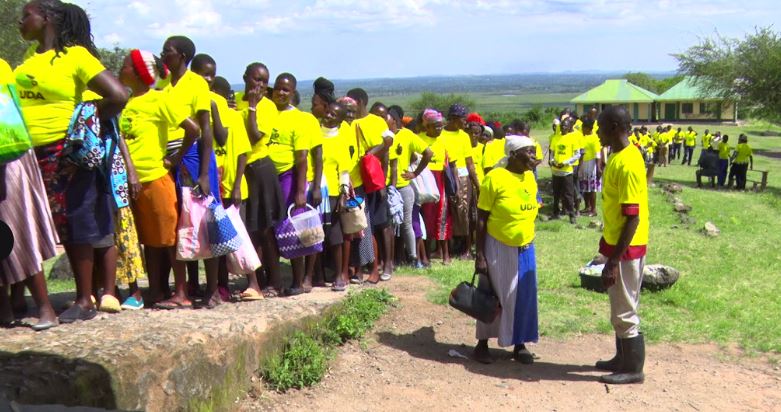
Environmentalists drawn from Egerton University have joined hands with Youth for Green Action Kenya (YGAK) to restore the degraded Baraget forest ecosystem in Nakuru County.
The ambitious environmental restoration drive targets to plant at least 200,000 trees to revive the shrinking forest cover and restore biodiversity in a bid to protect the water catchment areas amid growing impacts of climate change.
The initiative, driven by youth-led conservation efforts, seeks to breathe new life into the once-thriving Baraget ecosystem, which in recent years has faced significant degradation due to human activities and environmental pressures threatening its role as a critical water catchment area and habitat for wildlife.
Addressing the press after the planting exercise, Dennis Asiya, the Chief Executive Officer and co-founder of YGAK, affirmed the organisation’s commitment to environmental conservation, forestry, youth empowerment and championing climate action across the country.
He explained that the organisation conducts annual tree planting exercises in major forests, revealing that this year’s focus is Baraget Forest, which spans approximately 4,219 hectares, where they aim to plant 200,000 trees in four phases.
“Here in Baraget Forest, we have two sections, the indigenous and the exotic logs,” he said, emphasizing that indigenous trees play a critical role in conserving riparian land and supporting water retention within the ecosystem.
Further, Asiya attributed the drying up of rivers and streams in the region to the continued degradation of the forest, noting that the loss of tree cover has disrupted natural water retention systems and reduced the forest’s ability to sustain surrounding water sources.
He said the ongoing restoration efforts are aimed at reversing this trend by rehabilitating the forest ecosystem, improving soil stability and enhancing water infiltration to help revive both seasonal and permanent rivers.
“As the forest continues to shrink, we are witnessing rivers and streams drying up, which directly affects communities that depend on them for domestic use, farming and livestock,” he said.
Asiya expressed optimism that the tree planting initiative will not only restore the degraded landscape but also contribute to the long-term recovery of water catchment areas, ensuring a steady flow of rivers and streams while safeguarding livelihoods in the region.
He noted that students from Egerton University have played a crucial role in planting tree seedlings in deforested sections of the forest, describing their participation as a strong example of youth involvement in environmental conservation.
“Baraget Forest forms part of the Mau Forest complex that stretches across Kericho, Bomet and Narok counties and it is home to rich biodiversity,” he added.
He further explained that the forest serves as a source of major rivers such as Molo and Njoro, which drain into Lake Nakuru and Lake Baringo, respectively, underscoring its ecological importance not just locally but regionally.
“Our effort here is basically to breathe life into the largely deforested Baraget Forest so that the same forest can give us life by cleaning the air and absorbing carbon dioxide,” he said.
Asiya linked changing weather patterns and shifting seasons to widespread deforestation in major water towers, noting that the disruption has negatively affected farming calendars and food production.
“The seasonal shifts have largely been caused by climate change. By planting trees we enhance transpiration, which in turn supports rainfall needed for crop growth,” he said.
He added that the 200,000 tree seedlings will be planted in four phases to ensure proper monitoring and higher survival rates.
Asiya also highlighted the role of the Kenya Forest Service (KFS) as a key partner in the restoration exercise, saying the agency provides land, technical guidance and help to identify the most degraded sections that require urgent intervention.
Founded in 2018, YGAK has implemented several tree-planting initiatives across the country. “In 2023, the organisation planted 100,000 trees in the Mau Forest and Kaberwa Forest Station in Mt Elgon and another 200,000 trees with the support of over 120,000 student volunteers from different universities,” Asiya said.
Other areas of intervention include Elgeyo Marakwet, where 100,000 tree seedlings were planted as part of efforts to restore degraded landscapes.
“Apart from focusing on forests, we also run an initiative dubbed the ‘Greening Schools Initiative’, where we partner with learning institutions to plant tree seedlings and instil a culture of environmental conservation among young people,” he added.
To ensure sustainability, Asiya said the organisation works closely with KFS, local communities and Community Forest Associations (CFAs) to achieve at least an 85 per cent survival rate of planted seedlings through continuous monitoring and care.
He also applauded partners including the Youth for Green Action Kenya board, Victoria Furniture Group and Design Gallery and German Imaging Technologies for supporting tree planting initiatives revealing that the organisation targets planting one million trees by 2027.
Bena Ngenywa, the KFS commander in Nakuru County, commended YGAK for selecting Baraget Forest for restoration, noting that the project aligns with President William Ruto’s directive to plant 15 billion trees by 2032.
He urged members of the community who have been allowed to grow crops within designated forest areas to ensure the survival of the planted trees by taking responsibility for their care.
“Even if you plant potatoes in the forest, make sure that the trees we have planted survive,” Ngenywa said.
He acknowledged that Baraget Forest has for many years faced encroachment due to human activities but expressed confidence that the initiative was likely to reverse the damage.
Paul Rob, an elder and former Community Forest Association chairperson, appreciated YGAK’s focus on increasing indigenous tree cover, noting that such species are vital for water conservation and long-term ecosystem stability.
He added that alongside government regulations enforced by KFS, traditional conservation practices by the Ogiek community also play a significant role in protecting forests.
Fabian Mugambi, a Master’s student from Egerton University, said the exercise has provided students with an opportunity to apply practical skills beyond classroom learning.
“As Egerton University students we have come to participate in community-based activities aimed at restoring the degraded Baraget Forest while gaining hands-on experience,” Mugambi said.
By Absalom Namwalo
Fonte: Kenya News