Compartilhar
The Inseparable Seven: One Family’s Journey Through the Heart of the Liberation Struggle
Since the dawn of colonial ambition, the Eritrean people have remained steadfast in their resolve to protect their land and resources from those who sought to take what was not theirs. This legacy of guardianship continues to this day. Within this history, some individuals dedicated their entire lives to the liberation of their people, while others have worked tirelessly to document and preserve these incredible stories through their knowledge and artistic talent. Beyond physically defending the soil, preserving history is a crucial pillar of Eritrean identity.
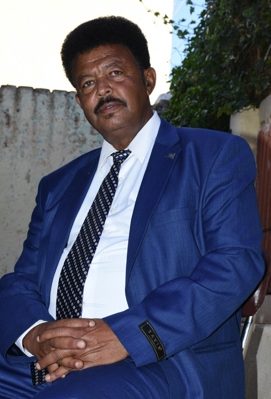
Today, we speak with Lieutenant Colonel Yonas Teages, a man who embodies both the veteran freedom fighter and the accomplished artist. He dedicated his youth to the battlefield as a freedom fighter, and the latter part of his life to writing, producing, and documenting the poignant and heroic sagas of the war. Through books, films, and documentaries, L/C Yonas has shared untold stories that have left a lasting impression on the national consciousness.
Beyond his military and artistic career, L/C Yonas is widely known for the heroic story of his own family. Numerous articles and a celebrated book titled “The Fate of One Family” have chronicled the journey of his family of seven, who left everything behind to join the independence struggle in the field. While some members returned home after independence, others made the ultimate sacrifice. Upon returning to Asmara, L/C Yonas decided to immortalize their journey, along with the stories of many other families. Starting with this first book, he has continued documenting Eritrean history through his artistic talent while remaining an active member of the defense forces.
- Thank you for your time, Lieutenant Colonel Yonas. Your family’s story is both poignant and heroic, having been narrated across various platforms. Could you tell our readers a bit more about it?
Thank you for having me. The Teages family consisted of seven members, all born and raised in Asmara. What makes our story particularly poignant is that every single member – including both parents and the siblings – joined the independence struggle in the field. “The Fate of One Family” represents the destiny of an entire household that joined the liberation struggle during a time of harsh colonial rule. My father joined in 1976, and the rest of us followed a year later in 1977.
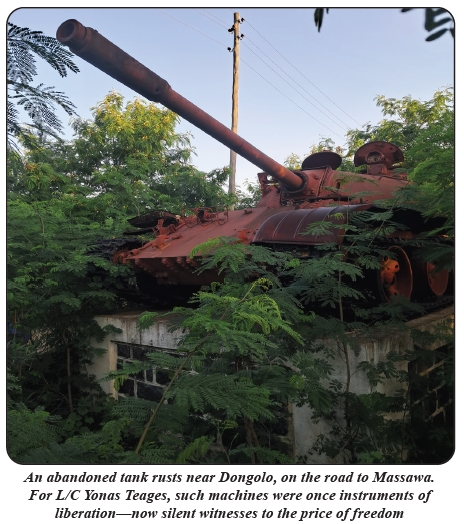
The story is vast and complex. To be brief: after joining, I underwent military training and was placed in the heavy weapons department in Adi-Keih, while my younger siblings attended the revolutionary school. My father served in the transportation sector as a driver, and my mother worked alongside other moms to help, heal, and care for wounded freedom fighters. My eldest sister joined the political office. Our once inseparable family was virtually disbanded, each member relentlessly dedicated to the fight for independence. I eventually became a tank fighter, operating heavy armor in violent and grueling battles. The journey was extremely painful; I lost many incredible colleagues and friends, including my own brother and sister. It was a relentless struggle, but we never wavered.
- What happened after independence was achieved? Did the family manage to reunite?
After independence, we didn’t reunite immediately. My parents returned to Asmara, I was stationed in Assab, and my sister went to Keren. Initially, we did not know the exact location of the other family members. Eventually, we made our way back to Asmara and were together once again – except for the two siblings who had paid the ultimate price in the course of the liberation war. However, the battle didn’t end there for our family. Having abandoned every single possession, we owned when we joined the struggle, we had to start from scratch to find a house and build a new life.
- When did you manage to write your book, “The Fate of One Family”?
I began writing the history of my family in 1992. I had a deep passion for art but was quite inexperienced at the time. I started with short stories, documenting events piece by piece and gathering every detail I could from my parents and siblings. When the artist Solomon Drar saw my work, he was so moved that he motivated and helped me publish it as a book. It was a difficult time; I was quite ill during the writing process, and the budget required for publication was far beyond my modest means. Ultimately, we published it using my sister’s savings – money she had intended for her future. Fortunately, the public embraced it immediately; every copy was sold. The book represents a small portion of the price paid for this nation. it was sent to schools and institutions as a historical teaching tool and was even narrated twice on the radio. I am so grateful that it is still being sold and read today.
- Which part of the book carries the most emotional weight for you?
While the book follows one family, I am always mindful that many other families lost far more. What affects me most is the story of my mother and all the other mothers in the field. They were the “mothers of the struggle,” looking after the entire community of freedom fighters. They cooked, cleaned, and cared for the wounded as if they were their own children. They were resilient and persistent, an incredible part of our independence history who experienced everything the fighters felt. I detailed my mother’s journey in the book because I know her experience resonates with so many other Eritrean women and mothers who served.
- Many readers have commented that the book feels compacted and needs to be expanded. What is your opinion on this?
I completely agree with that sentiment. At the time of writing, our living situation was unstable, and the cost of publishing was a massive hurdle. We had to compact the narrative significantly to fit the available resources and budget. The story certainly possesses enough detail to have been much more expansive.
- L/C Yonas, your work did not stop with that one book. You have written, directed, and produced many other projects, haven’t you?
Yes, I am deeply immersed in the documentation of Eritrea’s contemporary history. While I haven’t published another book recently, I have continued documenting the struggle through films. I have produced 13 documentaries that were broadcast on Independence Day, as well as over 10 feature films—two of which, “Mqur Merzi” and “Dagmay Hiwet”, received Raymok awards. I have also produced over six short stories and written or directed over 30 dramas, many of which were also award winners. Despite the stories already told, I know there are countless bitter and painful accounts still hidden. Every Eritrean family has these horrific and heroic stories; they are the foundation of our strength and unity. This history is what unites us forever.
- What does the family look like today, and what is next for you?
My father passed away in 2005, but my mother is still with us. She is elderly now, but she never stops praying for this land; her persistence is unwavering. The rest of us are doing well. We have families of our own—I am even a grandfather now.
As for my future work, I have several projects prepared that are a bit different from my previous style, which will be broadcast soon, alongside new documentaries. Our history is inexhaustible, and I hope we all do our part to document it. Documentation lives forever, even when we do not. This is how we keep our history authentically alive for future generations. To know where you are going, you must know where you came from. I am grateful to colleagues doing similar work, and I especially want to thank Mr. Solomon Drar for making my first book possible. Thank you.
Fonte: Shabait