Compartilhar
National Festival 2026: Heritage and Marine Resources
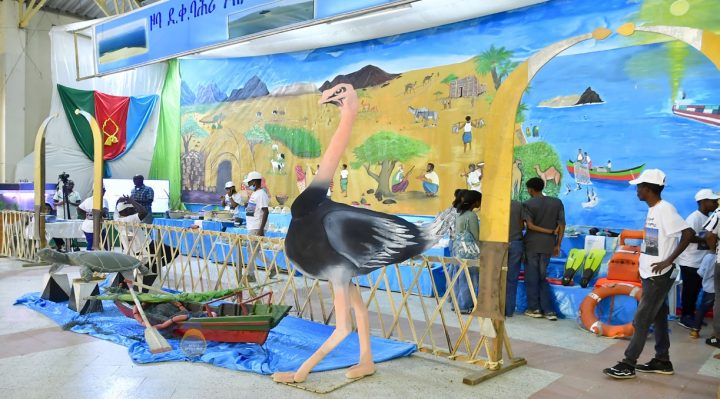
The National Festival, held from 18th to 26th July in Asmara, stands as one of the most vital gatherings for Eritreans at home and in the diaspora. It brings together the rich cultural mosaic of Eritrea’s nine ethnic groups that live across the country’s six administrative regions. It serves as a bridge connecting generations across physical and geographical boundaries.
To fully grasp the significance of the national festival, one must look back at its origins. Its roots were planted decades ago in Bologna, Italy. What began as a modest assembly organized by Eritreans in the diaspora quickly grew into an event held in cities across the globe. Following Eritrea’s independence, the festival’s heart was moved to Asmara. Over time, it has evolved into far more than a social reunion; it is a venue for national solidarity and cultural diplomacy, allowing Eritrea to share its story, values, and vision with the international community.
This year, the festival has provided an extraordinary array of activities, including engaging artistic performances and exhibitions showcasing development work across the six administrative regions. Two exhibitions in particular stood out: the captivating historical exhibition of the Debub region and the breath-taking ecological presentation of the Southern Red Sea region.
The Debub region’s exhibition offered visitors an overview of its diverse topography, rich agricultural traditions, and recent developments. The centerpiece, which instantly captivated visitors, was the detailed explanation of ancient mummification practices in Eritrea.
While mummification is widely associated with ancient Egypt, Eritrea did have its own distinct tradition of preserving the deceased, particularly within the quiet sanctums of historic mountain monasteries. Ms. Lwam Negassi, the presenter, explained that mummification generally occurs through two distinct pathways: chemical or medicinal interventions, and natural preservation driven by specific environmental conditions. In Eritrea, it is the latter that reigned supreme.
In Eritrea, around the fifth century, many holy men and saints were laid to rest within high-altitude cave monasteries, including famous sites such as Debre Libanos, Metera, and Baekam. The cool, arid microclimates of these high mountain caverns, combined with darkness, naturally halted the process of decay. Remarkably, the remains of saints preserved at Debre Libanos monastery for over 1,500 years are one example of ancient preservation.
To the faithful, this extraordinary preservation is viewed through a spiritual lens, a physical testament to divine promises made for the saints. Modern scientific analysis offers a complementary perspective, confirming that the unique atmospheric conditions inside these high-altitude caves provide the perfect natural recipe for long-term preservation. This synthesis of faith, history, and natural science has left an impression on everyone who walked through the Debub region’s exhibition.
A short walk away, the Southern Red Sea region offered a beautiful contrast, shifting the narrative from ancient mountain caves to the vibrant coastal ecosystems. Presented by representatives from the Ministry of Marine Resources, this exhibition showcased Eritrea’s rich marine biodiversity, with a strong focus on its coral reefs and coastal mangrove forests.
Mr. Omer Mohammed Mussa, a presenter representing the Ministry, guided visitors through the delicate world beneath the waves. He emphasized that Eritrea’s coastal waters are home to approximately 250 distinct coral species, many of which have adapted to be remarkably temperature-tolerant, a trait attracting growing interest from global marine scientists. Mr. Omer explained that corals are living, invertebrate marine organisms that form the foundational architecture of the sea. The corals are named for their striking forms and colors, and the exhibition featured plate, sponge, mushroom, brain, fire, deer, stomach, and pillar corals. While vibrant and dynamic underwater, corals turn stark white upon dying, as their calcium carbonate skeletons are exposed to air.
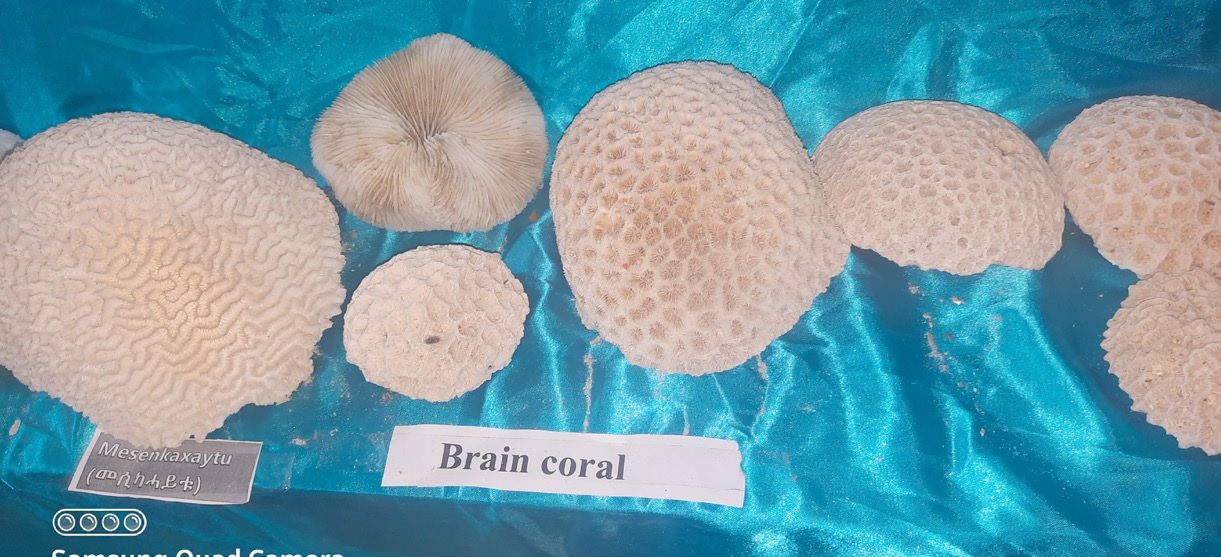
The exhibition made clear that these organisms are far more than aesthetic wonders; they are ecological powerhouses. Corals actively regulate environmental conditions by absorbing carbon dioxide, buffering shorelines against strong wave energy, and providing essential shelter, breeding grounds, and protection for countless fish species. Beyond ecological health, corals support local livelihoods by attracting eco-tourism and offering materials for decorative crafts. Coastal communities in Eritrea have also traditionally used coral compounds for medicinal treatments, including natural remedies with antibiotic and antifungal properties. In monastic traditions, specialized coral materials have even played a role in preparing ‘birana,’ the durable parchment used to transcribe sacred religious manuscripts.
Accompanying the coral display was an exploration of Eritrea’s coastal mangrove forests. Globally, five main types of mangroves exist, and three of them—Rhizophora mucronata, Avicennia marina, and Salsola tetragona flourish along the Eritrean coastline, covering roughly 15% of the shore. These mangroves act as vital coastal buffers, anchoring fragile mudflats and protecting the shoreline from relentless wave action. Biologically, they serve as crucial nurseries for young fish and crustaceans, forming the bedrock of local commercial fisheries. Furthermore, their nutrient-dense leaves and branches serve as essential, protein-rich forage for local livestock, including sheep, goats, and camels, reducing the need for pastoral communities to drive their herds far inland during dry seasons.
Mr. Omer emphasized that the presentation’s core mission was educational, fostering public appreciation of marine biodiversity and inspiring proactive conservation. To protect these pristine habitats, the Ministry of Marine Resources has introduced community awareness campaigns, ecological guidelines, and sensible visitor regulations.
Ultimately, the National Festival is far more than a simple summer gathering; it is a mirror reflecting the nation’s soul, natural wonders, and enduring spirit, from the ancient monasteries of Debub to the thriving coral sanctuaries of the Southern Red Sea.
This year’s festival illustrated how deeply interconnected Eritrea’s history, culture, and ecology truly are. By blending celebration with education and cultural activities, the event not only strengthens national pride and solidarity among Eritreans at home and abroad, but also serves as a beacon for sustainable development and cultural diplomacy.
Fonte: Shabait