Compartilhar
Mets reaffirm El Niño forecast, warn public against Misinformation
East African weather experts have reaffirmed their September forecast of enhanced rainfall in parts of the region, urging the public to avoid misinformation and remain guided by verified weather updates despite delays in the onset of rains in some areas.
Meteorologists and climatologists from seven countries made the clarification during an online Journalists-Scientists Dialogue organised by the Intergovernmental Authority on Development’s Climate Prediction and Applications Centre (ICPAC).
Participants included experts from Sudan, South Sudan, Kenya, Uganda, Rwanda, Somalia and Djibouti, who explained that delays in the onset of rains did not necessarily mean the seasonal forecast had changed.
“We have not changed our forecast,” said Jemimah Ongoma of the Kenya Meteorological Department (KMD), noting that above-average rainfall was still expected in most counties, including Kajiado, between October and December.
She added that El Niño conditions had been established in the Pacific Ocean, with forecasters awaiting the onset of short rains in areas where they had not yet begun.
The experts said public anxiety had been heightened by references to a “Super El Niño”, which some people interpreted as a prediction of sudden and exceptionally heavy rainfall.
Eunice Koech, a climate scientist at ICPAC, said forecasts from international monitoring agencies, including the United States National Oceanic and Atmospheric Administration (NOAA) and the Australian Bureau of Meteorology, continued to indicate the likelihood of a strong to very strong El Niño event.
She, however, cautioned against equating the strength of the phenomenon with the amount of rainfall expected in a particular area.
“El Niño’s strength does not imply that we are expecting extremely high rainfall,” Koech said, urging journalists and community leaders to communicate the phenomenon accurately.
She explained that rainfall patterns were influenced by several climatic factors and that the intensity of El Niño alone could not determine the amount of rain a region would receive.
KMD defines the onset of rains as the receipt of at least 20 millimetres of rainfall within three consecutive days, without a dry spell exceeding seven days thereafter.
Areas classified as having partially achieved the onset threshold were still being assessed based on rainfall amounts and the occurrence of subsequent dry spells.
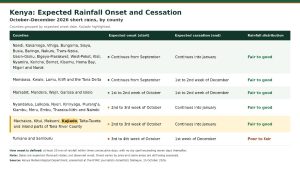
Kajiado, alongside Machakos, Kitui, Makueni and Taita-Taveta counties, had been projected to receive the onset of the short rains during the second to third week of October, with rainfall expected to continue into January.
Ugandan Meteorological Officer George Omony said scientists needed to improve how they communicated climate forecasts to the public.
“We, the scientists, are not communicating well to the public,” he said, explaining that the relationship between El Niño and rainfall patterns had not been adequately conveyed.
Omony noted that the suppression of rainfall between June and September was also associated with the phenomenon, but the connection had not been clearly communicated. He added that the Indian Ocean had not fully responded to changes in the Pacific, helping explain the delayed onset in some areas.
Kenya’s seasonal outlook, released on August 26, forecast above-average rainfall in more than 40 counties, including Kajiado, Nairobi, Machakos, Kisumu, Mombasa and Garissa.
Near-average to above-average rainfall was also expected in Turkana and parts of West Pokot, Samburu and Marsabit counties.
The rains were forecast to be fairly to well distributed, with a low probability of drought in most areas.
At the regional level, ICPAC’s outlook indicated a 90 per cent probability of enhanced rainfall over southern Ethiopia, central and southern Somalia, and north-eastern Kenya, although the timing of the onset was expected to vary across the region.
The experts urged journalists to seek clarification from meteorological agencies before publishing weather-related information, while encouraging the public to rely on official forecasts rather than unverified reports.
Ongoma called for sustained engagement between scientists and the media to improve public understanding of seasonal forecasts and support timely preparedness.
By Byron Ouma
Fonte: Kenya News